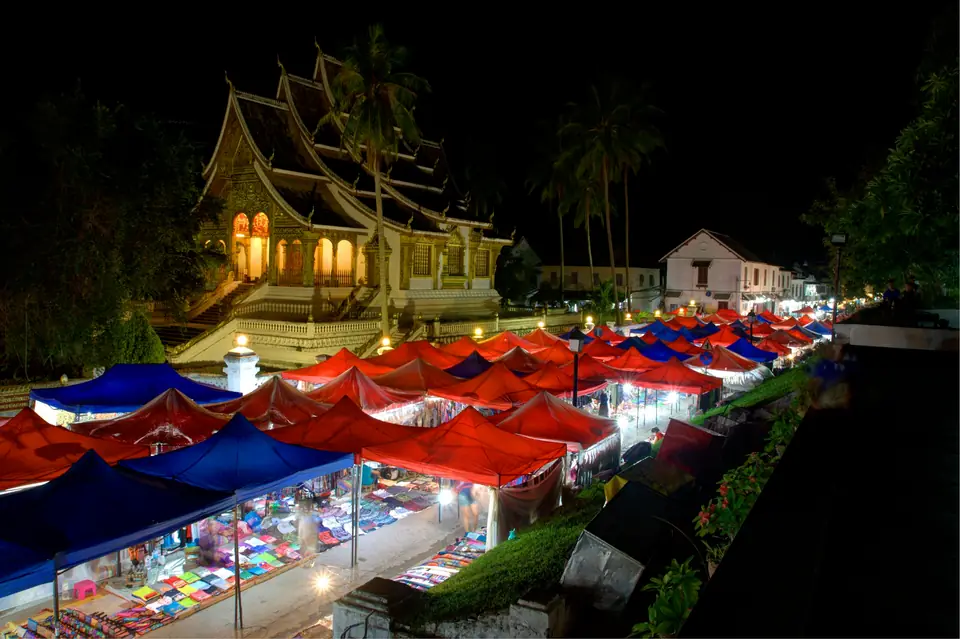
Craft market opposite the palace
Night Market Audio Guide
It began as a Christmas fair meant to last a few weeks, lit by candles, and was never taken down: every evening the former Avenue Pavie, Chinatown until 1975, is closed to traffic opposite the Royal Palace and fills with Lao silk, Hmong embroidery and spoons cast from bomb metal.
- 45 min of audio
- Hmong crafts and Lao silk
The Luang Prabang night market takes over, every evening from 17:00 until about 22:00, a stretch of Sisavangvong Road running from the tourist office toward the Royal Palace. It grew out of the Hmong women from nearby villages who sold their work here, became established as a showcase for Lao crafts, carving and silverwork, and in 2022 counted 853 vendors.
The most innocent objects carry history: cutlery made from the metal of the bombs the United States dropped on Laos between 1964 and 1973, embroidered tapestries born in a Hmong refugee camp and sewn little triangles that, according to tradition, ward off evil. The street is no ordinary one either: it was the city's Chinatown, in full view of the king.
Highlights
- Hmong embroidery — Paj ntaub of little triangles and pompoms that, according to tradition, ward off evil
- Bomb spoons — Cutlery cast from the metal of the 1964-1973 war
- Story cloths — Narrative tapestries born in the Ban Vinai refugee camp
- Loom silk — Scarves and skirts woven in villages such as Ban Phanom, a former court supplier
- Food alley — Street buffet, charcoal grills and fruit shakes at the end of the market
By day, Sisavangvong Road is an ordinary street. Around five in the afternoon, a stretch of a few hundred metres between the tourist office and the Royal Palace is closed to traffic, and on the asphalt rows of awnings, parasols and stalls spring up until close to ten at night. The Luang Prabang night market (ຕະຫຼາດມືດ) opened as a piece of Western Christmas staging, meant to last a few weeks, and was never taken down.
The history of the night market has disputed dates: some place it in late 1996, others in a Hmong request for selling space in 1993, and the provincial administration gives December 2002 as the moment it was established as a showcase for Lao crafts, wood carving and silverwork. What every version agrees on is its origin: Hmong women from the surrounding villages began selling their work to tourists on this street, hence the nickname “Hmong Market”. The other nickname, “Candle Market”, comes from its early days, when the street had no electric light and selling went on by candlelight.
The street drags its own past behind it. Around 1930 it was called Avenue Pavie, after Auguste Pavie, the first French vice-consul in Luang Prabang, and until 1975 it was the city’s Chinatown, next to the palace and in the king’s sight; its community fled after the communist victory, and all that remains of it is a clan association on the upper floor of a shophouse. Today the market gathers stalls of silk, embroidery and crafts, although not everything presented as handmade is, which is why some stalls display “Made in Luang Prabang” signs.
To know what to see at the night market, the audio guide walks its central aisle in four stops and 45 minutes, from the Royal Palace end to the food alley. The thread joining them is a street that changes its skin every night, and in which every cloth, every spoon and every vendor carries a story of war, flight and craft.
Above the awnings looms Mount Phousi, at whose foot the market is set up, and the origin of the Hmong embroidery sold here is explained at the Arts and Ethnology Centre, a museum devoted to the peoples of Laos and their craftspeople.
Christmas candles in the king’s sight
Pedestrian stretch opposite the Royal Palace
Summary of this stop
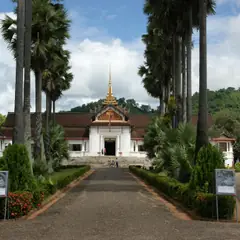
The tour starts beside the gate of the Royal Palace, at the point where the street becomes pedestrian each evening. Here the market’s double life is understood: the candle-lit Christmas fair that stayed for good, and before it the Chinatown that occupied this street until 1975, which the Chinese who remain still call the “street of the foreigners”.
One night a year, the street is completely transformed. According to a documented tradition, at Boun Lai Heua Fai, just after the full moon of Ork Phansa, each monastery builds from bamboo, banana trunks and paper a great fire boat, often in the shape of a naga and lit with dozens of candles. After dark, pushed by young men and followed by girls with lanterns, they parade along Sisavangvong Road and, as they pass the old palace, a jury scores them from a pavilion. Facing the gate, the audio guide tells where they go afterwards and what they take with them.
Hmong triangles against evil spirits
Hmong embroidery stalls
Summary of this stop
In the central aisle come the stalls of Hmong embroidery, those of the people who started the market. Some families have been in it for decades: Dao Xiong and her mother, Lee Thor, Hmong craftswomen, have sold embroidery here for more than 20 years; Dao’s parents sold candles to get by, and today their four children take part in the work, the youngest since the age of six, making key rings.
Those embroideries can be read. According to a documented tradition, in paj ntaub, the Hmong “flower cloth”, the tiny appliquéd triangles are fish scales, a barrier against evil; the pompoms on children’s hats disguise the children as flowers to hide them from evil spirits; the double snail is a symbol of marriage and the rooster, of protection. Each subgroup, Green, White or Striped Hmong, interprets the symbols in its own way.
Beside them gleam other textiles: those of the Khmu, the Akha or the Tai Lue, each with its own technique, and the iridescent silk of Ban Phanom, a village about ten minutes away by tuk-tuk whose looms once supplied the royal family and still work with the same patterns. Among the stalls, the narration shows how to tell one cloth from another.
Bomb spoons and refugee tapestries
Story cloths and bomb-metal spoons
Summary of this stop
Among the market’s most ordinary objects appear spoons, cutlery and ornaments of aluminium with an unexpected origin: the metal of the more than two million tonnes of cluster bombs the United States dropped on Laos between 1964 and 1973. In Ban Napia, in Xieng Khouang, known as the “war spoon village”, families melt down scrap to make spoons and jewellery.
The story cloths, the embroidered Hmong tapestries that narrate scenes, also have a wartime origin: they were born toward the end of the 1970s in the Ban Vinai refugee camp, in northeast Thailand, where thousands of Hmong fled from Laos after 1975, although other versions point to other camps. Today pieces embroidered by young Hmong are sold with captions in English about family, harvest and travel, and even Biblical scenes of the birth and resurrection of Jesus. It is said that around 2011-2012 an embroiderer sold blanket-sized tapestries here with a ghost story of people who left the land empty; beside the stall, the audio guide reveals how it ends.
The city’s night shift
Market food alley
Summary of this stop
At the end of the market, near the crossing with Kingkitsarat Road, an alley running down toward the river turns into a street food court, with a buffet of Asian dishes, charcoal grills and fruit shakes. It is the point where the real size of the market shows: in November 2022 it had 853 vendors, 339 of Lao silk, 242 of crafts and 272 of Hmong crafts, and that year it was reorganised with an odd-and-even shift so that the stalls would not pile up each night. In February 2026, the city also banned tourist vans from the central axis between the market entrance and the tip of the peninsula.
For many families, this is a second job. According to a documented tradition, a librarian who works full time by day sells hand-painted magnets and ornaments made from bomb fragments at night to raise her two children, and a few stalls further on a thirteen-year-old boy arrives from school and serves Chinese tourists in Mandarin while his father watches. At the entrance to the alley, the last stop of the audio guide gives voice to that night shift of Luang Prabang.