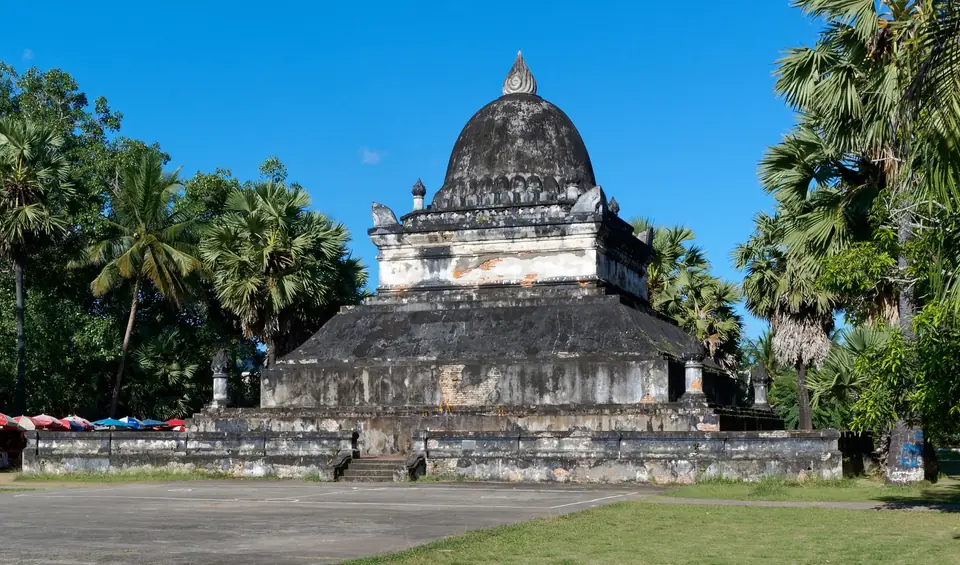
Temple of the Phra Bang and the watermelon stupa
Wat Visoun Audio Guide (Wat Visounnarath)
A king raised it in 1513 over the paddies of the guardian spirits to house the holiest Buddha in Laos; it burned in 1887, was reborn in brick copying itself, and its watermelon-shaped stupa once split open, exposing a treasure of Buddhas.
- 40 min of audio
- Watermelon stupa
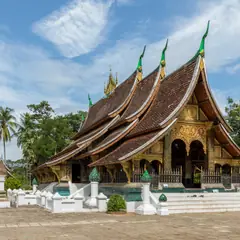
Wat Visoun, or Wat Visounnarath, is one of the oldest temples in Luang Prabang: it was founded by King Visoun of Lan Xang in 1513 to house the Phra Bang, which stayed here until the early 18th century. Its great wooden sim, with twelve teak pillars, burned in the sacking of 1887 and was rebuilt in brick between 1896 and 1898 imitating its proportions, its roof and its balusters.
In front stands That Pathum, the hemispherical-domed stupa that Queen Phan Tee Xieng raised around 1514-1515 and that the city calls That Makmo, the watermelon stupa. Damaged in 1887, it collapsed in 1914 and from its insides came Buddhas of gold, bronze and crystal from the 15th and 16th centuries. Inside the sim, rows of Buddhas rescued from other temples fill what was the Museum of Religious Art.
Highlights
- That Makmo — A 35-metre watermelon stupa, the only one with this dome in Laos, which hid a treasure of Buddhas
- 16th-century doors — Gilded carvings of Vishnu, Brahma, Indra and Shiva on the bull Nandi
- Rescued Buddhas — Rows of wooden and bronze Buddhas up to 400 years old along the walls
- Phra Luang — The largest seated Buddha in Luang Prabang presides over the altar
- Gate to Wat Aham — A crooked stone portal linking to the shrine of the guardian spirits
Few temples in Luang Prabang are made of so many absences. Wat Visoun (ວັດວິຊຸນນະລາດ), officially Wat Visounnarath, was founded in 1513, or 1512 according to some guides, by King Visoun, ruler of Lan Xang from 1500 to 1520, to house the Phra Bang, the most venerated Buddha image in Laos, which until then had been kept in Vientiane, where it had been since 1359. The Buddha stayed here until the early 18th century, and the compound occupies the former paddies of Phou Ngeu and Nya Ngeu, the couple of guardian spirits of the city.
The history of Wat Visoun begins with an outsized building. The original wooden sim occupied 70 craftsmen for three years and seven months; it measured 36 by 18 metres, had 21 windows with turned balusters and its double roof rested on twelve teak pillars of some 30 metres, brought from forests across the kingdom and each with its own name. Its appearance survives only in a drawing Louis Delaporte, of the French Mekong expedition, made in 1867: twenty years later, in 1887, the Haw horsemen of the Black Flags burned it, broke the stupa and carried off most of its Buddhas of jade, gold and precious stones.
What can be seen today is a rebirth. Between 1896 and 1898, under King Sakkarin Khamsouk according to most sources, the sim was rebuilt in brick and plaster imitating the proportions of the lost one; in 1942 it became a Museum of Religious Art, and between 2015 and 2020 a US Ambassadors Fund programme restored its roof and the stupa. Hence the label of the city’s oldest active temple lives alongside a paradox: of the original, at most the doors would remain.
To know what to see at Wat Visoun, the audio guide walks the compound in four stops and 40 minutes: the watermelon stupa, the stone gate to Wat Aham, the facade of the sim and its interior. The thread joining them is a temple of losses and rescues, raised on the land of spirits who never left.
When the Phra Bang left the razed temple, in 1894, it found refuge at Wat Mai, where it stayed until 1947. About 380 metres away in a straight line, the Arts and Ethnology Centre tells the country from the mountain peoples, far from the temples and the court.
The watermelon stupa and its hidden treasure
That Makmo
Summary of this stop
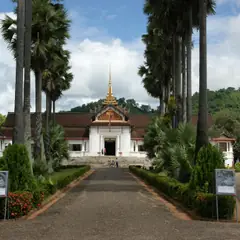
In front of the sim, to the northeast, stands a shape found nowhere else in Laos: a hemispherical dome on a stepped square platform, with a lotus pedestal at each corner and a flame finial. It is That Pathum, the 35-metre Sinhalese-style stupa that Queen Phan Tee Xieng, Visoun’s wife, raised around 1514-1515 over the Nong Xua pond. Its round dome earned it the nickname the whole city knows it by: That Makmo, the watermelon stupa.
Damaged in the sacking of 1887, the stupa collapsed in 1914, by lightning according to one source, and from its insides came Buddhas of gold, bronze, crystal and wood from the 15th and 16th centuries, now displayed in the National Museum of the former royal palace. In 1932, Chao Kom Khun Duangchanh, officials and neighbours paid for its reconstruction, and some of the objects found returned inside. In front of the dome, the audio guide reconstructs the day the watermelon split open.
A crooked gate between monks and spirits
Stone gate to Wat Aham
Summary of this stop
On the north side of the compound, a slightly crooked stone portal links directly to the neighbouring temple of Wat Aham. It looks like a minor passage, but it marks an ancient frontier: the temple of the Phra Bang was founded on the paddies of Phou Ngeu and Nya Ngeu, the founding spirits who, according to legend, died cutting a giant liana that blocked the sun.
On the other side a dark episode took place, recorded by a documented tradition. In 1527, Phothisarath, son and successor of Visoun, decreed that spirit worship was superstition, ordered their shrines destroyed and their altars thrown into the river, and over the couple’s a Buddhist monastery was built, the first Wat Aham. The worship went on in secret, and when the city suffered illness, drought and bad harvests, people blamed that destruction. Beside the gate, the narration tells how that war between monks and spirits ended and where they are believed to live today.
A brick temple imitating the burned one
Wat Visounnarath
Summary of this stop
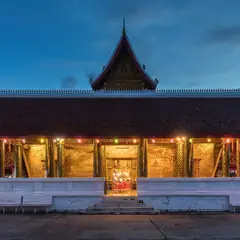
In front of the facade, the sim of 1896-1898 shows a double roof with naga finials and, at the centre of the ridge, a dok so faa of 17 small stupas with parasols. Its windows keep turned wooden balusters that copy those of the original building and recall the stone ones of Angkor and Wat Phou. All of it is a replica: the architecture of Wat Visoun reproduces in brick the silhouette of the great wooden temple that survives only in Delaporte’s drawing.
It is also said that the building had walls leaning slightly outward to imitate a Lao funerary coffin, so that whoever entered to venerate the Phra Bang would remember the impermanence of life; it is a popular belief, not a verified fact. What does seem to have crossed the fire are the wooden doors of the entrance, with gilded carvings of Vishnu, Brahma, Indra and Shiva on the bull Nandi, which come from the 16th-century building, although some sources present that survival as belief. Before the facade, the audio guide separates what is copy from what may be the last of the original.
Rescued Buddhas and a dance of spirits
Standing Buddhas along the walls
Summary of this stop
Inside, the eye rises toward where the twelve named teak pillars stood. On the altar presides the Phra Luang, the largest seated image in Luang Prabang, surrounded by lesser Buddhas, and along the walls run rows of wooden and bronze Buddhas, many gilded and up to 400 years old, in the rain-calling posture. They came from destroyed or abandoned temples: in 1942, with the support of Prince Phetsarath, the sim became a Museum of Religious Art to gather ancient Buddhas and Angkorian remains, along with ordination stones and inscribed stelae.
Among them stands out a carved wooden screen in which the white monkey Hanuman fights the black monkey Nilaphat while the monkey king Sugriva tries to separate them; it was commissioned in 1915 by Chao Boun Khong, viceroy of Luang Prabang from 1890 to 1920.
The temple, with its resident monks and novices, is not just a museum. According to a documented tradition, each Lao New Year the great red masks of Phou Ngeu and Nya Ngeu come out of the chests hung at Wat Aham, dance before the sim and the watermelon stupa and end their dance inside the sim itself, before the great Buddha, while children try to collect the hairs that fall from their costumes as amulets. Inside, the last stop of the audio guide tells how those spirits keep returning to the land that was theirs.