Royal temple of the golden facade
Wat Mai Audio Guide (Wat Mai Suwannaphumaham)
For more than two hundred years it has been called “New Monastery”, it served as barracks for the raiders who burned the city in 1887, kept the kingdom's protector Buddha for half a century and every April becomes again the courtyard to which all of Luang Prabang comes.
- 30 min of audio
- Golden facade
Wat Mai, founded around 1796 by King Anurut beside the royal palace, received its name of New Monastery after the restoration of 1821. It was one of the few temples in Luang Prabang to survive the sacking of 1887, housed the Pha Bang Buddha from 1894 to 1947 and was the seat of the supreme patriarchs of Lao Buddhism until 1984.
Its famous golden facade is not from the 18th century: it is a cement relief lacquered in black and gold, from the remodelling of the 1960s, narrating the Vessantara Jataka among villages, festivals and animals of Luang Prabang. Inside, the red walls disappear beneath thousands of tiny golden Buddhas.
Highlights
- Golden facade — Gilded relief of the Vessantara Jataka with villages, festivals and animals of Luang Prabang
- Water elephant — Hidden in the lower right strip of the golden relief
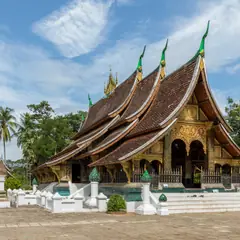
- Stepped roof — Red eaves dropping almost to the ground, crowned by three golden parasols
- Red interior — Thousands of golden Buddha tablets around the crowned image of Phra E
- Pha Bang courtyard — Esplanade where the protector Buddha is displayed and bathed each New Year
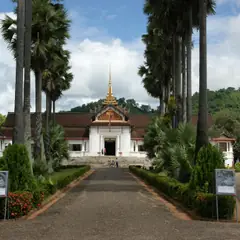
Right on Sisavangvong Road, next to the former royal palace, a temple with a red roof and a golden facade has been called “new” for more than two centuries. Wat Mai (ວັດໃໝ່ສຸວັນນະພູມາຣາມ), officially Wat Mai Suwannaphumaham, was founded by King Anurut around 1796, although other sources move the date earlier or later, and after the restoration of 1821 under King Manthatourat it received the name it keeps: Wat Mai, “New Monastery”.
The history of Wat Mai is tied to the court. As a royal temple beside the palace, it hosted the oath-of-allegiance ceremony with consecrated water, and in 1887 its abbot, a confidant of King Oun Kham, served as a courier and lodged the French vice-consul Auguste Pavie while the Siamese authorities tried to keep him from the monarch; sources differ, though, on who that abbot was. Pavie studied the monastery’s palm-leaf manuscripts and used them to write the first extensive history of Laos in a European language. That same year, Wat Mai was one of the few temples to survive the sacking of the city.
Then came its most illustrious guests. In 1894, the Pha Bang Buddha, palladium of the kingdom, was moved here from the razed Wat Visoun and stayed until 1947, and the temple was the seat of Laos’s supreme patriarch until 1984. Today the Buddha lives in the neighbouring compound, but it returns each New Year, and a shed at the temple keeps the long racing boats of the Luang Prabang festival.
To know what to see at Wat Mai, the audio guide walks the temple in four stops and 30 minutes: the pavement in front of the sim, the Pha Bang courtyard, the golden facade and the red interior. The thread joining them is a building that looks intact and is in fact a survivor made in layers.
The Buddha now lives in the chapel in the garden of the neighbouring Royal Palace, and it came here in 1894 from Wat Visoun, the temple King Visoun had built for it in 1513 and which the Black Flags razed in 1887.
A ‘New Monastery’ of 1796
Wat Mai Suwannaphumaham
Summary of this stop
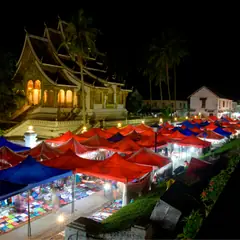
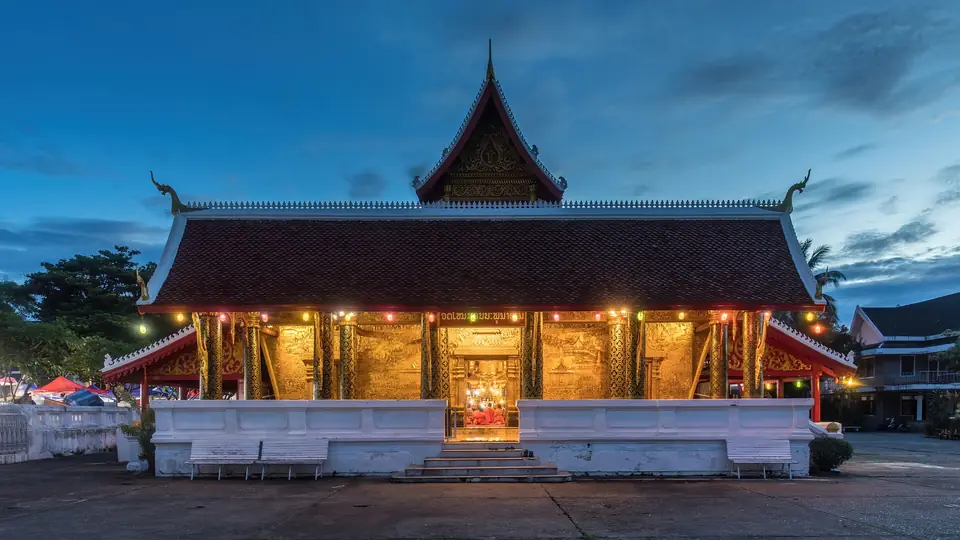
From the Sisavangvong pavement, the sim shows its silhouette: a multi-level red roof, four or five depending on how those of the porches are counted, dropping almost to the ground, with golden naga finials and, on the ridge, a three-parasol golden dok so faa. Under the eaves, great columns lacquered in black with gold stencilling and lotus-leaf capitals hold up the veranda.
The architecture of Wat Mai is read in layers. King Anurut founded the monastery around 1796; in 1821, with Manthatourat’s restoration, the front and rear porches were added to the sim, and in 1891 Prince Sakkarin, during the reign of his father Oun Kham, ordered the galleries on the two sides. From the pavement, the audio guide takes apart that name of “new” layer by layer.
The esplanade the Pha Bang returns to
Pha Bang courtyard
Summary of this stop
In front of the sim opens an esplanade that looks empty most of the year. Here the Pha Bang lived for half a century: it arrived in 1894 in a ceremony attended by Auguste Pavie, coming from Wat Visoun, razed in 1887, and stayed until 1947, when it passed to the Royal Palace. Today it is kept in the Haw Pha Bang of the neighbouring compound.
But every Pi Mai, the mid-April Lao New Year, the Buddha returns in procession from the National Museum and is displayed for three days in a pavilion raised in this courtyard so the faithful can bathe it. The blessed water reaches it through a hanglin, a wooden channel carved in the shape of a naga that is poured in at the tail and flows out of the mouth; until a few decades ago the king did it with nobles and monks, and today it is done by monks and the masks of Pu No and Na No.
According to the legend gathered in the city’s chronicles, Pu No and Na No, Grandfather and Grandmother Ngeu, are the founding spirits of Luang Prabang, who died cutting a giant liana that blocked the sun. Their red masks spend the year hanging from the roof of Wat Aham, and on the eve of New Year they go down to the Nam Khan to ask the river’s naga for water. In the courtyard, the narration tells who pours the first stream over the Buddha and why.
A gold that did not save the temple
Golden facade of the veranda
Summary of this stop
The front wall of the sim is a single golden wall: reliefs narrating the Vessantara Jataka, the Buddha’s penultimate life, set in villages, temples, festivals and animals of the Luang Prabang surroundings, with scenes from the Ramayana, and carved doors with devatas and Chinese-style dragons that merge into the panels. In the lower strip, teeming with animals, a water elephant appears in the right-hand corner.
That gold is more recent than it looks. The relief is of cement, covered first with black lacquer and then with gold, and comes from the remodelling of the 1960s, the work of the royal craftsmen in the service of King Sisavang Vong; the exact date varies by source, but all agree it is not from the original temple.
Nor was it beauty that saved Wat Mai in 1887, although a popular explanation without documentation repeats it. According to a documented tradition, on 7 June of that year the men of Kham Oum, Đèo Văn Trị, entered the city and made their camp at Wat Mai and Wat Xieng Thong; three days later the city was burning. At the foot of the facade, the audio guide tells how the temple went from raiders’ barracks to refuge of the Buddha who survived the fire.
Thousands of Buddhas and the patriarchs
Red interior of the sim
Summary of this stop
Behind the outer glitter, the interior of the sim lowers its voice. The red walls are covered with thousands of small golden votive Buddha tablets, columns and beams bear gold stencils and on the altar presides a large crowned and jewelled image the Lao call Phra E. Between them hang portraits of the Phra Sangkharat, the highest authority of Lao Buddhism.
This was the home of the patriarchs. King Sakkarin appointed Pha Sangkhalat Tan Tissapanya, a friend of Pavie who had accompanied Oun Kham’s flight to Pak Lai in July 1887, as the first supreme patriarch of Luang Prabang and installed him at Wat Mai; at his death, in 1911, the street opened between the palace and the temple was given his name, Thanon Sathou Tan. The last resident patriarch, Dhammayana, died in Bangkok in 1984 and was cremated in an urn offered by King Bhumibol. In the red half-light, the last stop of the audio guide traces the life of those monks who made a temple beside the palace the centre of Lao Buddhism.