Royal palace and National Museum
Royal Palace Audio Guide (Haw Kham)
France gave the king a brick palace beside the Mekong, the king planted a Lao spire on top of it and history left it mid-sentence in 1975: untouched bedrooms, a hall of mirrors finished just in time and, in the garden, the little golden Buddha that gives the city its name.
- 75 min of audio
- Palace frozen in 1975
Haw Kham, the former Royal Palace of Luang Prabang, was built between 1904 and 1909 for King Sisavang Vong, designed by a French architect and given by the French government. It replaced the teak palace lost in the sacking of 1887 and, after the last king's abdication in 1975, became the Luang Prabang National Museum, with the royal rooms kept as they were left.
Within its grounds lives the Phra Bang, an 83-centimetre standing Buddha cast in gold, silver and copper that reached Lan Xang in 1359, was carried twice to Bangkok and, according to its chronicle, once became so heavy that no one could move it. Since 2013 it has occupied a golden chapel begun by the monarchy and finished by the republic.
Highlights
- 1930 Lao spire — Golden Luang Prabang-style finial on a palace of French lines
- Throne Hall — Red walls of glass and mirror mosaic finished in the last years of the monarchy
- Cold War gifts — Display cases from socialist and capitalist countries, with fragments of Nixon's Moon rock
- Royal apartments — Bedrooms and dining room of the royal family kept as in 1975
- Haw Pha Bang — Golden chapel of the Phra Bang, the Buddha that gives the city its name
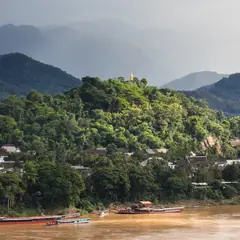
Few palaces tell the end of a monarchy so frankly. Haw Kham (ຫໍຄຳ), the former Royal Palace of Luang Prabang, was built between 1904 and 1909 for King Sisavang Vong: a French architect designed it and the French government gave it to the king as a residence and workplace. It filled the gap left by the old teak palace, lost when the Black Flags, a militia from China, razed and sacked the city in 1887, and this time it went up in brick, beside the Mekong, so that official visitors could land at the very foot of the stairway.
The history of the Royal Palace stops at a date. Sisavang Vatthana, king since 1959, was never crowned; on 29 November 1975, Souvanna Phouma and Prince Souphanouvong flew to Luang Prabang and persuaded him to abdicate, and in 1977 he was sent with the queen and the crown prince to Camp 01 in Houaphan. Since March 1976, although sources disagree on the exact day, the building has functioned as the Luang Prabang National Museum, with the bedrooms and rooms of the royal family as they were when the king left.
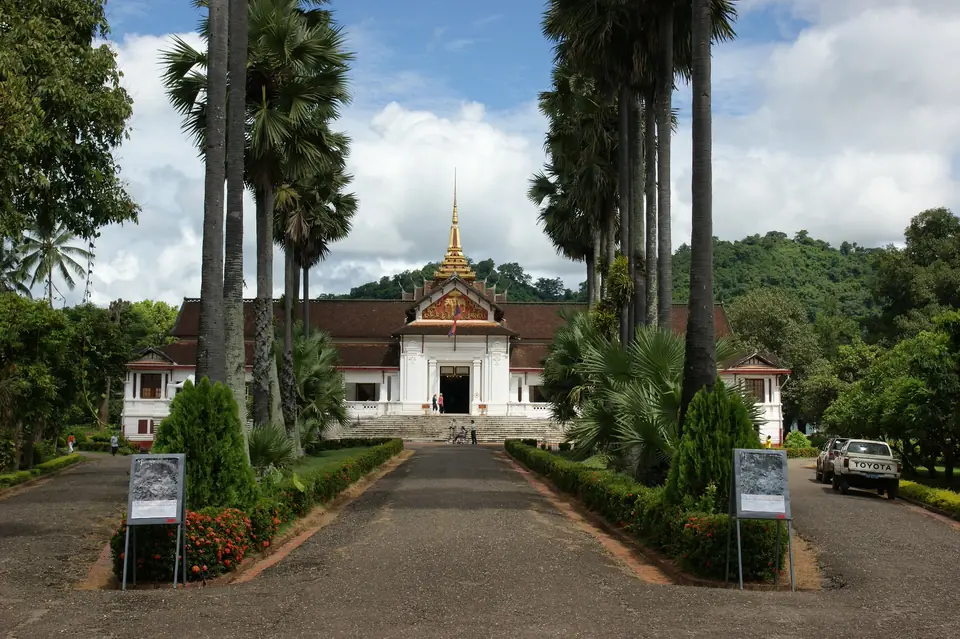
The architecture of the Royal Palace is read in layers. On a building of Beaux-Arts lines, the entrance pediment shows the three-headed elephant under the white parasol, emblem of the Lao monarchy, and high above gleams the Luang Prabang spire the king had placed in 1930. In front stands his 5-tonne statue, cast in the Soviet Union, and in the garden, the chapel of the Phra Bang, the Buddha that gives the city its name.
To know what to see at the Royal Palace, the audio guide walks the grounds in five stops and 75 minutes: the facade from the avenue of palms, the reception rooms, the throne hall, the royal apartments and the Haw Pha Bang. The thread joining them is a house left half-finished the day its last king departed, and a small Buddha that has seen several kingdoms fall and return.
The kings of Luang Prabang were crowned at Wat Xieng Thong, at the tip of the peninsula; right beside the grounds, Wat Mai kept the Phra Bang from 1894 to 1947, and across the main street rises Mount Phousi.
A Lao spire on a French palace
Royal Palace Museum
Summary of this stop
From the avenue of palms, the facade looks at first like one more colonial building: French proportions, an Italian marble stairway flanked by two cannons. But the pediment already changes the tone, with the Erawan, the three-headed elephant under the white parasol, surrounded by nagas. It is the first layer of a palace France gave the king between 1904 and 1909 and which replaced, in brick, the teak palace lost in the sacking of 1887.
The second layer came twenty years later. In 1930, Sisavang Vong replaced the pinnacle crowning the throne hall with a central spire of Lao design, in the Luang Prabang style, the same one that tops the roof today. Facing the facade, the audio guide explains what that gesture meant in a palace born as a gift from the protecting power.
Walls that follow the sun and Cold War gifts
Murals of the king's reception room
Summary of this stop
In the king’s reception room, the walls are painted with scenes of traditional Lao life. They were made in 1930 by the French artist Alix de Fautereau, with an unusual idea: each wall depicts the hour of the day at which the light from the windows falls on it. Busts of the kings and gilded Ramayana screens complete the room.
Across the lobby, in the former secretary’s reception room, the palace shows its diplomatic face. The state gifts of thirteen countries are displayed grouped into “socialist” and “capitalist” countries, and among them appear fragments of the Moon given by Richard Nixon and a silver inkstand from John F. Kennedy. Between the two rooms, the narration tells what that display case split into two blocks says about Laos.
A hall of mirrors finished too late
Throne Hall
Summary of this stop
The throne hall is the heart of the palace: red walls covered in glass and mirror mosaic with Lao legends and historical scenes, the throne, an elephant chair and display cases with gold and crystal Buddhas found in That Makmo. Those mosaics were made in the hall’s refit between 1970 and 1975, in the last years of the monarchy, so the shine was ready almost on the eve of the end.
The hall faces the river for a reason: the site was chosen so that official visitors arriving along the Mekong would land at the foot of the palace. And it has a darker memory. According to a documented tradition, when Sisavang Vong died in October 1959, his embalmed body spent eighteen months in the palace, folded into a throne-shaped coffin facing the Mekong, while governors and villagers combed the jungle for a sandalwood tree thick enough to seat the king inside. In the centre of the hall, the audio guide walks through that mourning, which ended with the procession of 29 April 1961.
Rooms stopped in 1975
Royal apartments
Summary of this stop
At the back, the royal apartments keep bedrooms, dining room and music room with the furniture as it was left in 1975. It is the most domestic part of the palace and also the hardest: here lived Sisavang Vatthana, the never-crowned king who abdicated in November 1975 and who in 1977 was sent with Queen Khamphoui and Crown Prince Vong Savang to a camp from which they did not return. The date of his death is still disputed.
A documented tradition sketches his portrait. Sent to France at the age of ten, he went through a lycée in Montpellier and Sciences Po in Paris, and on his return he could no longer speak Lao: for years a palace official had to teach it to him again. He read Proust and loved French food, but in the grounds’ kitchen, built in 1974, the queen often cooked him very Lao dishes, from grilled fish to the spicy sauce jaew bong. Among those rooms, the narration gives voice to the daily life of a family that did not know it was saying goodbye.
The Buddha who chose to stay
Haw Phra Bang
Summary of this stop
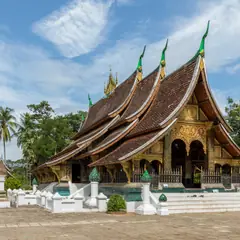
In the southeast corner of the grounds, the Haw Pha Bang raises stepped roofs, naga finials and serpent railings. It was designed by the master craftsman Manivong Khattiyarath: begun in 1969 under Sisavang Vatthana, it was left as foundations and pillars, and finished, according to official sources, in 2011, before the Phra Bang was enthroned in it on 14 December 2013.
The Phra Bang is a standing Buddha with palms in the gesture of dispelling fear: 83 centimetres, around 53 kilos according to official tourism, and an alloy of gold, silver and copper. In 1359, the king of Cambodia gave it to his son-in-law Fa Ngum, founder of Lan Xang. According to its Pali chronicle, from the late 16th century, on reaching Vientiane it refused to go further north and became so heavy that not even twenty-four men could lift it; it is also said that, taken to Bangkok in 1778, it seemed to bring misfortune to the Siamese kingdom, which returned it in 1782.
The image is still alive in the calendar: each year, on the third day of Pi Mai, the Lao New Year, it goes out in procession to Wat Mai, where the faithful bathe it for three days and three nights before it returns to its chapel. At the foot of the stairway, the last stop of the audio guide tells why this small Buddha seems the true owner of the palace.