West bank of Thebes
Colossi of Memnon Audio Guide
Two stone giants that outlived the temple they guarded and a crack that, for two centuries, turned the north colossus into the statue that sang at dawn before Roman emperors and travellers.
- 20 min of audio
- Statues of Amenhotep III
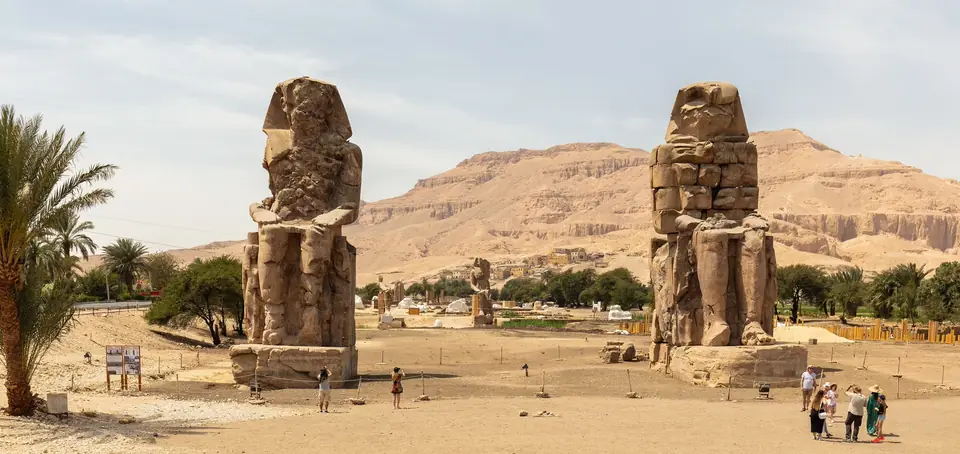
The Colossi of Memnon depict Amenhotep III seated on his throne and were raised around 1350 BC before the entrance of his mortuary temple, on the west bank of Thebes, the work of the architect Amenhotep son of Hapu. Each weighs some 720 tonnes and the quartzite of their blocks came from the quarry of Gebel el-Ahmar, near present-day Cairo, after a journey of about 675 kilometres overland. The temple they guarded, of 35 hectares, surpassed the Ramesseum and Medinet Habu; today only they remain.
Their fame came from a break. After an earthquake in 27 BC, what remained standing of the north colossus began to emit a sound at sunrise, and Greeks and Romans identified it with Memnon, the hero fallen at Troy who greeted his mother, Dawn, every morning. Their legs still hold 107 inscriptions from those who came to hear it, among them the verses a poet carved during the visit of Emperor Hadrian.
Highlights
- North colossus — split in 27 BC and repaired with five courses of sandstone
- South colossus — carved from a single block of quartzite, about 720 tonnes
- 107 Roman inscriptions — 61 in Greek, 45 in Latin and one bilingual
- Tiye and Mutemwiya — the queens beside the king’s legs and the god Hapi on the throne
- Kom el-Hettan — the 35-hectare temple and its colossi re-erected in 2012 and 2025
In the middle of the farmland of Luxor’s west bank, beside the road leading to the necropolises, two seated figures have gazed towards the Nile for more than three thousand years. Both represent Amenhotep III and were carved in quartzite around 1350 BC for the gate of his mortuary temple, the largest in Egypt. An earthquake around 1200 BC brought that temple down shortly after it was finished, and the river floods and the plundering of its stone took the rest. The two colossi at the entrance were the only things left standing.
The history of the Colossi of Memnon has, however, a second life that begins with a crack. From 27 BC, the north colossus, split at the waist, sounded at dawn, and Roman Egypt made it its great attraction. Germanicus, Tiberius’s adopted son, came to hear it in AD 19, on a journey through Egypt that the emperor had not authorised and that earned him a harsh reprimand; that same year he would die in Syria, convinced he was being poisoned. In the 2nd century, Lucian of Samosata was already mocking the visitors who returned from here swearing the statue had delivered them an oracle in verse. For the neighbours on the west bank, by contrast, the colossi are neither Memnon nor Amenhotep: they call them al-Colossat or es-Salamat.
What to see at the Colossi of Memnon goes beyond two statues beside a road: the architecture of a royal gateway, a Trojan legend, a visitors’ book carved in stone and a temple that is now emerging from the ground again. The audio guide, documented and checked against historical sources, covers it in four stops and twenty minutes.
The same Amenhotep III built the core of Luxor Temple, on the east bank, and also on the west bank survives the village of the royal tomb craftsmen, Deir el-Medina.
Two giants guarding an empty gate
Colossi of Memnon
Summary of this stop
In front of the colossi any reference for scale is missing, and that is disconcerting. Each figure stands today at around 14 metres on a pedestal of almost 4, and with the crowns they lost measured 40 cubits, some 21 metres, although the figures vary by source and by how they are measured. Each statue weighs some 720 tonnes. They were raised by Amenhotep son of Hapu, the king’s architect, in the same place where they still stand: the entrance of Amenhotep III’s mortuary temple.
They are not a lone pharaoh. Beside the legs of each colossus, attached to the front of the throne, stand two much smaller female figures: Queen Tiye and the king’s mother, Mutemwiya; between the ankles there was a third, now destroyed. On the sides of the throne, the reliefs of the Nile god Hapi appear when walking around the statue. The whole was a family gateway before a building that no longer exists, and what that empty gate says about the king who had it carved is what the narration reveals at this point.
The crack that gave the north colossus a voice
North colossus
Summary of this stop
The north colossus, the one on the right seen from the road, shows its history at a glance: a great crack in the lower half and, above the waist, five courses of sandstone blocks of a different stone. The original quartzite had travelled some 675 kilometres overland from Gebel el-Ahmar, near present-day Cairo; the courses of the Roman repair may have come from Edfu. Its twin, the south colossus, carved from a single block and with no additions, allows a comparison with how it was before the repair.
Strabo attributed the break of 27 BC to an earthquake; Pausanias and the verses of Julia Balbilla blamed, instead, the Persian king Cambyses. What is certain is that from then on the stone began to sound at dawn. Strabo himself heard it in the 20s BC, at the first hour of the day, with the prefect Aelius Gallus and his escort, and did not rule out that one of those present had caused it. The most widespread natural explanation points to the morning warmth and the dew evaporating in the cracked stone.
Greeks and Romans had another answer. They turned the pharaoh into Memnon, the king of Ethiopia killed by Achilles at Troy, son of Eos, Dawn; according to Ovid, each morning’s dew is the goddess’s tears for her son. The sound was Memnon’s greeting to his mother, or her weeping, and if one day the statue fell silent, the god was angry. How a pharaoh came to bear the name of a Trojan hero is still debated, and the audio guide explains the hypotheses at the foot of the colossus.
Emperors’ graffiti on the legs
Inscriptions on the north colossus’s legs
Summary of this stop
At the foot of the north colossus, the legs and the pedestal are covered with lines of Greek and Latin letters. There are 107 inscriptions from Roman times, dated between AD 20 and 250: 61 in Greek, 45 in Latin and one bilingual. Many are by visitors who left a record of whether they had heard Memnon or not, and together they turn the colossus into an ancient visitors’ book.
One of them has an exact date: on 14 March AD 92, the prefect of Egypt Titus Petronius Secundus heard the stone at the first hour of the day and honoured it with two Greek verses, carved beneath a Latin dedication by Titus Atius Musa, prefect of the Second Cohort of Thebans. From 19 to 21 November 130 the emperor Hadrian and the empress Sabina arrived, with the poet Julia Balbilla, who carved three epigrams in Aeolic Greek on the colossus’s legs. That visit left an episode the poet fixed in verse: the day Sabina came, Memnon stayed silent.
The last reliable mention of the sound dates from the year 196. Afterwards, the upper half was repaired with the five courses of sandstone, and the colossus has not sounded again; the attribution of that work to Septimius Severus is a tradition with no secure date. What happened the day after Sabina’s visit, and what Balbilla wrote, is left for the narration in front of those very letters.
The ghost temple of Kom el-Hettan
Site of the vanished temple
Summary of this stop
Behind the colossi, to the west, stretches the ground of Kom el-Hettan, strewn with bases, fragments and statues raised again. The great absence is the temple itself: 35 hectares, more than the Karnak of its time, more than the Ramesseum or Medinet Habu. The earthquake of around 1200 BC brought it down, and the Nile’s annual floods went on undermining what remained. The most widely circulated Victorian image of the place, Louis Haghe’s lithograph after sketches by David Roberts, published in the series Egypt and Nubia, shows the two colossi as islets in the middle of the flood.
Today the field is filling up again. In March 2012 a third quartzite colossus of some 15 metres was raised at the Second Pylon, with Queen Tiye beside the right leg; its 250-tonne body was moved with compressed-air cushions, pulleys and three hundred workmen under the direction of the Spaniard Miguel Ángel López. In December 2025 two alabaster colossi of Amenhotep III, of 13.6 and 14.5 metres, were presented at the Third Pylon, reassembled since 2006 from hundreds of fragments. How the temple the colossi guarded is being drawn again, statue by statue, is what closes the route.