New Kingdom necropolis
Valley of the Kings Audio Guide
Almost five hundred years of royal tombs dug in secret, plundered by the very men who built them and signed by Roman tourists; and among them all, that of a king who survived because he was forgotten.
- 120 min of audio
- Tomb of Tutankhamun
The Valley of the Kings is the necropolis of the New Kingdom pharaohs, a limestone wadi on the west bank of Luxor dominated by el-Qurn, a peak of some 450 metres almost shaped like a pyramid. Thutmose I is the first king whose burial here is confirmed, and from then on tombs and chambers kept being opened until 65 had been numbered, of which only some 20 held kings. Here lies KV62, the tomb of Tutankhamun, the first royal tomb found largely intact.
The valley’s great secret was betrayed by those who dug it and guarded it: workmen on strike for lack of grain, thieves who confessed their robberies on papyrus and priests who ended up emptying the tombs to hide the royal mummies elsewhere. Tutankhamun was saved for another reason: the rubble from the tomb of Ramesses V and Ramesses VI covered his staircase during the great waves of looting.
Highlights
- Peak of el-Qurn — some 450 metres of natural pyramid, home of the cobra goddess Meretseger
- Tomb of Tutankhamun (KV62) — the king’s mummy is still on display beside his sarcophagus
- Tomb of Ramesses V and VI (KV9) — 995 graffiti from Greco-Roman visitors
- Tomb of the sons of Ramesses II (KV5) — the largest in the valley, with at least 130 chambers
- KV numbers — the numbering John Gardner Wilkinson painted in 1827 and still in use
On the west bank of Luxor, behind the Theban hills, a canyon of white limestone opens without a single plant. There, for almost five hundred years, the pharaohs of the New Kingdom had their tombs dug away from any gaze. The first whose burial in the valley is confirmed is Thutmose I, who reigned around 1504–1492 BC; his architect, Ineni, left it written that he directed the work without anyone seeing or hearing him. Some researchers propose that the first may have been Amenhotep I, and not even Thutmose I’s tomb is identified with certainty, but from him on the valley never stopped filling with corridors and chambers.
The history of the Valley of the Kings is also that of its failure as a hiding place. Workmen, thieves and priests knew the secret only too well; Roman tourists were already strolling through the open tombs; in 1827 an Englishman painted numbers on their entrances, and in 1912 an American patron declared the valley exhausted. Ten years later, on 4 November 1922, the first step of Tutankhamun’s tomb appeared. What to see in the Valley of the Kings, beyond the inside of the tombs, is what the audio guide unpacks in the open air along the central path, from the entrance to the staircase of KV62, in a route that is documented and checked against historical sources.
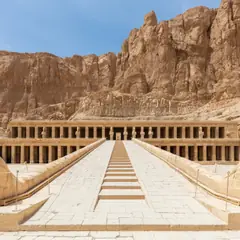
The men who dug and painted these tombs lived in the village of Deir el-Medina, and on the other side of the cliffs rises the Temple of Hatshepsut. Some pieces from the valley, such as objects from Tutankhamun’s tomb, are displayed in the Luxor Museum.
A pyramid nobody had to build
Peak of el-Qurn
Summary of this stop
From the entrance of the valley, the view goes straight to a summit crowning the hills: el-Qurn, “the horn”, a peak of some 450 metres that from here looks almost like a pyramid. The ancient Egyptians called it Ta Dehent, “the Peak”, and regarded it as the home of Meretseger, a cobra goddess whose name means “She Who Loves Silence”. For kings who no longer built pyramids, a natural pyramid watching over their tombs was probably the best reason to choose this place.
Beneath that summit 65 tombs and chambers have been numbered, although the figure changes depending on how shafts and minor chambers are counted. And most are not what their fame suggests: only some 20 contain the remains of kings. The rest are tombs of queens, princes and favoured nobles, unmarked shafts and embalming caches. What exactly that silence the goddess loves means, and who was bound to keep it, is told in the narration before el-Qurn itself.
Workmen without grain and a stolen cauldron
Entrances of KV7 and KV5
Summary of this stop
Along the central path, facing the mouths of the tomb of Ramesses II (KV7) and that of his sons (KV5), the valley shows what remained after centuries of looting: open, empty entrances. KV5 looks modest, but in 1995 Kent R. Weeks’s team revealed that it was the largest in the valley, with at least 130 chambers documented by 2006; Howard Carter had used it in 1902 only as a dump.
Those who dug and decorated these tombs lived in the village of Deir el-Medina, and not always at peace with the pharaoh. In year 29 of Ramesses III they stopped work because their grain rations did not arrive: according to the papyrus of the scribe Amunnakht, they crossed the checkpoint shouting that they were hungry and sat for 18 days behind the mortuary temple of Thutmose III. Later came the thieves. Papyrus Mayer B, written around 1118 BC, records the confession of one of them: five men led by a foreigner named Nesamun spent four days forcing the tomb of Ramesses VI to carry off a cauldron and three bronze basins.
The final blow was dealt by the guardians themselves. During the 21st Dynasty, the priests of Amun opened most of the tombs, removed their treasures and gathered the royal mummies in caches. The one at TT320, beside Deir el-Bahari, held more than 50 kings, queens and relatives, and Émile Brugsch emptied it in 48 hours in July 1881. How that cache came to light is one of the stories the audio guide reserves for this stretch of the path.
Roman tourists in the tomb of Memnon
Entrance of KV9
Summary of this stop
The great entrance of KV9, the tomb of Ramesses V and Ramesses VI, has been open since Antiquity. In Greco-Roman times it was identified with the tomb of Memnon, the hero of the Trojan War, and its visitors left 995 graffiti between the 1st century BC and the 4th century AD, mostly in Greek and in black or red ink, high on the walls of the corridors, at the height of the floor of the time. Some are surprisingly frank: one confesses he cannot read the hieroglyphs and another that he liked nothing except the sarcophagus.
They were not the only tenants. In Coptic times several open royal tombs were used as churches, stables and even dwellings, and some were inhabited by Christian hermits. Much later, in 1827, John Gardner Wilkinson painted the KV numbers over the entrances of the 21 tombs then open, starting from the valley entrance; that numbering is still in use and today runs from KV1, the tomb of Ramesses VII, to KV64, found in 2011.
Between the 1st and 3rd centuries travellers from India also came. In six tombs some 30 inscriptions in three Indian languages have been identified, half of them in ancient Tamil, whose reading Ingo Strauch and Charlotte Schmid presented in February 2026. A certain Cikai Korran signed eight times in five tombs with the same formula, one of them five or six metres above the entrance of the tomb of Ramesses IX. How he managed to reach so high, and what another visitor who introduced himself as a king’s messenger left written, is kept for the narration in front of this doorway.
The rubble that saved Tutankhamun
Tomb of Tutankhamun
Summary of this stop
At the bottom of the valley, west of the main path and at the foot of the great entrance of KV9, a small staircase descends to KV62. Its survival has an almost domestic explanation: more than 150 years after Tutankhamun’s burial, the rubble from the excavation of KV9 and the huts of the craftsmen who carved it covered his entrance, and the tomb was forgotten during the great waves of looting of the 20th and 21st Dynasties. In 1912 Theodore M. Davis closed his publication on the valley with a sentence that time proved wrong: he feared the Valley of the Kings was exhausted. Ten years later, on 4 November 1922, the team of Howard Carter and Lord Carnarvon found the first step.
Three weeks later, on 26 November, Carter opened a tiny breach in the second sealed door and put in a lit candle. By its flickering light strange animals, statues and gold slowly emerged, and the answer he gave Carnarvon went down in history as “wonderful things”. His excavation diary for that same day, however, notes something different.
Almost the entire burial equipment, 5,398 objects, left for Cairo and is now in the Grand Egyptian Museum. The king, by contrast, never left: his mummy and sarcophagus are still displayed inside KV62, and in 2014 a replica of the burial chamber opened beside the valley, based on Factum Arte scans from 2009, to ease the pressure of visitors. What Carter really noted beside that candle, and what he compared with the antechamber, is heard at the end of the route, at the foot of the staircase.