Ancient Egypt
Karnak Temple Audio Guide
Some thirty pharaohs worked for almost two thousand years on the great sanctuary of Amun-Ra, and many erased, covered or reused the work of their predecessors: Karnak is a temple that reads like a palimpsest.
- 120 min of audio
- Sanctuary of Amun-Ra
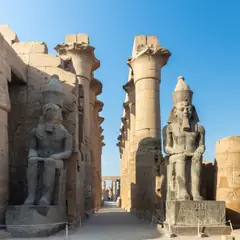
The Egyptians called it Ipet-isut, “the most select of places”. Work began under Senusret I, who reigned between 1971 and 1926 BC, and carried on into the Ptolemaic period, so the complex adds up pylons, courts, obelisks and chapels from reigns centuries apart. Its most famous piece is the Great Hypostyle Hall of Seti I: 134 sandstone columns in 16 rows, the 12 of the central nave crowned by open papyrus capitals at 21 metres high.
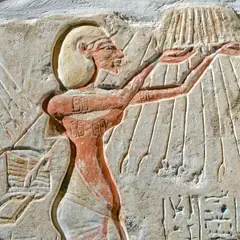
Beneath the grandeur lies a silent war of names. Ramesses II cut away his father’s cartouches to put his own, Ramesses VI covered those of Ramesses IV, and Amenhotep III filled a pylon with whole dismantled chapels. Even the foundations hold surprises: in 1899 eleven columns collapsed in a chain because they rested on blocks from Akhenaten’s dismantled temple.
Highlights
- Great Hypostyle Hall — 134 columns in 16 rows and a 21-metre central nave
- Overwritten cartouches — Ramesses II, Ramesses IV and Ramesses VI fighting over the same columns
- Hatshepsut’s obelisk — 30 metres of pink granite, still standing
- Unfinished First Pylon — a 113-metre façade without a single relief
- Sacred Lake and granite scarab — the modern ritual of walking circles to make a wish
On the east bank of Luxor, where ancient Thebes once stood, lies the city’s great sacred precinct. The Egyptians called it Ipet-isut, “the most select of places”, and dedicated it to Amun-Ra. Work began under Senusret I, who reigned between 1971 and 1926 BC, and did not stop until the Ptolemaic period (305–30 BC): some thirty pharaohs added pylons, courts, halls, obelisks and chapels there, each with the ambition of leaving a mark over those of his predecessors.
That is why the story of Karnak Temple cannot be told in a straight line. There are kings who cut away their fathers’ names to carve their own, pylons stuffed with dismantled chapels, obelisks walled in between masonry and columns that fell and were raised again in the early 20th century. Later came the closing of the pagan temples, ordered by Constantius II in AD 356, and the Coptic churches set up among the ruins. What to see at Karnak, how to read its architecture and what stories its stones hide is what the audio guide unpacks along a route of about two hours, from the avenue of rams to the Sacred Lake.
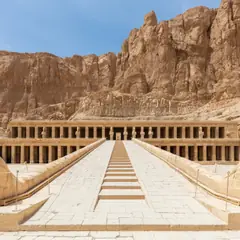
To the south, the avenue of sphinxes ends at Luxor Temple, and some of the blocks from Akhenaten’s dismantled temple are displayed today, reassembled, on a wall of the Luxor Museum. Across the Nile, the Temple of Hatshepsut completes the story of the queen of the obelisk.
Rams of Amun before an unfinished pylon
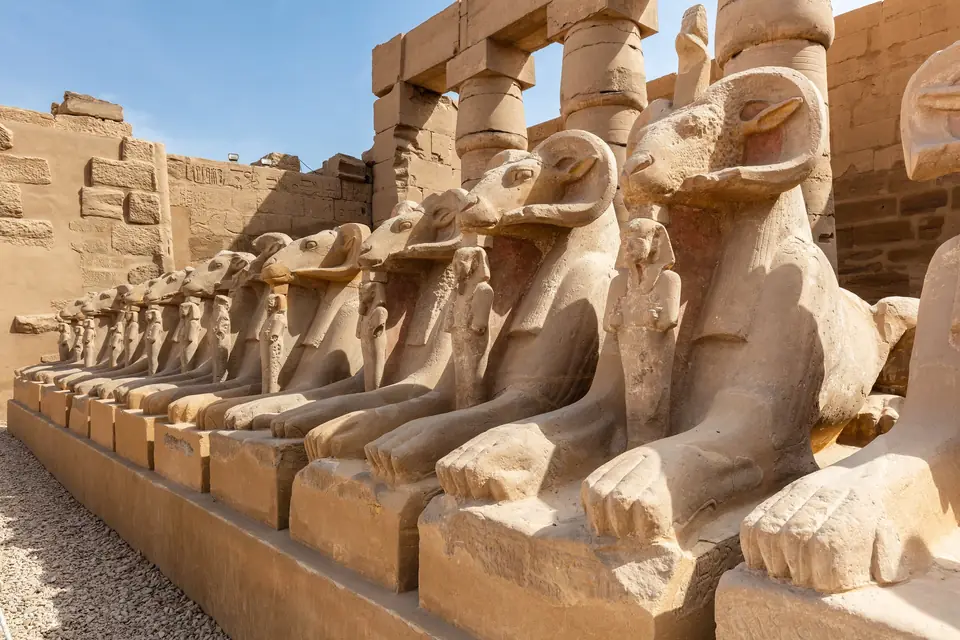
Avenue of ram-headed sphinxes
Summary of this stop
The route begins before a double row of ram-headed sphinxes, the animal of Amun, flanking the approach to the precinct. That path links up with the roughly 2,700-metre avenue of sphinxes and rams joining Karnak to Luxor Temple: rediscovered in 1949, it was reopened on 25 November 2021 with a parade of hundreds of university students dressed as pharaohs recreating the Opet festival, in front of President Abdel Fattah al-Sisi.
Behind it rises the First Pylon, the present entrance, and its first lesson is that it was never finished. It is attributed to Nectanebo I (380–362 BC), although an earlier pylon and court of the 22nd Dynasty existed and some sources assign it to Shoshenq I. It measures 113 metres wide and 15 thick, has not a single relief and its towers were left at uneven heights, 21.70 and 31.65 metres. Inside the great court, behind the north tower, remains of the mudbrick ramp used to haul the blocks up still survive, and what that ramp reveals about how a pylon was built is left for the narration on the spot.
Shishak, the pharaoh in the Bible
Bubastite Portal
Summary of this stop
In the great court, beside the temple of Ramesses III, opens the Bubastite Portal. On its wall, the pharaoh Shoshenq I strikes a group of captives above rows of city names enclosed in crenellated ovals: an original list of 156 place names from his campaign through Syria-Palestine, around 925 BC.
That relief has an echo far from Egypt. Shoshenq is identified with Shishak, the pharaoh mentioned in the Bible, and when Jean-François Champollion visited Karnak in 1828 he thought he could read “the kingdom of Judah” in one of those ovals. What that reading stirred up, and what is known today about that list, is told in front of the portal.
Twelve columns and a war of names
Karnak Great Hypostyle Hall
Summary of this stop
The Great Hypostyle Hall, between the Second and Third Pylons, is the visual heart of Karnak: 103 metres wide by 52 deep and 134 sandstone columns in 16 rows. The 12 of the central nave, with open papyrus capitals, reach 21 metres, although published figures vary depending on whether the abacus is counted. It was built by Seti I (1294–1279 BC), although its authorship is still debated: some assign the central nave to Amenhotep III and the side aisles to Horemheb, and a 2010 reassessment proposes an earlier peristyle from Horemheb’s time. From the 19th Dynasty the hall hosted coronations and jubilees, and during processions part of the Theban population was allowed in to see the king or the divine image on its barque.
High up in the nave, light enters through stone grilles, and that is where the war of names begins. Seti I decorated the north half in fine raised relief; his son Ramesses II finished the south half in sunk relief, quicker to carve, and had some of his father’s cartouches cut away, including those on those very grilles, to put his own. Later, on the central columns, Ramesses IV added his cartouches next to those of Ramesses II, and shortly afterwards Ramesses VI covered them by carving his own name on top. Learning to tell those layers apart on the shafts is what the audio guide teaches in the middle of the hall.
Eleven columns that fell in 1899
Rebuilt columns of the north wing
Summary of this stop
The north half of the hypostyle hall looks as ancient as the rest, but its columns were dismantled and put back together. On 3 October 1899 eleven of them collapsed in a chain, with a crash heard as far as Luxor Temple. The culprit was underground: the foundations were thousands of talatat blocks from Akhenaten’s dismantled temple (c. 1352–1336 BC), which saline groundwater had been dissolving.
Georges Legrain, in charge of Karnak since 1895, rebuilt the north half on new foundations and, in the south half, slipped modern brick under the columns without taking them down. He declared that phase finished on 15 May 1902. How a forest of stone on that scale is raised again, and what trace Akhenaten left in its foundations, is what is heard among those columns.
A queen’s needle, walled in stone
Hatshepsut’s Obelisk
Summary of this stop
Beyond the Third Pylon, in a narrow space, two obelisks stand: that of Thutmose I, 21.2 metres, and further on that of Hatshepsut, of pink granite and some 30 metres. The queen raised two for her jubilee in year 16 of her reign; the north one still stands, the south one fell and its tip lies near the Sacred Lake. A later stone doorway walled the bases into its jambs. The standard account attributes that concealment to Thutmose III, set on erasing the queen, but a recent analysis of the chronology suggests she may have walled them in herself.
The pylon just crossed keeps its own secret. Amenhotep III covered it in gold and precious stones and filled its towers with hundreds of blocks from dismantled monuments; recovered in the early 20th century, they allowed the reconstruction of the White Chapel of Senusret I and the Red Chapel of Hatshepsut in the precinct’s open-air museum. And Karnak produced an even larger obelisk: according to an inscription of Thutmose IV, the one commissioned by Thutmose III spent 35 years lying in the hands of the craftsmen until his grandson raised it. The long journey that took it to a square in Rome is told beneath the queen’s needle.
Seven laps around a 3,400-year-old scarab
Karnak Sacred Lake
Summary of this stop
The route ends beside the Sacred Lake, the rectangular pool where the priests purified themselves. At its north-west corner, on an oval pedestal, rests a colossal red granite scarab that Amenhotep III (1390–1352 BC) dedicated in his mortuary temple on the west bank; it was probably Taharqa (690–664 BC) who moved it here. Around it a custom that is documented but not at all pharaonic is repeated daily: visitors circle the pedestal making a wish, most often seven laps, although a version with three also circulates.
A few steps away, in the court before the Seventh Pylon, Georges Legrain found a cache in 1903 with close to 800 stone statues and 17,000 bronzes, considered the largest deposit of Egyptian statues on record. Other sources speak of more than 900 statues, because the excavation diary was lost. The water table stretched the work out until 1907 and most of the pieces ended up in the Cairo Museum. What that discovery meant, among pylons and obelisks reflected in the water, closes the route.