Ancient Egyptian art
Luxor Museum Audio Guide
A small, dimly lit museum on the Corniche that holds what Thebes gave back: statues buried beneath Luxor Temple, an Akhenaten wall rescued from a pylon’s fill and a royal mummy that returned from a curiosity museum in Canada.
- 75 min of audio
- Statues, mummies and talatat
Luxor Museum was planned in 1962, when Egypt’s Ministry of Culture commissioned its designs from the architect Mahmud El Hakim, and it opened in 1975 with Anwar el-Sadat and Valéry Giscard d’Estaing. It is a two-storey building, sober and modest in size, designed so that each piece emerges from the darkness. Over the years it added a wing of Italian design for the statue cache found in 1989 and another, in 2004, devoted to the glory of Thebes in the New Kingdom.
In one of its halls lies the mummy attributed to Ramesses I, founder of the 19th Dynasty. It spent some 140 years in the Niagara Falls Museum in Ontario, in a former corset factory, alongside a whale skeleton, a two-headed calf and the barrels of those who went over the falls. Its label carries two unexpected names: Niagara Falls and Atlanta.
Highlights
- Cache hall — 26 statues found by chance beneath Luxor Temple in 1989
- Amenhotep III on a sledge — 2.49 metres of red quartzite with Amun’s name chiselled out
- Akhenaten wall — 183 talatat assembled over 18 metres with scenes of Aten worship
- Mummies of Ahmose I and Ramesses I — two dynasty founders in dimly lit halls
- Sobek and Amenhotep III group — calcite that Ramesses II claimed with an inscription
On the Nile Corniche, between the hotels and the cruise boats, a two-storey building holds some of the most extraordinary pieces of ancient Egypt without needing vast halls. Luxor Museum grew out of a 1962 commission from Egypt’s Ministry of Culture to the architect Mahmud El Hakim; its display cases were installed between 1972 and 1975, and that year it was inaugurated by President Anwar el-Sadat and France’s Valéry Giscard d’Estaing. Since then it has grown at the pace of whatever Thebes itself gave back.
The history of Luxor Museum is that of pieces that the subsoil, oblivion and even a freak show across the ocean kept hidden for centuries. Statues of pharaohs and gods that appeared in 1989 beneath the court of Amenhotep III at Luxor Temple; a wall of Akhenaten rebuilt from blocks that served as fill; objects from Tutankhamun’s tomb, such as shabtis, model boats, sandals and gilded bronze rosettes; and two royal mummies in dimly lit halls. What to see in the Luxor Museum, and why each piece has a journey back behind it, is what the audio guide unpacks hall by hall, over seventy-five minutes.
The cache statues come from Luxor Temple, and Akhenaten’s talatat from the Ninth Pylon of Karnak Temple. To follow the trail of the New Kingdom pharaohs on the other side of the river there is the Valley of the Kings.
A museum small on purpose, facing the Nile
Luxor Museum
Summary of this stop
From the Corniche, the façade announces nothing monumental. The building Mahmud El Hakim designed for the Ministry of Culture in 1962 is sober, with restrained lines and modest dimensions, and that modesty is deliberate: inside, the low light and isolated display cases let each statue emerge from the darkness as a presence, not as one more object in a row.
Its inauguration, in 1975, brought together two heads of state, Anwar el-Sadat and Valéry Giscard d’Estaing, and the museum still celebrates its anniversary every 12 December. On climbing the ramp to the first floor, the scribe Amenhotep son of Hapu, the architect of Amenhotep III, waits seated in granite with his papyrus. And why that man of no royal blood ended up venerated as a god is one of the first stories the narration tells right there.
The crocodile god that came out of a canal
Sobek and Amenhotep III group
Summary of this stop
On the ground floor a great calcite group dominates: the crocodile god Sobek, seated, extends the ankh, the sign of life, to the young Amenhotep III. The piece reached the museum by a stroke of luck. In 1967, workmen digging the Armant canal stumbled on the temple of Sobek at Dahamsha and, inside it, on a shaft closed by a sandstone slab that slid on two bronze wheels.
The back of the statue tells another story. Hieroglyphic lines run across it with which Ramesses II appropriated a work that portrayed Amenhotep III. How that borrowed signature is read on the stone is left for the audio guide, before Sobek himself.
The pharaoh taken apart in three-handspan blocks
Akhenaten wall
Summary of this stop
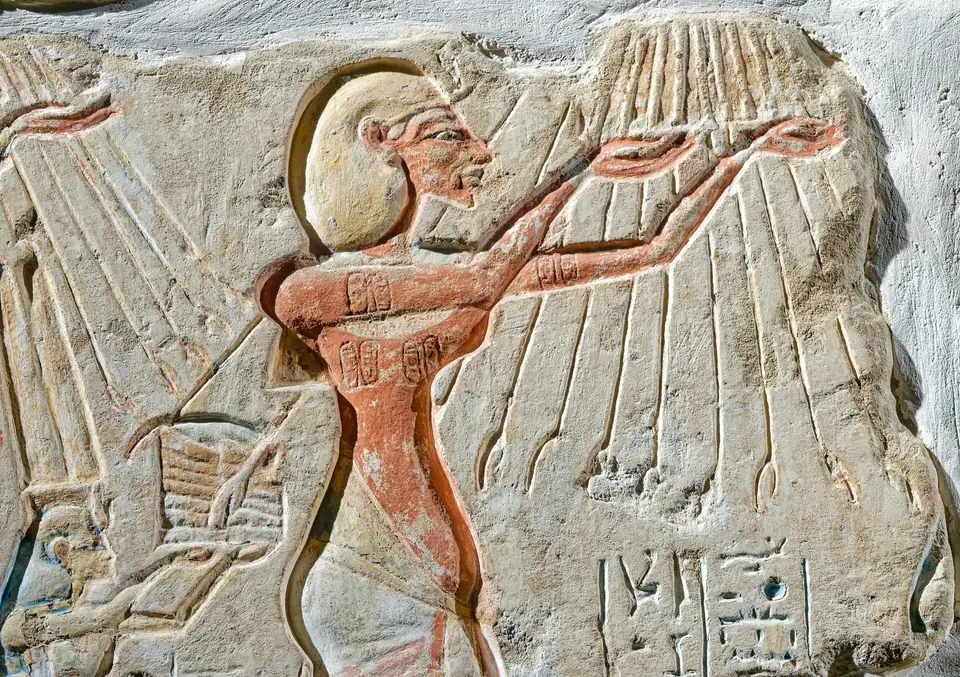
On the upper floor stretches a reconstructed 18-metre wall made of 183 talatat, small blocks of painted sandstone that belonged to Akhenaten’s temples at Karnak. They show Akhenaten and Nefertiti worshipping the sun disc Aten, rows of attendants, offerings and scenes of everyday work. After Akhenaten’s reign those temples were dismantled and Horemheb used the blocks as fill for Karnak’s Ninth Pylon: an uncomfortable reign, literally buried inside someone else’s work.
The name of the blocks has its own story. “Talatat” was a word used by the Egyptian workmen on the digs, which the Egyptologist Henri Chevrier brought into archaeological vocabulary. Its origin is debated: it could come from Italian tagliata, “cut ashlar”, or from Egyptian Arabic talata, “three”, because each block measures three handspans in length. What those scenes say about the cult of the Aten is revealed in the narration, in front of the wall.
A founding king among two-headed calves
Mummies of Ahmose I and Ramesses I
Summary of this stop
In March 2004 the wing devoted to the glory of Thebes in the New Kingdom opened, with chariots, bows, spears, arrows and an axe of gold and wood. In its dark halls two royal mummies lie unwrapped: that of Ahmose I, founder of the 18th Dynasty, and the one attributed to Ramesses I, founder of the 19th, with arms crossed high on the chest, a posture reserved for kings.
The journey of that second mummy is almost novelistic. Stolen in the 19th century, it spent some 140 years in the Niagara Falls Museum in Ontario, housed in a former corset factory, labelled, so the story goes, as a mere Egyptian nobleman between a whale and a two-headed calf. Tradition has it that the German Egyptologist Arne Eggebrecht recognised it on a visit and exclaimed aloud that it was a royal mummy. In 1999 the Michael C. Carlos Museum in Atlanta bought Niagara’s Egyptian collection and, after its analyses, in October 2003 returned the mummy to Egypt, where a children’s choir and a military band received it.
Its identity, nonetheless, remains open: the Atlanta analyses pointed to a high probability, but some maintain that there is no firm proof and no DNA analysis has ever been done. How the money was raised to bring it back is part of the story the audio guide tells in front of the display case.
The statues a shovel found in 1989
Cache hall
Summary of this stop
On 22 January 1989, during routine cleaning at the western end of the court of Amenhotep III at Luxor Temple, one of the areas most trodden by tourists, a cache of statues of pharaohs and gods appeared. The works aimed to straighten papyrus-bundle columns that were leaning because of the rising water table, and while taking soil samples a workman’s shovel struck a polished stone base almost two metres down, although the figures vary according to the account. Why those statues ended up underground is still debated: some attribute it to the priests during the Roman occupation of the temple, others to the Assyrian invasion, and others see it as a ritual deposit.
The star piece is Amenhotep III in red quartzite, 2.49 metres tall, standing on a processional sledge. In its inscription, Amun’s name appears chiselled out: the mark of Akhenaten’s persecution of that god, which closes the circle opened at the talatat wall. Around it, a kneeling Horemheb offers two vessels to Atum, beside Hathor, Iunyt, a sphinx of Tutankhamun and the cobra of Amun-Ra Kamutef from Taharqa.
In 2026 the hall reopened after four months of works: the pieces on display rose from 17 to 26 and, for the first time, the complete cache occupies its own hall, with a layout that recreates the moment of discovery. Behind that reopening lies a story no label mentions, that of whoever moved stone kings and gods to their new display cases, and with it the route comes to a close.