Pharaonic temple
Luxor Temple Audio Guide
A pharaonic temple turned towards Karnak to receive the gods in procession, later a Roman fort, a church and a mosque, and still at prayer beneath a mosque hung over its columns in the very centre of Luxor.
- 75 min of audio
- Temple, church and mosque
Luxor Temple, the Ipet-resyt or “southern sanctuary” of ancient Thebes, was built by Amenhotep III around 1390–1352 BC over an even older shrine from the time of Hatshepsut. Tutankhamun and Horemheb decorated its Great Colonnade with the Opet festival, Ramesses II added a 65-metre-wide pylon and a court of 74 columns, and Alexander the Great rebuilt the barque shrine of Amun at its heart. Unlike almost every Egyptian temple, it does not follow the axis of the sun: it faces Karnak, some 3 kilometres to the north.
No age left it in peace. The Romans enclosed it in a fort and covered pharaonic reliefs with frescoes of Diocletian; in AD 395 part of the court became a church, and above it the Abu el-Haggag mosque is still in use, perched at the height the village houses reached before the excavation. Its original door was left hanging in mid-air, unused, as a mark of the old ground level.
Highlights
- Eastern obelisk — pink granite with baboons greeting the sun; its twin stands in the Place de la Concorde in Paris
- Ramesses II’s First Pylon — 65 metres wide, 24 high, with the Battle of Kadesh in relief
- Abu el-Haggag Mosque — in use and resting on the columns of Ramesses II’s court
- Great Colonnade — two rows of seven colossal columns with the Opet festival on the walls
- Imperial cult chamber — Roman frescoes of Diocletian over 18th Dynasty reliefs
In the very centre of Luxor stands a temple that has never ceased to be used. The ancient Egyptians called it Ipet-resyt, the “southern sanctuary”, and conceived it as the destination of a festival: every year the images of Amun, Mut and Khonsu left Karnak and processed along the road to reach it. The core was built by Amenhotep III around 1390–1352 BC; the oldest surviving structure is a shrine from the reign of Hatshepsut, around 1473–1458 BC. On that skeleton worked Tutankhamun, Horemheb, Ramesses II and, in the Greek period, Alexander the Great.
The history of Luxor Temple is a succession of owners who claimed it without erasing the one before: a Roman fort at the end of the 3rd century, a church from AD 395, a mosque afterwards and a village perched over its ruins for centuries, until Gaston Maspero began excavating it after 1884. Even its function is debated: the traditional reading makes it the home of the Theban triad, while the Chicago Epigraphic Survey proposes that it served the cult of the royal Ka, the renewal of kingship. What to see at Luxor Temple, and how to read its architecture layer by layer, is what the audio guide unfolds in five stops and seventy-five minutes, with narration that is documented and checked against historical sources.
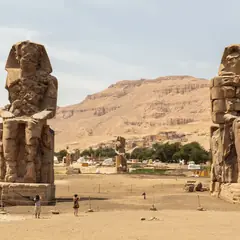
The avenue of sphinxes links it to Karnak Temple, and the statues found in 1989 beneath its court are displayed in the Luxor Museum. On the west bank, the Colossi of Memnon are the other great signature of Amenhotep III.
A lone obelisk before the pylon
Eastern obelisk and avenue of sphinxes
Summary of this stop
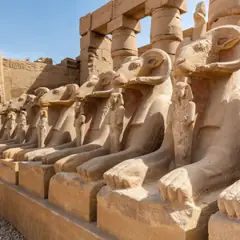
The route starts at the foot of the First Pylon, where Nectanebo I’s avenue of human-headed sphinxes ends, the last stretch of the 2.7-kilometre processional road that joined the temple to Karnak. That avenue explains the first oddity of the place: unlike most Egyptian temples, Luxor Temple does not follow an east–west axis but faces Karnak, some 3 kilometres to the north, because that was where the gods came from during the Opet festival.
Before the façade stands a single pink granite obelisk. At its base, four baboons raise their arms to the rising sun. It once had a partner: in November 1830 Muhammad Ali gave both obelisks to France at Champollion’s urging; the western one, the shorter, was brought down in 1831, reached Paris in 1833 and Louis-Philippe raised it in the Place de la Concorde in 1836. The fragment of pedestal that travelled with it ended up in the Louvre, because its baboons were judged too obscene to display in the street. The heights of the two vary by source, and there is not even agreement on which is taller.
The obelisk that remains in Luxor has its own story too: according to the documented tradition, transport was so expensive that the French engineers took only one and left its twin standing. What happened next with the ownership of that stone, and the date it stopped being French on paper, is revealed by listening to the narration on the spot.
The chapel that bent Ramesses II
Triple barque shrine
Summary of this stop
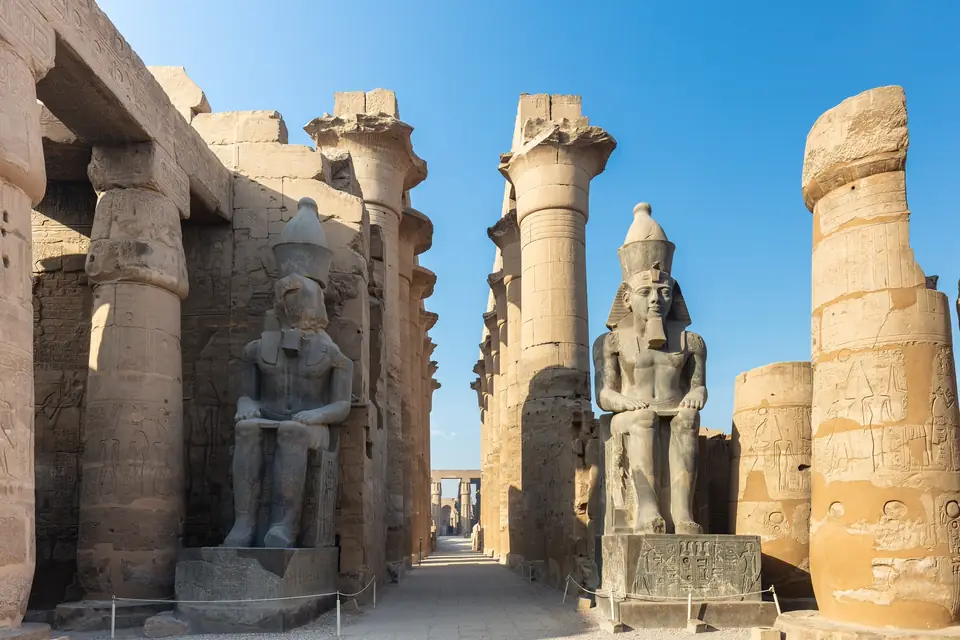
Once through Ramesses II’s pylon, 65 metres wide and 24 high and decorated with the Battle of Kadesh against the Hittites, a colonnaded court opens, 57 by 51 metres, with 74 papyrus-bundle columns and statues of the king between them. It is the pharaoh’s great signature in the temple, added in front of Amenhotep III’s building.
In the north-west corner of the court waits the key to its architecture: the triple barque shrine of Hatshepsut and Thutmose III. Ramesses II’s architect chose to respect it, and that is why the court and the pylon ended up skewed relative to the axis of Amenhotep III’s temple. The kink, visible as soon as one looks at the whole, is a trace of respect for the oldest construction on the site.
The same calculation affected the obelisks: they had different heights and were set out of step so that, seen head-on, they looked identical. How that optical trick is read on the ground is left for the audio guide.
A mosque hung fifteen metres up
Abu el-Haggag Mosque
Summary of this stop
On the east side of Ramesses II’s court, on the left on entering, a mosque with two mudbrick minarets rests directly on the ancient columns. It is the Abu el-Haggag Mosque, still active, which holds the tomb of Sheikh Yusuf Abu el-Haggag. This part of the temple had already become a church in AD 395; when it became a mosque is a disputed question, and sources propose dates ranging from the 7th century to the Ayyubid period, as well as a rebuilding in the 19th century.
Its position has an explanation. From the Middle Ages the village of Luxor lived inside and around the temple, until it formed an artificial hill of rubble some 15 metres high. When Maspero began excavating after 1884 he removed houses, storerooms and dovecotes, but the mosque was left untouched, and its original wooden door stayed up high, unused, marking the level on which its worshippers once walked.
Devotion is still alive: every 14 Shaban thousands of Luxor residents come to the mosque for a procession more than 800 years old, in which young men drag boats through the streets, and the Egyptologist Georges Legrain already linked it in 1914 with the Opet procession of barques. According to local tradition, an official once wanted to demolish the mosque; what happened to him on the morning planned for the demolition is told by the narration at the foot of the suspended door.
Opet on Tutankhamun’s walls
Great Colonnade
Summary of this stop
Amenhotep III’s Great Colonnade is two rows of seven colossal columns with open papyrus capitals, a corridor designed to dwarf whoever walks it. Its side walls tell precisely the festival that justified the whole temple: the Opet procession, with the barques of the gods on their way to the southern sanctuary.
Those scenes came late. After the neglect of the temple under Akhenaten, it was Tutankhamun, around 1336–1327 BC, and Horemheb who completed the decoration and returned the procession to the walls.
On the other side of the colonnade opens Amenhotep III’s sun court, ringed by a double row of closed-bud papyrus columns. Beneath its floor slept a secret buried in Roman times: in January 1989, during routine work led by Mohammed el-Saghir, statues appeared at a depth of almost a metre. How many came out in the end and where they can be seen today is part of the story of this stop.
Roman emperors over pharaonic reliefs
Imperial cult chamber
Summary of this stop
At the end of the 3rd century the Romans surrounded the temple with a fort for a legion, and under Diocletian (284–305) the hall in front of Amenhotep III’s offering hall became an imperial cult chamber. Its columns were removed, the axial door was walled up with a niche and the 18th Dynasty reliefs were covered with painted stucco bearing frescoes of Diocletian and his three co-rulers. Today the flaking stucco lets the pharaohs show through beneath the emperors.
Further back lies the barque sanctuary, which Alexander the Great, king of Egypt from 332 BC, rebuilt and which appears in its reliefs with him as a pharaoh before Amun; the bases of the four columns he had raised still emerge from the foundations. Alexander claimed to have been crowned here, although he may never have travelled south of Memphis.
That search for legitimacy went back a long way: an inner hall of Amenhotep III contains the scenes of the Divine Birth, which present the god Amun-Ra, disguised as Thutmose IV, as the king’s true father. How each new master of the temple came to appropriate that idea closes the route.