Artisans’ village
Deir el-Medina Audio Guide
The walled village of those who dug and painted the tombs of the Valley of the Kings: their houses, their own tombs beneath mudbrick pyramids and thousands of notes naming them one by one, from the strike over grain to excuses for missing work.
- 60 min of audio
- Everyday life in the New Kingdom
Deir el-Medina is the village the Egyptian state built at the start of the New Kingdom, probably under Thutmose I, for the artisans of the royal tombs. Its residents called it Set Maat, the Place of Truth. Inside its wall some 68 houses lined both sides of a single street, and on the west slope they built their own tombs, crowned by small mudbrick pyramids. To the north an almost intact Ptolemaic temple of Hathor survives.
Of no other village in ancient Egypt is so much known about ordinary life. A failed well turned into a rubbish dump yielded more than 5,000 ostraca: absence reports, lawsuits, wills, household errands. Thanks to them we know the scribe who noted how the gang crossed the checkpoint shouting that it was hungry, the foreman accused of sitting on a king’s sarcophagus and the family that sent for the healer because the cat had eaten the father’s remedy.
Highlights
- Tomb of Sennedjem (TT1) — a vaulted ceiling painted on a yellow ground with the fields of Aaru
- Main street — some 68 houses in 5,600 m² inside the walled enclosure
- Temple of Hathor — built by Ptolemy IV, saved by becoming a monastery
- Great Pit — more than 50 m deep, with more than 5,000 ostraca recovered
- Pyramid chapels — small mudbrick pyramids above the artisans’ tombs
In a hollow on the west bank of Luxor, where the hill of Gurnet Murai hides the Nile, lie the foundations of a village unlike any other monument in Egypt. No pharaohs or priests lived here, but the men who dug and painted the tombs of the Valley of the Kings. The village was born at the start of the New Kingdom, probably under Thutmose I (around 1506–1493 BC), when royal tombs began to be opened in the nearby valleys, and was emptied around 1110–1080 BC, in the time of Ramesses XI, amid tomb robberies, Libyan raids and civil war. Its residents were not slaves: they were free state officials, paid in grain up to three times what a field labourer earned, and passed the post from father to son.
The history of Deir el-Medina is known by name because its residents wrote everything down. A woman called Naunakhte dictated before witnesses a will that disinherits three of her eight children for not caring for her in old age; the architect Kha and his wife Merit took more than 400 objects with them to the tomb, which today fill an entire room of the Egyptian Museum in Turin; and when a court could not clear up a theft, the god’s statue was carried in procession before the accused so that it would bow, or not, towards the culprit. What to see at Deir el-Medina, from the Temple of Hathor to the tomb of Sennedjem, and how to read in its stones the life of a neighbourhood more than three thousand years old, is what the audio guide unpacks in four stops and sixty minutes of walking.
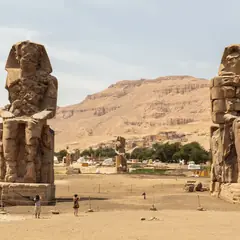
The tombs where its residents worked are in the Valley of the Kings, and on the plain of the same west bank rise the Colossi of Memnon.
A late temple and a dump of voices
Ptolemaic Temple of Hathor
Summary of this stop
The first thing the visitor finds is a small, almost intact stone temple, surrounded by its mudbrick wall, with votive chapels inside the enclosure and a stairway from the time of Ramesses II before the façade. It looks like the heart of the village, but it is a newcomer: Ptolemy IV built it in the 3rd century BC, and his successors completed it, over shrines of Seti I and Ramesses II, centuries after the artisans had gone. In its three chapels Ptolemy IV is seen making offerings to Hathor in the form of a cow, a many-headed Hathor above the central door and, in the left-hand chapel, the judgment scene of Osiris, a theme more at home in tombs than in temples. Beside it emerge the terraces of the older enclosures, where the residents worshipped their deified patrons.
In Christian times the temple became the monastery of St Isidore, and that conversion saved it from destruction and gave the place its Arabic name: Deir el-Medina, “the monastery of the town”. The artisans, by contrast, called it Set Maat, the Place of Truth, and they themselves were the Servants in the Place of Truth.
About 200 metres to the north opens the Great Pit, a hole more than 50 metres deep and 35 across that failed as a water well and ended up as a dump. Between 1949 and 1951, Bernard Bruyère took 6,000 m³ of rubble out of it by hand and recovered more than 5,000 ostraca, the written fragments from which almost everything known about the village comes. What those notes said, and why a rubbish tip ended up being the best archive of ordinary Egypt, is what the narration reveals before the temple.
The street where missing work was put in writing
Houses of the main street
Summary of this stop
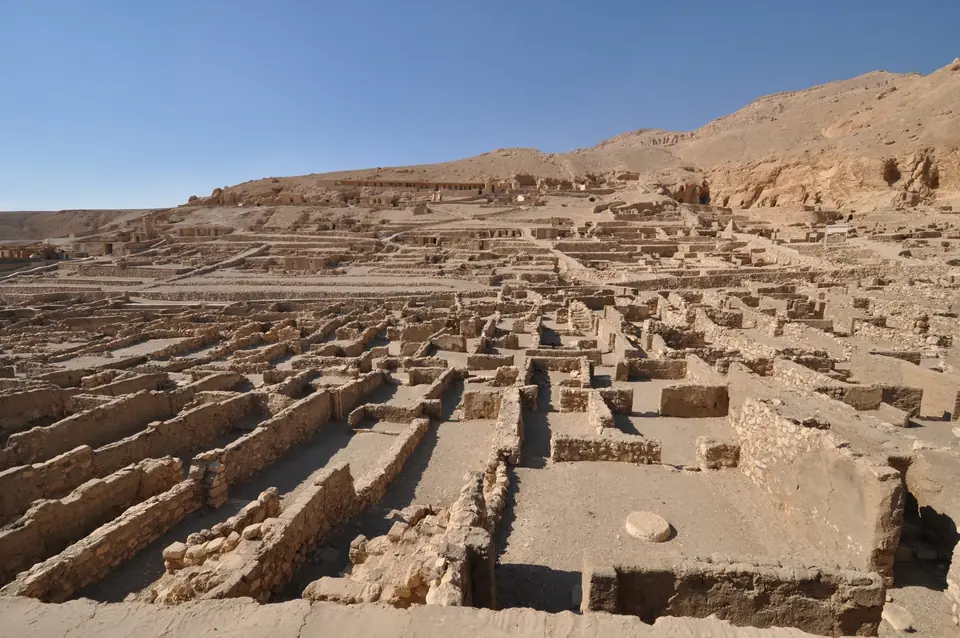
A single narrow street crosses the enclosure from end to end, and on both sides stand the stone and mudbrick low walls of the houses. At its height, the village brought together some 68 dwellings in 5,600 m², averaging about 70 m² each: an entrance, a main room with its mudbrick platform, two small rooms and a kitchen with cellar and stairs to the roof. The walls were whitewashed on the outside and the windows set high against the sun; in many houses the niches where statuettes were placed are still visible.
Those who lived here formed a small administration, with its own court of foreman, deputies, artisans and scribe. And the administration kept count of everything. A limestone absence report, dated to year 40 of Ramesses II (around 1250 BC) and now in the British Museum, lists 40 workmen and notes in red ink why each was absent: illness is the most frequent, but one is missing because of a scorpion sting, another for hauling stones for the scribe and ten because of the menstruation of his wife or daughter.
The same habit of writing left far more intimate notes. Two ostraca in the same hand tell of the urgency of the family of the draughtsman Nebre, who decorated tombs of Seti I and Ramesses II: his son Nakhtamun asks his brother for fresh goose fat, very quickly, because the cat has eaten the previous day’s, and explains that his father is not sleeping well. What he asked for next, and who the woman was that he sent for, is left for the narration on this street.
A strike beneath the cobra’s peak
Village layout and el-Qurn peak
Summary of this stop
From the west slope the whole layout of the village can be read: the single street, the crowded houses and the enclosure wall, which follows the shape of the narrow valley and separated the artisans from the outside. From here it is also clear how the work was organised. The workmen were divided into two gangs, the “left” and the “right”, which decorated opposite sides of the tomb like the crew of a ship; while the works lasted they slept in a camp above the mortuary temple of Hatshepsut, whose remains are still visible, and cooked food was sent up to them from the village.
That arrangement broke down. According to the Strike Papyrus, written by the tomb scribe Amennakht and now kept in the Egyptian Museum in Turin, in year 29 of Ramesses III (around 1158 BC) the gang crossed the checkpoint shouting “we are hungry!”, after spending 18 days of the month sitting behind the mortuary temple of Thutmose III demanding their unpaid grain rations. It is often presented as the first strike in history, although sources disagree both on the exact date and on whether it deserves that title. It was also put in writing how the foreman Paneb was denounced to the vizier for stealing stone from the tomb of Seti II for his own tomb and for sitting on the king’s sarcophagus; the accusation came from a rival who aspired to his post, and it is not known whether he was ever punished.
Above it all rises el-Qurn, “the Horn”, the 420-metre peak that the artisans called the Peak of the West. For them it embodied Meretseger, the cobra goddess “who loves silence”, who was believed to bite anyone who robbed the tombs or broke an oath. A draughtsman of the village called Neferabu offended her, fell gravely ill and left on a stela a confession and a warning to the whole gang. What he wrote still sounds like real fear, and the audio guide tells it in front of the mountain.
A neighbour’s yellow paradise
Tomb of Sennedjem
Summary of this stop
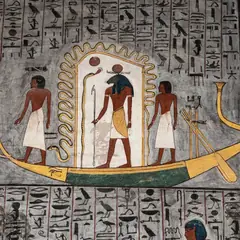
On the west slope, small mudbrick pyramids crown the artisans’ funerary chapels. That of Sennedjem, artisan of the royal necropolis, is restored, with its access shaft in the front courtyard. Below waits a chamber of 5.12 by 2.61 metres under a 2.40-metre vault, with its 40 m² of walls and ceiling entirely painted on a yellow ground and red floor. On the east wall, Sennedjem and his wife Iyneferti plough, sow and reap in Aaru, the Egyptian afterlife, among palms, sycamores and canals; in the tympanum, baboons adore the rising sun. Very close by one can also visit the tomb of Pashedu, kneeling before Osiris, and that of the sculptor Ipuy, decorated with artisans at work.
The chamber survived the abandonment of the village and appeared intact in 1886. The most detailed account attributes its opening, in January, to Salam Abu Duhi, a resident of Qurna, and three other men, although another version credits Gaston Maspero in February. Inside were 165 objects and more than 20 burials of the family, and Eduardo Toda emptied it in three days bound for the Bulaq Museum. That it was intact comes with qualifications: the forty chests and coffers appeared empty, and it has been suggested that the family itself re-entered to remove reusable objects.
The necropolis held another surprise. In 2014, from a looted tomb came the torso of a woman who lived between 1300 and 1070 BC; under infrared light more than 30 tattoos made in her lifetime appeared on her skin, lotus flowers, Hathor cows, baboons and a row of divine eyes across the throat, the first figurative tattoos found on an Egyptian mummy. Who she may have been and what those eyes protected is the last story of the route.