Mortuary temple
Temple of Hatshepsut Audio Guide (Deir el-Bahari)
Against the cliffs of the west bank, the woman who reigned as pharaoh left her case set in stone: divine birth, the voyage to Punt and crowned colossi. And on the walls the chiselled silhouettes of the attempt to erase her remain.
- 60 min of audio
- Temple on three terraces
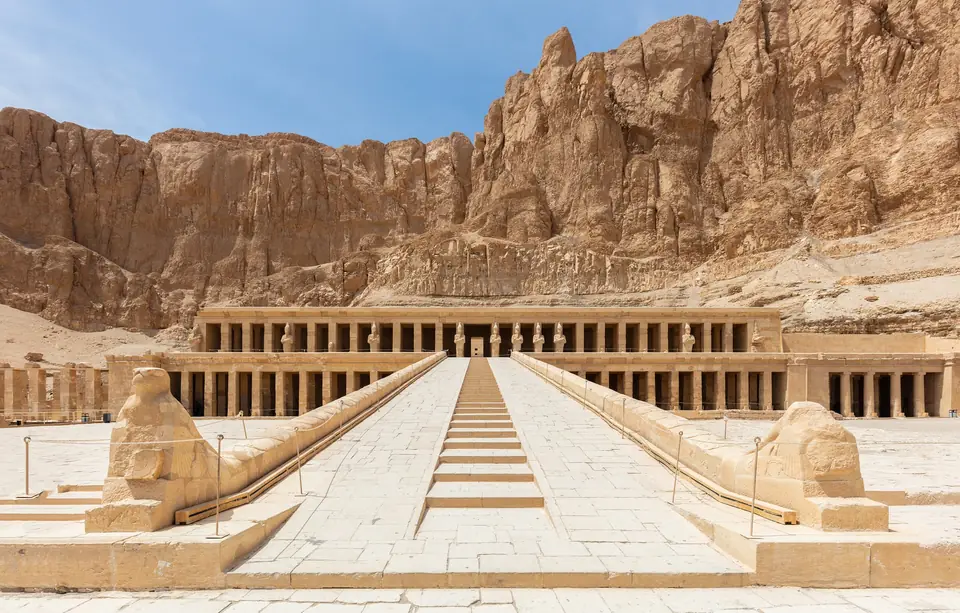
The Temple of Hatshepsut, called Djeser-Djeseru, “Holy of Holies”, was built between years seven and twenty of her reign, with plans modified several times as work went on, in the cliff amphitheatre of Deir el-Bahari. It copies the terraced scheme of the neighbouring temple of Mentuhotep II, some six centuries older, and is climbed by two great ramps to a sanctuary of Amun cut into the rock, each year the destination of the god’s barque during the Beautiful Festival of the Valley.
Its walls are also the file of a disappearance. Some twenty years after the queen’s death, in year 42 of Thutmose III, a campaign began that attacked only her image as king and was abandoned after two years, leaving half-chiselled figures beside intact gods. Her statues ended up smashed with mallets in a quarry and in a pit, and much of what is seen today on the façade is the result of decades of reconstruction.
Highlights
- Punt Colonnade — five ships, Queen Ati and the only secretary bird in ancient Egypt
- Divine Birth Colonnade — the oldest known scene of its kind
- Upper terrace façade — 26 pillars with 5.2-metre Osiride colossi
- Scraped silhouettes — the female pharaoh erased beside intact gods
- Sanctuary of Amun — cut into the rock and open to the public in 2017
At the back of a rock amphitheatre on the west bank of Luxor, three terraces of pillars climb towards the cliff, joined by two ramps on the axis. It is the temple that Hatshepsut, the woman who reigned as pharaoh, had built for Amun between years seven and twenty of her reign: Djeser-Djeseru, “Holy of Holies”. Beside it, just to the south, lie the ruins of the temple of Mentuhotep II, some six centuries older, whose terraced scheme she copied; above, the pyramidal summit of el-Qurn dominates the valley where the queen’s tomb lies. Who designed it is not clear: Senenmut, her steward, proclaimed himself chief architect of Deir el-Bahari and tradition credits him with the work, but the high priest Hapuseneb has also been proposed, as has direct intervention by Hatshepsut herself.
The story of the Temple of Hatshepsut does not end with her. In year 42 of Thutmose III the campaign began that chiselled away her image as king; around 300 BC its chambers became a healing sanctuary; between the 6th and 8th centuries the Copts built a monastery on top; since 1961 a Polish-Egyptian mission has been rebuilding it stone by stone. What to see at the Temple of Hatshepsut, and what both her portraits and her absences tell, is what the audio guide covers in five stops and sixty minutes of climbing, documented and checked against historical sources.
Her great obelisk still stands in Karnak Temple, on the other bank, and behind the cliffs opens the Valley of the Kings, the necropolis of the New Kingdom pharaohs.
A garden for Amun at the foot of the cliff
Lower terrace and central ramps
Summary of this stop
On the esplanade before the first ramp the shape of the building makes sense: a staircase of colonnades wedged against the rock, following the model of the temple of Mentuhotep II and adjusted with plans modified several times during construction. This flat ground was not an empty space. Hatshepsut conceived the temple as “a garden for my father Amun”, and the lower terrace had two persea trees and two T-shaped pools; part of what was to grow here arrived by sea, among the 31 incense trees brought back by the Punt fleet.
The name of the place comes from another age. Between the 6th and 8th centuries the Copts built the monastery of St Phoebammon over the terraces and painted figures of Christ on the reliefs; hence Deir el-Bahari, “the northern monastery”. In the 1850s and 1860s, Auguste Mariette destroyed the monastery’s remains to bring to light the temple beneath.
Under the flat ground in front, just outside the precinct wall, the largest intact tomb found in Egypt appeared in 1891: 153 sets of coffins of priests and priestesses of Amun of the 21st Dynasty, with papyri, shabti boxes and food baskets. The assemblage ended up spread among some 30 museums, one of them in Madrid, and how it got there is told in the narration, a few steps from the entrance.
Five ships bound for the land of Punt
Punt Colonnade
Summary of this stop
The south colonnade of the middle terrace holds the great news report of the reign. In year 9, Hatshepsut sent five ships to the land of Punt, on the Red Sea coast, under the command of the chancellor Nehsi. The reliefs show laden ships, myrrh trees and a village of houses on stilts, and present the expedition as tribute paid to Egypt, although it was a trading mission: a distant voyage turned into propaganda.
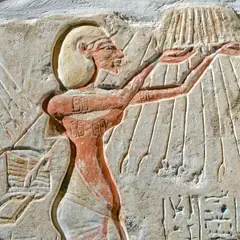
Among the figures the chief Parahu stands out and, behind him, his wife, Queen Ati, shown with an extremely obese body. Her appearance has been explained as advanced steatopygia or as elephantiasis, with no consensus. The fleet returned with gold, baboons, panther skins and 31 incense trees.
These walls still hold surprises. In June 2018 the Polish mission identified on them the only known depiction of a secretary bird in all of ancient Egypt, and the audio guide points out where to look for it among the colonnade’s fauna.
A girl, daughter of Amun, and her scraped silhouette
Divine Birth Colonnade
Summary of this stop
On the other side of the ramp, the north colonnade of the middle terrace tells the divine birth of Hatshepsut: Amun-Ra, in the form of her father Thutmose I, begets the girl with Queen Ahmose; the god Khnum moulds her and the goddess Hathor suckles her. It is the oldest known scene of this kind, and on it the queen rested her right to the throne.
Beside the intact gods, however, the protagonist is missing. Her figures appear scraped away, sometimes replaced by an offering table or by the name of Thutmose II. The campaign began some twenty years after her death, in year 42 of Thutmose III, attacked only her image as king and was abandoned after two years, when Amenhotep II came to the throne, so that many figures were left half-chiselled. Her statues were dragged out of the temple, smashed with mallets and thrown into a quarry and a pit known as the “Hatshepsut Hole”. Between 1911 and 1936 the Metropolitan Museum expedition led by Herbert Winlock excavated the temple.
Why it was done remains open. The popular version of a personal revenge by Thutmose III fits poorly with a twenty-year delay; other explanations include rejection of female kingship, a dispute between lineages or an initiative by Amenhotep II as co-regent. The clues the walls themselves offer are the centre of the narration at this colonnade.
Crowned colossi and a hidden architect
Osiride statues of Hatshepsut
Summary of this stop
The façade of the upper terrace had 26 pillars, each with a 5.2-metre Osiride statue of Hatshepsut, arms crossed: those on the south side wear the white crown of Upper Egypt and those on the north the double crown of Lower Egypt. That the queen appears here again is due to decades of reconstruction. Since 1961 the Polish-Egyptian mission of the Polish Centre of Mediterranean Archaeology has been consolidating the temple, and the upper terrace opened to the public in 2000; before that, Émile Baraize’s interventions between 1925 and 1952, with stone, concrete and plaster, were poorly documented, and much of what is seen is reconstruction.
Another character slipped into the doorways. Senenmut, the queen’s steward, of plebeian origin in Armant, left portraits of himself in discreet places in the temple, among them the granite portal of the Upper Court and the entrance of the chapel of Thutmose I.
Besides his tomb at Sheikh Abd el-Qurna, Senenmut had a second one dug, TT353, known as the “secret tomb”: a staircase some 90 metres long descending to three chambers beneath the temple itself. Winlock’s expedition found it in 1925–1927, empty and unused, with the oldest known astronomical ceiling in Egypt. It is closed to the public, and what that painted sky shows is left for the audio guide at the foot of the colossi.
The sanctuary that faces Karnak
Rock-cut sanctuary of Amun
Summary of this stop
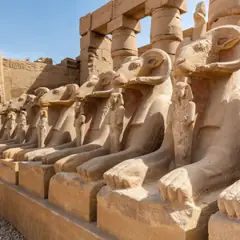
Beyond the granite portal opens the Festival Court, with the solar altar court on the right and, at the back, the rock-cut sanctuary of Amun, open to the public in 2017. The whole temple exists to receive: every year, at the Beautiful Festival of the Valley, the barque of Amun left Karnak, crossed the Nile, climbed a 1-km causeway flanked by more than 100 sandstone sphinxes, the oldest attested avenue of sphinxes, and spent a night here before returning. Many local guides call it the Opet festival, but Opet joined Karnak with Luxor on the east bank. The axis of the temple also points towards Karnak, and it is said that on certain winter dawns the sun links the two sanctuaries, although the dates vary by source.
Almost a thousand years after Hatshepsut, around 300 BC, these chambers became the sanctuary of Amenhotep son of Hapu, later joined by Imhotep. The sick slept here awaiting the visit of the healing god and left some five hundred Greek and Demotic graffiti on the walls; what they asked for and gave thanks for completely changes the reading of the place.
These terraces also hold a recent memory. On 17 November 1997, six armed men entered the temple and killed dozens of people, most of them foreign tourists; the toll ranges between 58 and 62 victims depending on whether the Egyptians are counted. The route recalls them with respect before closing with the view over the other bank of the Nile.