Neoclassical fountain
Plaza de Cibeles Audio Guide
A marble goddess of 1782 presides over Madrid's most famous crossroads: she gave water to the water-carriers, spent the Civil War buried under sandbags and is today the altar where the city celebrates its titles. Around her, four palaces of different eras close the square.
- 20 min of audio
- Neoclassicism of Charles III
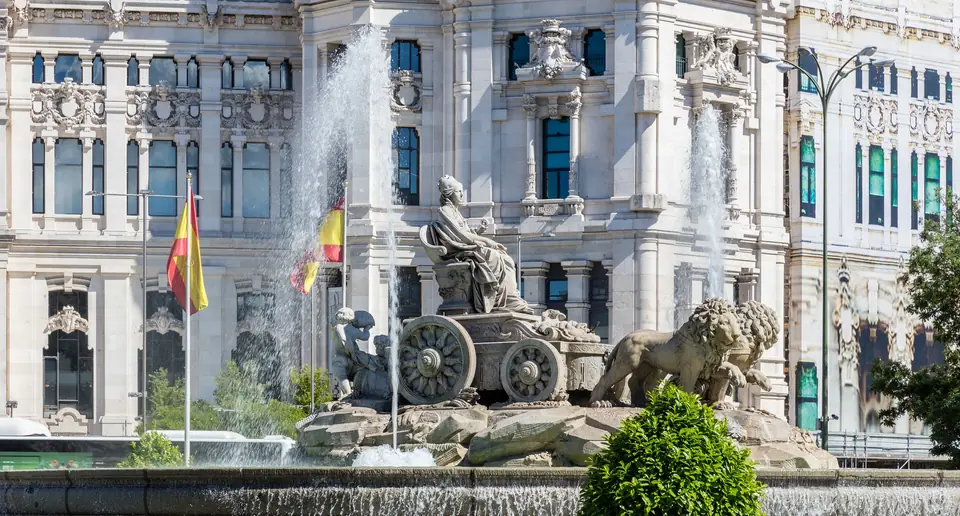
The Cibeles Fountain stems from Charles III's neoclassical embellishment plan: Ventura Rodríguez designed it between 1777 and 1782, Francisco Gutiérrez Arribas sculpted the goddess and the Frenchman Roberto Michel the two lions, in dark Montesclaros marble. It is surrounded by the Palacio de Buenavista (1777), the Bank of Spain (1891), the Palacio de Linares, now Casa de América, and the former Palacio de Comunicaciones, now the City Hall.
Before it was a monument it was a public service: until 1862 its spouts supplied the water-carriers and the neighbours, and the draught animals drank from its basin. In February 1895 it was moved to the centre of the square, during the Civil War it disappeared beneath a mountain of sandbags and around 1988 it became established as a symbol of Real Madrid's victories.
Highlights
- Cibeles Fountain — The goddess of dark marble of 1782 and her two lions, Hippomenes and Atalanta
- Water-carriers and draught animals — The fountain that supplied Madrid with water until 1862, with a stone bear for 50 water-carriers
- Civil War — The goddess buried under sandbags and a brick pyramid
- Palacio de Cibeles — The “Our Lady of Communications” of 1919, now City Hall, with a viewpoint
- Real Madrid celebrations — From the football parties of 1962 to Raúl's crane
Plaza de Cibeles is the great crossroads of Madrid: the point where Calle de Alcalá meets the axis of the Prado and Recoletos, and where the districts of Centro, Retiro and Salamanca now touch. At its centre, the fountain of the goddess Cybele stems from Charles III’s neoclassical embellishment plan; the architect Ventura Rodríguez carried out the project between 1777 and 1782. There is also a version according to which the fountain was originally intended for the gardens of La Granja de San Ildefonso, in Segovia, although no document has confirmed it. The square was not always called this: first it was “Plaza de Madrid”, in 1900 the City Council renamed it “Plaza de Castelar” and only afterwards did it take the name of the goddess.
The history of Plaza de Cibeles is that of a fountain that changed its job several times. It was a neighbourhood service, with spouts for the water-carriers and for the public; its water was reputed, according to tradition, to cure any ailment, and when in 1895 the goddess was left isolated in the centre of the roundabout Madrilenians kept filling pitchers at a small fountain beside Correos, a custom that even inspired a popular song. It was a war shelter between 1936 and 1939. And since the late 1980s it has been the stage where Real Madrid celebrates its titles, a role the square had already played before with another club. In June 1986, after Emilio Butragueño’s four goals against Denmark at the World Cup in Mexico and a few days before a general election, hundreds of fans gathered here chanting that the striker deserved to go to La Moncloa.
The architecture of Plaza de Cibeles reads like an amphitheatre with four corners: the Palacio de Buenavista, of 1777, the oldest; the Bank of Spain, inaugurated in 1891; the Palacio de Linares, commissioned in 1877 by the Marquis of Linares and now Casa de América; and the white bulk of the former Palacio de Comunicaciones, by Antonio Palacios and Joaquín Otamendi. In the goddess’s turreted crown, moreover, hide a frog and a snake that almost nobody gets to see. What to see in Plaza de Cibeles is arranged in five stops that go round the roundabout from corner to corner, and each tells a different life of the same fountain; the full experience is better understood by walking it with the audio guide.
Down the avenue, about 600 metres away, waits the Prado Museum, with Retiro Park behind it; along Calle de Alcalá, a kilometre away, you reach the Puerta del Sol.
The goddess who faces Calle de Alcalá
Cibeles Fountain
Summary of this stop
From the corner of the Bank of Spain the fountain is seen head-on. The goddess Cybele sits in a chariot set on a rock in the middle of the basin, with sceptre, key and a crown in the shape of a wall, and looks towards the first stretch of Calle de Alcalá. Francisco Gutiérrez Arribas sculpted the figure and the wheels of the chariot; the Frenchman Roberto Michel, the two lions that pull it. Goddess and lions are of dark Montesclaros marble, in Toledo, and the rest of the ensemble of Redueña stone. The lions are not mere decoration: they represent Hippomenes and Atalanta, turned into beasts by Zeus and condemned to draw the goddess’s chariot.
Around it, four buildings of different eras close the square: the Palacio de Buenavista of 1777, the Bank of Spain inaugurated in 1891, the Palacio de Linares that the Marquis of Linares commissioned in 1877 and the former Palacio de Comunicaciones. Just behind this point, beneath the Bank of Spain, lies the Gold Chamber, built from 1932 at a depth that the figures in circulation put between 28 and 48 metres.
Over that chamber hangs Madrid’s most repeated legend: if the alarms went off, the water of the Cibeles would flood the chamber and drown the thieves. Other versions speak of a conduit connected to the fountain and to the Las Pascualas stream, and some maintain that the only thing that could flood is the access pit, not the chamber. What is true about the goddess as guardian of the gold is revealed by listening to the narration on that same corner.
Water-carriers, a bear and a moved fountain
Palacio de Buenavista
Summary of this stop
Beside the railing of the Palacio de Buenavista, on the north-west corner, the fountain stood for more than a century: at the entrance to the Paseo de Recoletos, without steps and facing Neptune. There it worked as a public service. Until 1862 it had two open spouts, one for the official water-carriers who took water to the houses and another for the public, while the draught animals drank from the basin.
In 1791 Juan de Villanueva added at the sides a dragon and a stone bear, the work of Alfonso Bergaz the younger, which spouted water through bronze pipes; the bear served the 50 water-carriers assigned to the fountain. Today those sides are empty, and the bear is kept in the Museo de los Orígenes.
In February 1895 the fountain was moved to the centre of the square, on a four-step platform that raises it above the roundabout and separates it from the public, and the goddess came to face Calle de Alcalá. What life was like around that basin of water-carriers is told by the narration in front of the palace.
Sandbags, a stolen hand and a ghost
Casa de América
Summary of this stop
In front of Casa de América, the square shows its wounds. During the Civil War, between 1936 and 1939, the Republican side buried the fountain beneath a mountain of sandbags crowned by a pyramidal brick structure, to protect it from bombs and gunfire. The goddess spent the war invisible, turned into a mound in the middle of the square.
Peace did not spare her damage. In 1994 and in 2002 her left hand was torn off: one of the times the original turned up, the other it had to be replaced with a modern hand.
On the other side, the Palacio de Linares has a reputation as a haunted house. According to a Madrid rumour, José de Murga and Raimunda Osorio fell in love without knowing they were half-siblings, obtained from Pius IX a bull to live together in chastity and had a daughter, Raimundita, whose spirit, they say, still sings through the halls. No evidence has been found that they were siblings or that they had offspring, and authors such as Torcuato Luca de Tena in 1990 and Carmen Maceiras Rey in 2009 refuted much of the story. What exactly the legend tells and why it stays alive is revealed by listening to the narration before the palace.
Our Lady of Communications
Palacio de Cibeles
Summary of this stop
On the south-east corner rises the white bulk of the Palacio de Cibeles, the former Palacio de Comunicaciones. The project by Antonio Palacios and Joaquín Otamendi won the competition of 1904, laid its first stone in 1907 and was inaugurated on 14 March 1919 as a central post, telegraph and telephone office, on lands of the former Buen Retiro Gardens. Not all sources agree on those dates or on Otamendi’s first name, but the monograph on the building itself fixes them this way.
Because of its size and its cathedral-like look, Madrilenians nicknamed it “Nuestra Señora de las Comunicaciones”. A century later it changed tenant: at the end of 2007 Madrid City Council moved here from the Casa de la Villa and the Casa de Cisneros. The renovation opened the CentroCentro cultural centre, with the Glass Gallery beneath its glazed vault, and a viewpoint in the central tower, about 40 metres up, open to the public in 2011.
From that viewpoint the square is seen as a circle with the goddess at the centre. What the square reveals seen from above is told by the narration before the façade.
Two fountains for a rivalry
Plaza de Cibeles
Summary of this stop
From the platform of the Paseo del Prado, the square is understood as a stage. Cibeles was first the party spot of Atlético de Madrid: at least since the Cup Winners’ Cup of 1962 its fans celebrated here, because the club’s headquarters was at number 22 Calle del Barquillo. Around 1988, with the Quinta del Buitre winning the League, the fountain became established as a symbol of Real Madrid.
To protect the monument, the City Council banned first the fans and then the players from climbing the fountain. In the 2006/2007 League the captain Raúl reached the goddess from a crane to put a club scarf on her, and in the 2011 Copa del Rey Iker Casillas put a flag and scarf on her and ended up kissing her.
Today each great Madrid triumph is split between two fountains on the same axis: Real Madrid celebrates at Cibeles and Atlético at Neptune, a few hundred metres further south, where the red-and-whites moved their celebrations from 1991. Why they moved and how Madrid divided up its gods is revealed by listening to the narration on the platform.