Egyptian temple
Temple of Debod Audio Guide (Templo de Debod)
A Nubian shrine some 2,200 years old that spent half a century under the waters of the Nile, travelled to Madrid in 1,350 crates and was reassembled stone by stone on the site of the Montaña Barracks. It still faces west, as it did on the banks of the river.
- 25 min of audio
- Nubian temple in Madrid
The Temple of Debod was born in the early 2nd century BC, when the Nubian king Adikhalamani of Meroe built a chapel with reliefs dedicated to Amun and Isis at Debod, on the banks of the Nile some 15 km south of Aswan. The Ptolemies extended it on all four sides to about 12 by 15 metres and consecrated it to Isis of Philae, and the emperors Augustus and Tiberius completed the work and decorated the pronaos. Taken down in 1961 because of the Aswan Dam, it was given by Egypt to Spain in 1968 and the City Council inaugurated it in Madrid in July 1972.
What stands in the park today is a puzzle solved almost blind: Martín Almagro Basch's team reassembled some 2,300 pieces with only a plan, a sketch and a few photos, with more than a hundred blocks that had lost their numbering. The lost parts were completed with Villamayor stone, of a different colour, so that the new is not confused with the original, and the three stone gateways ended up in a different order from the one they had in Nubia.
Highlights
- Gateways over the pond — Two pylons and the temple gate aligned east to west over water that evokes the Nile
- Hypostyle façade — The front of columns that fell in 1868 and was raised again in Madrid with two-coloured stone
- Chapel of Adikhalamani — The 2nd-century BC core with reliefs of the Nubian king before Amun and Isis
- Upper terrace — The lintel with the northernmost known mention of Apedemak, the lion god of Meroe, and the model of Nubia
- Montaña Barracks monument — Joaquín Vaquero Turcios's bronze recalling July 1936
The Temple of Debod is a Nubian shrine some 2,200 years old that stands in Madrid, at the top of the park that occupies the former site of the Montaña Barracks. Its core was begun in the early 2nd century BC by King Adikhalamani of Meroe, a chapel decorated with reliefs and dedicated to Amun and Isis in the town of Debod, on the banks of the Nile some 15 km south of Aswan. That is the usual attribution; one hypothesis assigns the first shrine to Ptolemy IV Philopator, with the later decoration by the Nubian king. Under Ptolemy VI, Ptolemy VIII and Ptolemy XII the temple grew on all four sides until it measured about 12 by 15 metres and was dedicated to Isis of Philae, and the Roman emperors Augustus and Tiberius completed the extension and decorated the pronaos.
The history of the Temple of Debod is that of a survivor. After it ceased to function as a temple in the 6th century, it was used by nomads, Christians and Muslims, and signed by 19th-century travellers. From 1907, with the first Aswan Dam, it spent about nine months a year under the waters of the Nile. In 1961 it was taken down and stored on Elephantine Island, and in 1968 Egypt gave it to Spain in return for its help in the UNESCO campaign to save the temples of Nubia, to which Spain contributed half a million dollars for Abu Simbel and Philae. It is often pointed out that the friendship between Francisco Franco and Gamal Abdel Nasser was key to the grant. The other three temples given by Egypt were Dendur, now in New York, Ellesiya, in Turin, and Taffeh, in Leiden. Mayor Carlos Arias Navarro inaugurated it in Madrid on 20 July 1972, although some sources give 18 July.
The architecture of the Temple of Debod reads like a reconstruction file: an anastylosis on a stone podium that isolates the blocks from the ground, with worn ancient ashlars beside new blocks of Villamayor stone (Salamanca), of a different colour. Inside wait the chapel of Adikhalamani, the naos room with the only surviving naos and a Roman-period side room that breaks the symmetry of the plan; it was identified in 1991 as a mammisi, the birth room of the divine child, although later research points to another use and it keeps the name by custom. Once in Madrid, the temple served for summer film screenings and theatre performances, a use that, together with pollution, climate and vandalism, left deep marks on the stone. The donation required that it not be left exposed to the weather, and whether to cover it or not is still debated: in 2002 an underground museum was considered, in 2020 Zahi Hawass asked for it to be covered and the municipal plenary agreed to speed up the covering, while the later Conservation Plan rated its condition as adequate and the temple remains in the open air.
What to see in the Temple of Debod is arranged in six stops, from the monument of the former barracks to the gateways over the pond, the façade of columns, the chapels in half-light, the terrace with the model of Nubia and the sunset viewpoint. Each two-coloured stone tells a double journey, from the Nile to Madrid, and that story is better followed by walking the temple with the audio guide.
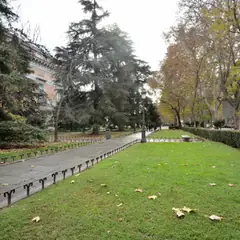
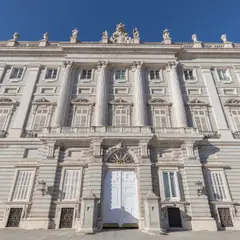
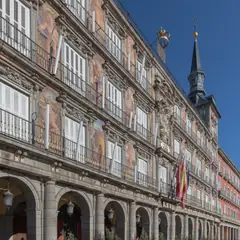
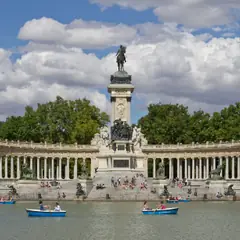
About 750 metres to the south, on the same cornice of the Manzanares, stands the Royal Palace of Madrid, and a little further on, a little over a kilometre away, Plaza Mayor.
An Egyptian temple above the Montaña Barracks
Monument to the Fallen at the Montaña Barracks
Summary of this stop
Before the temple, the hill had another memory. At this point in the park stands a bronze figure of a mutilated man before a wall of sandbags, by Joaquín Vaquero Turcios, recalling the Montaña Barracks. The barracks were built between 1860 and 1863 on the Príncipe Pío hill, the very place where Napoleon’s troops shot the insurgents of 2 May 1808.
In July 1936 General Joaquín Fanjul barricaded himself in the barracks, which were left practically destroyed. Accounts of the episode say the shelling began at dawn on 20 July, directed by artillery lieutenant Orad de la Torre, and that when the militiamen entered most of the rebels were killed, especially the officer cadets: ninety out of some hundred and forty. Between 500 and 900 deaths were counted. Fanjul was captured along with his son, tried on 15 August for military rebellion and shot that same month.
The garden of the Nile stones thus rests on two episodes of death, 1808 and 1936. How an Egyptian shrine came to live alongside this memory is revealed by listening to the narration beside the bronze.
Three gateways still facing west
Stone Gateways over the Pond
Summary of this stop
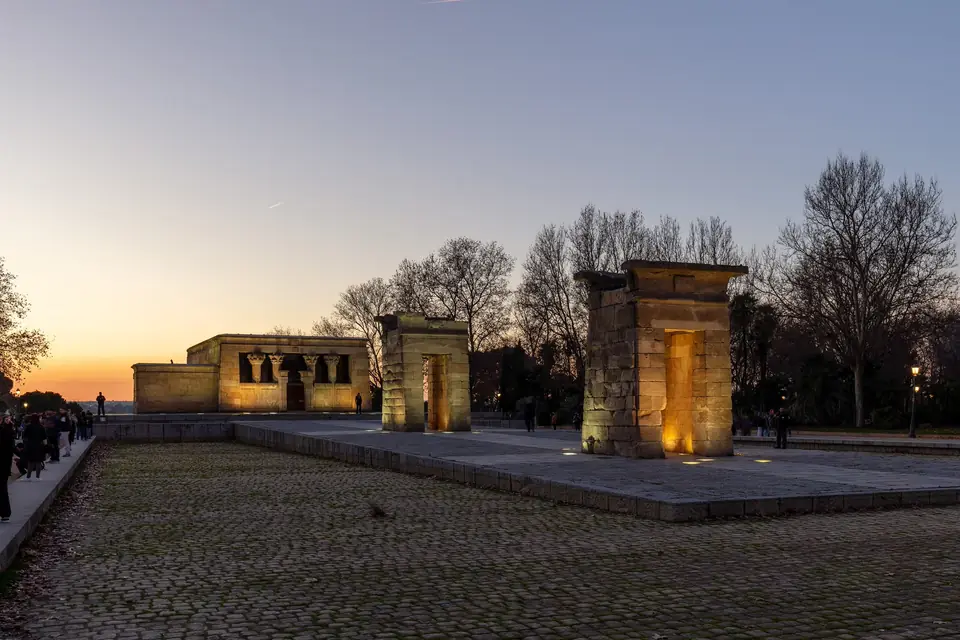
At the eastern head of the pond, two free-standing pylons and the temple gate line up over shallow water that evokes the Nile; one of the gates bears the winged sun disc with serpents. The reconstruction kept the east-to-west orientation the temple had in Nubia, so the building still faces where it faced above the river.
That respect for the axis coexists with a licence: the three stone gateways were reassembled in Madrid in a different order from the one they had in Nubia. It is not strange, given the starting point. Martín Almagro Basch’s team reassembled a puzzle of 2,300 pieces with only a plan, a sketch and a few photos; more than a hundred blocks had lost their numbering and many fragments bore marks that did not match the plan.
What changed place and what was kept to the millimetre, and how a puzzle without all its instructions was solved, is told by the narration before the pond.
The façade that a looting made disappear
Temple of Debod
Summary of this stop
Facing the temple rises the hypostyle façade, the front of columns of the pronaos, now closed with a large glass window. It was the last great piece of the ancient building: the emperors Augustus and Tiberius completed the extension begun by Ptolemy VI, Ptolemy VIII and Ptolemy XII, and decorated this four-column pronaos.
The pronaos collapsed in 1868 and, according to a documented tradition, it was not the work of an earthquake alone: after the collapse its ashlars were stolen, and that is why most of that front had disappeared when the temple was taken down. In Madrid, the anastylosis raised the façade again, lost since the 19th century, completing what was missing with stone of another colour brought from Villamayor, in Salamanca.
The result can be read at a glance: worn ancient ashlars beside new blocks that mark what was replaced. How much of this front is original and how much is reconstruction is clarified by listening to the narration in front of the window.
The Nubian king whom the Nile left without colour
Chapel of Adikhalamani
Summary of this stop
In the half-light of the interior appears the oldest core of the temple, the chapel of Adikhalamani or of the reliefs. Here the Nubian king of Meroe is shown making offerings to Amun, Isis and other gods, in the chapel he began in the early 2nd century BC at Debod, some 15 km south of Aswan.
The reliefs have lost their polychromy. Since 1907, with the first Aswan Dam, the temple spent about nine months a year under the waters of the Nile, which erased the colour and damaged part of the carving. On the walls there also remained another layer of history: more than two hundred graffiti, with caravans of dromedaries, a gazelle, a rowing boat, Coptic crosses, Greek, Coptic and Arabic inscriptions and some thirty signatures of 19th-century travellers.
They are the trace of nomads, Christians and Muslims who used the building after it ceased to be a temple in the 6th century. What each layer of scratches says about those who passed through here is revealed by listening to the narration inside the chapel.
The lion god and the journey in crates
Terrace with the Model of Nubia
Summary of this stop
On the upper terrace, a small museum gathers column fragments, a stela with lion and uraeus and a large model of Lower Nubia that places the landscape lost beneath the waters. Also displayed there is the access lintel to the chapel of Adikhalamani, which calls the king “beloved of Apedemak”, the lion god of Meroe: it is the northernmost known mention of this god.
The terrace is also the place to understand the rescue. In 1968 Egypt gave the temple to Spain for its help in the UNESCO campaign to save the temples of Nubia. Taken down in 1961 and stored on Elephantine Island, it left in crates for Alexandria in April 1970; on 6 June it was loaded onto the ship Benisa and on 18 June it reached the port of Valencia. From there some 90 lorries brought the 1,350 crates with the stones to Madrid, a transport of about ten million pesetas that the Madrid City Council paid in full.
Where Debod stood on the model and why the lion god matters so much so far north is told by the narration on the terrace.
The sunset that brings Madrid together
Temple of Debod Viewpoint
Summary of this stop
The route ends at the western viewpoint of the esplanade. The temple that was inaugurated in Madrid on 20 July 1972, according to the most cited date, after two years of reconstruction work, still faces west, and every evening the esplanade and the gardens fill with Madrilenians and tourists who come to watch the sunset. The places beside the pond fill early, especially at weekends.
When there is no wind, the pond acts as a mirror and the temple appears doubled in the water. Those who know it well place the best of the evening in the twenty or thirty minutes after dusk, with the sky purple and the temple already lit, when a good part of the crowd has left. Why a temple conceived for the sun of the Nile fits so well on Madrid’s horizon is revealed by listening to the narration at the viewpoint.