Kilometre zero of Spain
Puerta del Sol Audio Guide
It began as a modest gate in the 15th-century wall and is today the square from which Spain's roads are measured and the year is seen out. Beneath its clock, Madrid has celebrated a republic, camped by the thousands and suffered police charges and cells.
- 20 min of audio
- New Year's Eve chimes
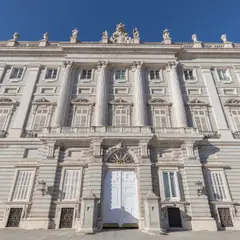
The Puerta del Sol was in the 15th century one of the gates of the wall that surrounded Madrid, and owes its name to a sun that adorned the entrance, which faced east. Its oldest building is the Real Casa de Correos, built by the French architect Jaime Marquet between 1766 and 1768; the semicircle of uniform façades that closes it arrived between 1857 and 1862, when Lucio del Valle, Juan de Ribera and José Morer remodelled a square that until then occupied half of today's space.
The façade that appears on every Spanish television each New Year's Eve has a less festive past. It was the Ministry of the Interior from 1847 and, after the Civil War, the seat of the Directorate-General of Security, whose cellars served as cells where opponents of Franco's regime were detained and tortured. Above those cellars Losada's clock strikes the twelve chimes, televised since 1962.
Highlights
- Kilometre Zero — The slab that marks the origin of Spain's radial roads
- Real Casa de Correos — The oldest building on the square, built between 1766 and 1768
- Puerta del Sol clock — Inaugurated in 1866, its chimes have been televised since 1962
- The Bear and the Strawberry Tree — Some 20 tonnes of sculpture that have changed place three times
- La Mariblanca — A copy of the figure that crowned the square's fountain from 1630 to 1838
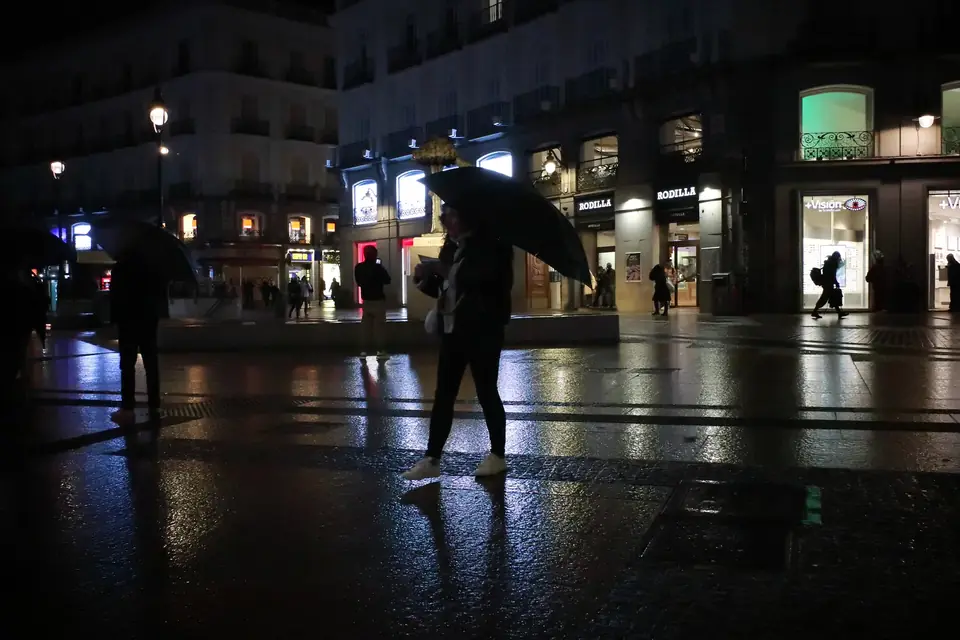
The Puerta del Sol began as little: in the 15th century it was one of the gates of the wall that surrounded Madrid, and its name comes from a sun that adorned the entrance, which faced east. Since the Golden Age, the steps of San Felipe made it one of the town’s most famous gossip spots, the place where news, rumours and slander crossed. Today it is a completely pedestrian square, since 20 August 2020, from which ten streets radiate, among them Alcalá, Carrera de San Jerónimo, Mayor, Arenal, Preciados and Montera, and from which Spain measures its roads.
The history of the Puerta del Sol is also the political history of Madrid. On its ground takes place Goya’s “The Charge of the Mamelukes”, which recalls the uprising of 2 May 1808 against the Napoleonic invasion. On 10 April 1865, in the so-called Night of San Daniel, a serenade of students, workers and democrats ended, according to documented tradition, in a charge by the Civil Guard that left 14 dead and 193 wounded. On 14 April 1931 the crowd celebrating the Second Republic filled the square up to the roofs of trams and kiosks. And on 15 May 2011 dozens of protesters camped here; a week later they were thousands. There is also an episode whose version is still disputed: on 12 November 1912 the President of the Council of Ministers José Canalejas was shot dead by the anarchist Manuel Pardiñas while looking at the window of the San Martín bookshop, at present number 6; the official version spoke of the assailant’s suicide, and some later investigations maintain that his wounds do not fit that explanation.
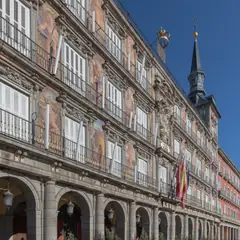
The architecture of the Puerta del Sol is arranged around a contrast. To the south, the Real Casa de Correos, of brick and stone with a central balcony, the work of Jaime Marquet between 1766 and 1768 and the oldest building on the square. Opposite, the semicircle of dwellings with identical façades built by Lucio del Valle, Juan de Ribera and José Morer between 1857 and 1862, after demolishing the convents of San Felipe and Nuestra Señora de las Victorias. Above number 11, the former Hotel París, shines the illuminated Tío Pepe sign, present on the square since 1920 and put back there in 2014; at the ends, the remodelling begun in March 2022 grouped the kiosks into glass pavilions.
What to see in the Puerta del Sol fits into a circular walk of six stops: the kilometre zero slab, the Correos façade, the Bear and the Strawberry Tree, the Mariblanca, Charles III on horseback and, to close, the clock of the grapes. Each keeps a story that is not on the postcards, and Spain’s most trodden square is understood differently when walked with the audio guide.
About 350 metres away opens Plaza Mayor, and down Calle de Alcalá, a kilometre away, Plaza de Cibeles.
The slab where all the roads begin
Kilometre Zero
Summary of this stop
In front of the central door of the Real Casa de Correos, on the pavement, a slab marks kilometre zero: the origin of Spain’s radial roads. The decision to fix that point before the Casa de Correos is dated to 1856 or 1857, depending on the source. The present plaque derives from the one of 1950, which was replaced in 2009, and in the works of 2022-2023 it was surrounded by a compass rose with the names of all the provincial capitals.
The contrast is that of the whole square: the centre from which a country is measured was, at the start, a modest gate of the 15th-century wall. Behind the slab rises the oldest building on the Puerta del Sol, Jaime Marquet’s Real Casa de Correos, finished in 1768 and seat of the Presidency of the Community of Madrid since 19 December 1985.
Why a secondary gate ended up as the starting point of all roads is revealed by listening to the narration beside the slab, among those who stop to step on it for the photo.
A festive balcony above some cells
Real Casa de Correos
Summary of this stop
On the corner of Correos with Calle de Carretas, the façade concentrates two centuries of political life. Seat of the Ministry of the Interior since 1847, its balcony saw the republican flag flutter on 14 April 1931, while Miguel Maura pushed through the crowd to the door. After the Civil War the building passed to the Directorate-General of Security, and its cellars were cells where opponents of Franco’s regime were detained and tortured. On 20 October 2025 it was declared a Place of Democratic Memory, a decision that pits the central Government against the Community of Madrid and that the National Court suspended as a precaution in May 2026.
On the façade the plaques are spread out: one honours the Madrilenians who rose against the Napoleonic invasion on 2 May 1808, another recalls the victims of the attacks of 11 March 2004 and a third tribute is dedicated to those who died of COVID-19.
Beneath these same windows the Night of San Daniel took place. According to documented tradition, Narváez’s Government had dismissed the rector Juan Manuel Montalbán for refusing to remove Emilio Castelar from his chair, author of the article “El rasgo” against the queen; on 10 April 1865 the serenade called in the square was dispersed with gunfire and fixed bayonets, and the order is attributed to the Minister of the Interior, Luis González Bravo, whose office was in this building. What that night foretold for the reign of Isabella II is told by the narration in front of the façade.
The bear born of a lawsuit
Statue of the Bear and the Strawberry Tree
Summary of this stop
At the eastern end of the line of benches of the north arc stands the symbol of the city: the statue of the Bear and the Strawberry Tree, by Antonio Navarro Santafé. Placed on 10 January 1967, it weighs about 20 tonnes and is 4 metres tall; the bear leans on the tree and points its muzzle at one of its fruits. The sculptor took as a model a brown bear from the Casa de Fieras of the Retiro.
For something so heavy, the statue has travelled quite a bit: it changed place within the square in 1986, in 2009 and in April 2023. And its posture, according to a documented local custom, keeps the memory of an old lawsuit between the Council of Madrid and the chapter of priests of the town over the pastures and trees of the Madrid lands. Tradition adds an anatomical detail that few notice in the figure.
How that dispute ended, and why the bear standing on its hind legs against the tree on the town’s coat of arms depends on its settlement, is revealed by listening to the narration before the statue.
The Mariblanca and the square that vanished
Statue of the Mariblanca
Summary of this stop
At the western end of the north arc, a small white marble female figure recalls the old fountain of the square. It is a copy: the original Mariblanca crowned the fountain of the Puerta del Sol between 1630 and 1838, then wandered through the Descalzas, the Retiro and Recoletos, where it was smashed in 1984, and today is kept in the Casa de la Villa. The copy has been in the square since the mid-1980s.
It is not even known for certain whom it represents. Chroniclers and historians dispute whether it is Diana, Venus or an allegory of Faith; the popular name alludes only to the colour of the marble.
The figure is, above all, a remnant of the previous square, half the size of the present one. There stood the convent of San Felipe, whose steps were a gossip spot since the Golden Age and which was demolished around 1840, after Mendizábal’s disentailment laws, and that of Nuestra Señora de las Victorias. On their site, between 1857 and 1862, the semicircle of uniform façades was laid out. What that Puerta del Sol of convents and rumours was like is reconstructed by the narration beside the Mariblanca.
Charles III, the square that votes and camps
Equestrian Statue of Charles III
Summary of this stop
In the centre of the oval fountain stands Charles III on horseback: a bronze reproduction of the work by Juan Pascual de Mena, placed in 1994, reaching nine metres with the pedestal. A spiral inscription runs around the base summarising his reign. The oval fountain is recent: the remodelling begun in March 2022 replaced the two previous fountains with this one.
What is unusual about the monument is how it came here: its location was chosen in a referendum held in the square itself. It fits a space that has been completely pedestrian since 20 August 2020 and that in 2011 was taken over by citizens. On 15 May, after a Democracia Real Ya demonstration, dozens of protesters camped in the Puerta del Sol; within a week they were thousands, and the square became the symbol of the 15-M Movement until the police evicted the last campers on 2 August.
What was decided in that vote and how the square lived through those months of camping is told by the narration facing the fountain.
Twelve chimes for a whole country
Puerta del Sol Clock
Summary of this stop
The route ends looking upwards, at the turret that crowns the Casa de Correos. Its clock, inaugurated by Isabella II on 19 November 1866, is attributed to the León-born clockmaker based in London José Rodríguez Losada, who donated the mechanism to the City Council; the attribution is well established, although some authors dispute it. Nor is it true, as is often repeated, that it was inaugurated on the queen’s birthday: the date commemorated her first proclamation. The pendulum measures 3 metres.
The New Year’s Eve chimes have been televised since 1962, and about 28 seconds before midnight the ball descends from the turret. On New Year’s Eve 2018-2019 the clock for the first time delayed its hands by an hour to strike the chimes for the Canary Islands as well. According to documented tradition, neither this clock nor its predecessors always had a good reputation: Madrilenians dedicated a satirical verse to its failures in the early days, and on New Year’s Eve 1989 a confusion between quarters and chimes in the broadcast left millions of Spaniards with the grapes in their hands.
The origin of the twelve grapes is disputed. One explanation places it in December 1882, as a mockery by a group of Madrilenians of a custom of well-off families; another attributes it to Alicante farmers in 1909. What is certain is that the Madrid press was already speaking of the custom in 1894. Which theory is more convincing, and why a whole country keeps holding its breath before this clock, is revealed by listening to the narration beneath the tower.