Habsburg Madrid
Plaza Mayor Audio Guide
Beneath 237 identical balconies, Madrid's Plaza Mayor was the town's pantry, bullring, Inquisition court and scaffold. Three fires rebuilt it, and a bronze horse kept for centuries a secret made of birds' bones.
- 25 min of audio
- Arcaded square of 1619
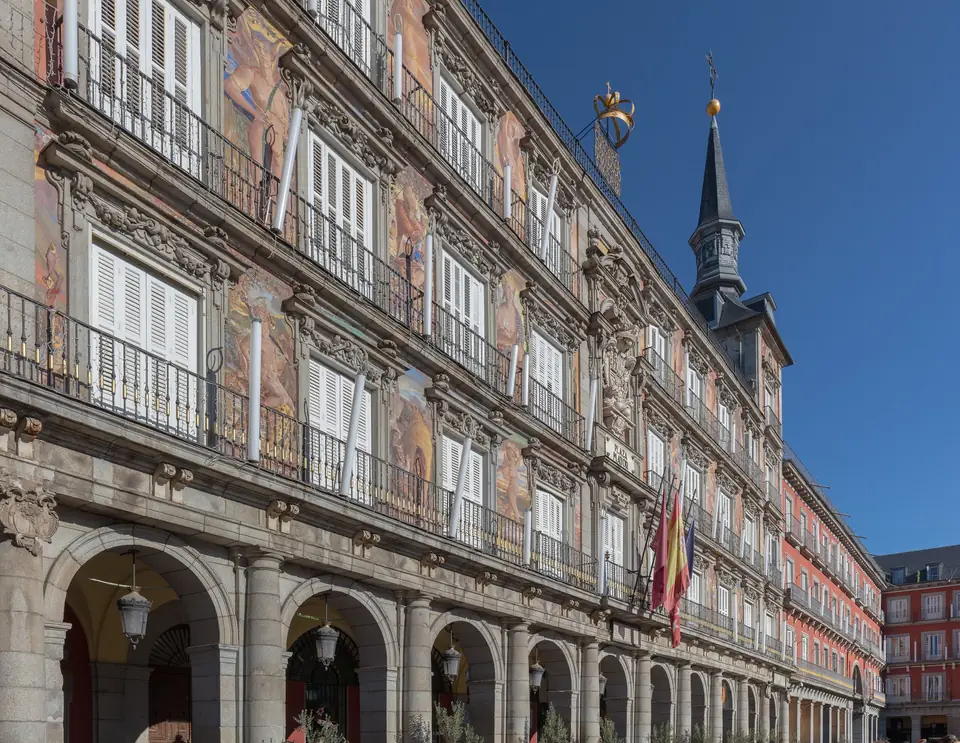
The square grew on the old Arrabal square, the town's main market, at the crossing of the roads to Toledo and Atocha and just outside the medieval wall. After a first project by Juan de Herrera under Philip II, Philip III commissioned Juan Gómez de Mora in 1617 to finish it, and it was completed in 1619: an arcaded rectangle closed off by dwellings whose façades all face inwards.
Its order is the scar of three fires. The one of 1631 burned for three days; that of 1672 took the Casa de la Panadería, and that of 1790 razed a third of the square. Juan de Villanueva then lowered it from five storeys to three and closed its corners with great arches, a work his pupils did not finish until 1854.
Highlights
- Casa de la Panadería — The bakehouse that set the price of bread, rebuilt after the fire of 1672
- Statue of Philip III — Florentine bronze by Giambologna and Pietro Tacca with birds' bones inside
- Casa de la Carnicería — In front of it stood the scaffold of the knife or the axe
- Arco de Cuchilleros — Villanueva's great arch that bridges the drop to the Cava de San Miguel
- 237 balconies — The three uniform storeys left by the rebuilding after the fire of 1790
The Plaza Mayor is the great arcaded square of Habsburg Madrid, and before it was a square it was a market. It occupies the site of the old Arrabal square, the town’s main market, built at the crossing of the roads to Toledo and Atocha, just outside the medieval wall that ran along the Cava de San Miguel. Philip II already had a first project by Juan de Herrera; in 1617 Philip III commissioned Juan Gómez de Mora to finish the square, which was completed in 1619. When the work truly began is still debated: some sources place it between 1580 and 1619, with the Casa de la Panadería under way from 1590, and others maintain that construction did not start until 1617 with Gómez de Mora.
The history of Plaza Mayor can be followed in its names, which changed in step with the history of Spain: Arrabal square, Plaza de la Constitución in 1812, Plaza Real in 1814, Plaza de la República in 1873 and again Plaza Mayor since the end of the Civil War. Under those signs the square was the town’s pantry, a festival ring that kings watched from their balcony, the stage of the Inquisition’s autos-da-fé and a scaffold for public executions. And it burned three times: in 1631, in 1672 and in 1790.
The architecture of Plaza Mayor is the one that last fire left. Juan de Villanueva lowered the buildings from five storeys to three, closed the corners with great arches and chose stone over wood. The result is an arcaded rectangle of 120.9 by 93.06 metres according to one measurement, 434 by 334 Castilian feet (another source gives 129 by 94 metres), with arcades of granite pillars and 237 balconies that all face inwards. The entrances are counted in different ways, between ten gateways and nine arches, and they connect with the streets 7 de Julio, Felipe III, Sal, Gerona, Toledo and Ciudad Rodrigo.
What to see in Plaza Mayor is arranged in five stops, from the Casa de la Panadería to the Arco de Cuchilleros, passing the equestrian statue of Philip III and the Casa de la Carnicería. Each tells one of its lives, from the price of bread to the stake, and the square so orderly that is seen today from the café terraces is understood differently when walked with the audio guide as far as the exit by Cuchilleros.
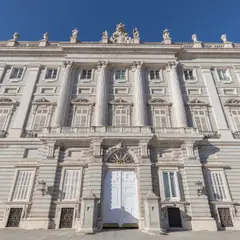
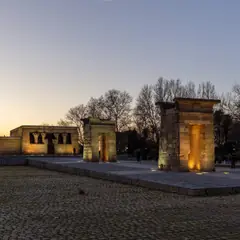
About 350 metres away lies the Puerta del Sol; to the west, the Royal Palace of Madrid is about 650 metres away, and a little further on, a little over a kilometre, the Temple of Debod.
The Bakehouse that set the price of bread
Casa de la Panadería
Summary of this stop
In the centre of the north side rises the Casa de la Panadería, framed by two towers with spires. It was built by Diego Sillero around 1590 and housed the town’s Main Bakehouse, the one that set the price of bread in the great market that had given rise to the square. Today its ground floor houses the Madrid Tourism Centre.
The building changed its trade several times. Between 1745 and 1774 it was the seat of the Royal Academy of Fine Arts of San Fernando, and from 1774 to 1871 of the Royal Academy of History. From bread to academics, the house sums up the passage of the square from marketplace to the city’s showcase.
The market, in a way, never left: every December since 1860 the Christmas market returns, and on Sunday and holiday mornings the philately and numismatics stalls fill the arcades. What the painted façade of a bakehouse that decided how much it cost to eat in Madrid hides is revealed by listening to the narration in front of the Panadería.
A votive flame and a balcony for kings
Plaques and Coat of Arms of the Casa de la Panadería
Summary of this stop
The façade of the Panadería reads like a document. Some plaques recall the construction of the square in 1619 and the rebuilding of the building after the fire of 2 August 1672, a date that some sources move back to 1670 but that the plaque itself fixes at 1672. That fire razed the house, and Tomás Román rebuilt it in seventeen months, until 1674, adding the two towers with spires and a royal balcony from which the kings watched the shows in the square.
According to a documented tradition, the fire did not start in an oven or a kitchen, but in the flame of a small lamp that lit a painting of Our Lady of the Rosary beside the building. No deaths are known, but only the ground floor and the cellar were saved; the plaque dismisses it with a laconic “having burned… it was rebuilt from the foundations”.
Higher up, Charles II’s stone coat of arms brings together the arms of Castile, León, Aragon, Sicily, Austria, Burgundy and Granada, and lacks Portugal, recognised as independent in 1668. The murals covering the façade are much more recent: Carlos Franco painted them in 1992, after winning a municipal competition in 1988, with mythological figures such as Cybele, Proserpina, Bacchus and Cupid, replacing those by Enrique Guijo of 1914. What the coat of arms, the plaque and the balcony tell together is unveiled by the narration beneath the façade.
Birds’ bones inside the royal horse
Statue of Philip III
Summary of this stop
In the centre of the square stands the equestrian statue of Philip III: the king bareheaded and in half armour, the Golden Fleece on his chest and the horse with its left foreleg raised. It is a bronze cast in Florence in 1616 by Giambologna and Pietro Tacca, a gift from Cosimo II de’ Medici, and it was not born for this place. It spent more than two centuries in the Casa de Campo until, on 22 March 1848, Isabella II had it moved here on the proposal of Ramón de Mesonero Romanos; the inscription on the pedestal records the date.
The horse kept a secret. In April 1931 an explosive put in through its mouth burst the statue and exposed numerous tiny bones of sparrows and swallows that had been trapped inside for centuries. After the repair the horse’s mouth was sealed.
From the pedestal the whole stage can be taken in: the arcaded rectangle and its 237 balconies, the grandstand from which the town watched everything that was celebrated here. How so many birds ended up inside the bronze is told by the narration before the statue.
Three scaffolds and a mistaken proverb
Casa de la Carnicería
Summary of this stop
Facing the Panadería, on the south side, is the Casa de la Carnicería, the former general meat depot and now a hotel. The square was also a court and a place of executions, and the scaffold moved according to the penalty: before the drapers’ doorway for the garrotte, in front of the Casa de la Panadería for the gallows and before the Casa de la Carnicería for the knife or the axe.
On 30 June 1680 the square hosted a great auto-da-fé before Charles II, in which the Inquisition sentenced 117 people, 21 of them to die at the stake. Francisco Rizi painted it on a canvas now held by the Prado Museum.
According to a documented tradition, on 21 October 1621, with the reign of Philip IV just begun, Don Rodrigo Calderón was executed here, the trusted man of the Duke of Lerma, who had started as his page. After Lerma’s fall he was arrested in Valladolid in 1619, accused of murder and of witchcraft against Queen Margaret, and only confessed to the death of the soldier Francisco de Juaras. As a nobleman he was not hanged but beheaded, yet his composure on the scaffold entered the proverbs: “to be prouder than Don Rodrigo on the gallows”. Why the proverb gets the scaffold wrong is revealed by the narration in front of the Carnicería.
The arch that descends to the old wall
Arco de Cuchilleros
Summary of this stop
On the south-west corner, hidden from the centre by the arcades, opens the Arco de Cuchilleros. Passing through it reveals the great arch and the staircase that descends to the Cava de San Miguel between very tall, sloping façades. It is Villanueva’s work after 1790 and it is so tall because it bridges the steep drop to the old line of the wall; its name comes from the guild of cutlers that supplied the butchers of the square.
Here the three fires can be read. The first, in 1631, caught at night in the oven of a private house, burned for three days, caused thirteen deaths and ruined more than fifty homes; Gómez de Mora rebuilt it, exchanging the lead roofs for tiles. According to a documented tradition, putting out fires here was always a battle without water: in 1631 the water-carriers’ vessels had to be requisitioned. The one of 1790 razed a third of the square, and Villanueva lowered it from five storeys to three and closed the corners with arches, a work his pupils Antonio López Aguado and Custodio Moreno finished in 1854.
That last fire, which tradition describes as lasting nine days, also reached the church of San Miguel de los Octoes. Who directed the firefighting is disputed, since some sources attribute it to Sabatini and others to Villanueva, and it is said that neighbouring buildings were pulled down to make firebreaks. The church was left damaged and was demolished in 1809; on its site stands today the San Miguel Market. A few steps away, under the arcades and in streets like Botoneras, the taverns serve the calamari sandwich, emblem of a city without a sea, and very close by remain open the Posada de la Villa, in operation since 1610, and the Posada del Peine, considered the oldest hotel in Spain. What lesson the fire left in the stone of the square is understood by listening to the narration before going down the steps.