Official residence of the kings
Royal Palace of Madrid Audio Guide (Palacio Real de Madrid)
The largest royal palace in Western Europe is the answer in stone to a night of fire: it was raised after Christmas Eve 1734, when the old Alcázar burned, on the same crag where Madrid began as an Andalusi fortress. With 3,418 rooms, its halls still stage the State.
- 30 min of audio
- Largest royal palace in Western Europe
In the 9th century Emir Muhammad I built a fortress at Magerit, the Arabic name of Madrid, on this crag above the Manzanares to defend Toledo against the Christian advance; from that fortress came the Royal Alcázar of the Habsburgs. After the fire of 1734, Philip V ordered a new palace and works began in 1738 to plans by Filippo Juvara, which Giovanni Battista Sacchetti had to adapt to the site of the old Alcázar. The result covers more than 135,000 m², almost twice Buckingham Palace or Versailles, and it remains the official residence of the kings of Spain, managed by Patrimonio Nacional.
The whole building is a precaution against fire. After seeing the Habsburgs' palace burn for four days, with more than five hundred paintings lost and melted silver gathered in buckets, the new palace was designed entirely in masonry, with vaulted roofs and wood reduced to joinery and roof structures. And its roof soon lost its stone tenants: the series of ninety-four kings that crowned the balustrade was taken down in 1760.
Highlights
- Throne Room — The only room that has never changed function, beneath one of Tiepolo's last vaults
- Hall of Columns — Balls, the Maundy Thursday washing of feet and concerts with the Palatine Stradivarius
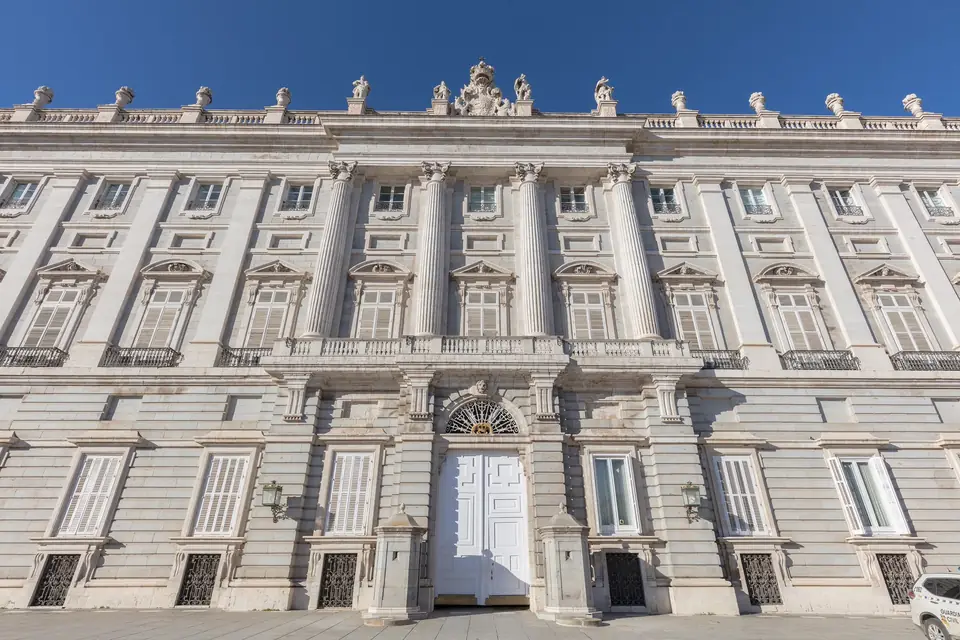
- Plaza de la Armería — The south façade of a palace of stone and vaults designed not to burn
- Sabatini Gardens — The statues of kings that crowned the cornice, now around the pond
- Cornice viewpoint — The crag above the Manzanares where the fortress of Magerit stood
The Royal Palace of Madrid, also known as the Palacio de Oriente, is the largest royal palace in Western Europe: more than 135,000 m² and 3,418 rooms, almost twice Buckingham Palace or Versailles. It overlooks the cornice of the Manzanares, right where Madrid was born. In the 9th century Emir Muhammad I built a fortress here at Magerit, the Arabic name of the city, to defend Toledo against the Christian advance, and that fortress was the seed of the Royal Alcázar in which the Habsburgs lived.
The history of the Royal Palace of Madrid begins with a catastrophe. On Christmas Eve 1734, with the Court at El Pardo, a fire broke out in the Alcázar and lasted four days. Philip V ordered a new palace and works began in 1738 to plans by Filippo Juvara; after his death, Giovanni Battista Sacchetti had to adapt the project to the site of the old Alcázar. Charles III was the first king to live in it continuously, from 1764, and Alfonso XIII the last. In between it was home to Joseph Bonaparte, who according to a documented tradition commissioned Juan de Villanueva to build a passage towards the Palacio de los Vargas, in the Casa de Campo, beneath the Campo del Moro, and to Ferdinand VII, who wanted French-style halls lined with silk. A disputed version holds that the old paintings he removed from the walls, gathered at the urging of his wife Isabel of Braganza, ended up giving rise to the Prado Museum. Around the city there is also a rumour, with no basis beyond popular tradition, of secret tunnels beneath the palace and of a Philip IV who travelled one of them, flooded, by gondola to visit a cloistered novice.
The architecture of the Royal Palace of Madrid is a lesson learned from fire: a building entirely of masonry, with vaulted roofs and wood reduced to a minimum. Inside, Sabatini’s Main Staircase (1760) climbs more than 70 steps between lions by Felipe de Castro and Robert Michel, beneath a vault painted by Corrado Giaquinto. The Royal Armoury keeps the armour Charles V wore at the battle of Mühlberg, dated 1544, and the greyhound armour by Desiderius Helmschmid, the only armour for a dog in the world. Outside, the Royal Guard changes guard on Wednesdays and Saturdays before the Puerta del Príncipe, and on the first Wednesday of each month, except January, August and September, the Solemn Changing of about 50 minutes takes place in the Plaza de la Armería, in the manner of Alfonso XII and Alfonso XIII.
What to see in the Royal Palace of Madrid is arranged in five stops, from the gardens on the north side to the Throne Room, and all of them tell the same story: that of an immense palace raised as a response to a night of fire. That thread is better followed by walking it with the audio guide, researched and fact-checked against historical sources.
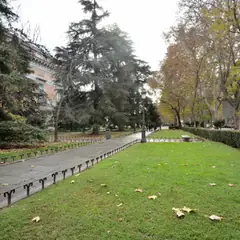
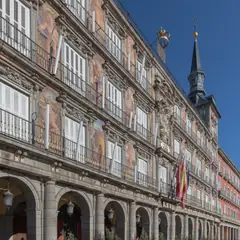
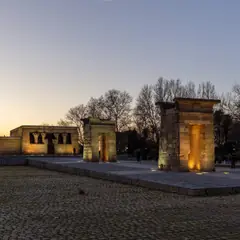
To the north, about 750 metres along the same cornice, stands the Temple of Debod, and to the east, about 650 metres away, Plaza Mayor completes Habsburg Madrid.
Stone kings taken down from the roof
Sabatini Gardens
Summary of this stop
The Sabatini Gardens, in French design and begun in 1933 on the site of the Sabatini stables, occupy the north side of the palace. From their pond the scale of the building reads in reverse, from the bottom up, and around the water stand statues that were not made for a garden: they are kings of Spain carved to crown the palace.
They belong to a series of ninety-four kings sculpted from 1749 under the direction of Juan Domingo Olivieri and Felipe de Castro. Charles III took it down from the balustrade in 1760 and from 1787 the statues were scattered through gardens and parks all over Spain. The documented withdrawal responds to the change of taste towards classicism; some returned to their place after the restoration of 1973, such as those of Moctezuma II and Atahualpa at the corners.
Legend tells it otherwise. According to it, the queen mother Elisabeth Farnese dreamed that those stone kings fell on her and killed her, and her son had them taken down and stored in the cellars. What lies behind that nightmare and where the banished kings of the roof ended up is revealed by listening to the narration beside the pond.
The crag where Madrid was a fortress
Cornice Viewpoint
Summary of this stop
On the balustrade above the Campo del Moro the ground drops suddenly towards the Manzanares, and that drop explains the whole place. Here Emir Muhammad I built the fortress of Magerit in the 9th century to watch the road to Toledo against the Christian advance, and on it the Royal Alcázar later grew.
At the foot of the viewpoint stretch the gardens of the Campo del Moro, whose name is attributed to the troops of Ali ibn Yusuf camping there in 1109 in an attempt to retake Madrid, an episode that has never been proven. Beneath that same slope ran, according to a documented tradition, the passage that Joseph Bonaparte commissioned from Juan de Villanueva, also the author of the Great Grotto of the Campo del Moro.
The crag also weighed on the palace project. Filippo Juvara wanted it larger and on another site, but after his death Giovanni Battista Sacchetti had to fit it onto the site of the old Alcázar. Why the palace ended up on this edge, and not where its first architect dreamed it, is told by the narration facing the void.
The façade that swore never to burn again
Plaza de la Armería
Summary of this stop
The Plaza de la Armería, executed in 1892 on the site of Philip II’s old stables, opens between the palace and the Almudena cathedral. Facing it rises the south façade, with an attic bearing the statues of Philip V, Maria Luisa Gabriella of Savoy, Ferdinand VI and Barbara of Braganza, and in the centre the clock that took the place of the panel of the Sun crossing the Zodiac.
That façade is the consequence of one night. On Christmas Eve 1734 fire caught in the old Alcázar and lasted four days; some silver objects melted and their remains, with precious stones, were gathered in buckets. More than five hundred of the nearly two thousand paintings in the Alcázar were lost, among them Velázquez’s The Expulsion of the Moriscos, while Las Meninas was saved by being unnailed from its frame and thrown out of a window. According to a documented tradition, help was slow to arrive because the alarm bells were confused with those calling people to Mass. The origin of the fire remains uncertain: it is pointed to a room of the Court painter Jean Ranc, without certainty, and some recall that the fire served as a justification for replacing the Alcázar with a palace in Bourbon taste.
The response was a palace entirely of masonry, with vaulted roofs and wood reduced to joinery and roof structures. How that promise against fire can be read in the very stone of the façade is revealed by listening to the narration in the plaza.
The ballroom that signed history
Hall of Columns
Summary of this stop
The Hall of Columns was the palace’s great ballroom and banquet hall until the reign of Isabella II. Every Maundy Thursday it also hosted the Washing of the Feet and a meal for the poor: before grandees of Spain, ministers and diplomats, the king and queen served the food and washed the feet of twenty-five poor people.
The room has never stopped being a stage. Today the Palatine Stradivarius sound in it, in concert, the quartet of two violins, a viola and a cello decorated by Antonio Stradivari that Charles IV acquired in 1775. And the palace, the official residence of the kings although the current monarchs do not live in it, is still used for State ceremonies.
Beneath these same chandeliers, according to a documented tradition, Spain’s accession to the European Economic Community was signed and, on 18 June 2014, the abdication of King Juan Carlos I. What links two such different signatures in the same former ballroom is told by the narration in the centre of the hall.
A throne that saw the country change
Throne Room
Summary of this stop
The Throne Room, conceived by Sacchetti in 1737 and finished in 1772, is the only room in the palace that has never changed function. Crimson velvet embroidered in silver, mirrors and console tables by Giovanni Battista Natali and bronze lions by Matteo Bonarelli surround the throne, and above it unfolds The Greatness and Power of the Spanish Monarchy, one of Giambattista Tiepolo’s last works.
Around that permanence the palace changed hands. Charles III was the first king to live in it continuously, from 1764; his wife Maria Amalia of Saxony, for whom the Queen’s Apartment was prepared, died in 1760 without ever occupying it. Alfonso XIII was the last king to live here, and during the Second Republic (1931-1939) the building was renamed the National Palace and was inhabited by President Manuel Azaña, whose office, beside the Royal Chapel, keeps his name.
A vault that exalts the Monarchy over a room that kings, a Republic and a president passed through: how Tiepolo’s ceiling converses with everything that happened beneath it is revealed by listening to the narration in front of the throne.