World Heritage
Prado Museum Audio Guide (Museo Nacional del Prado)
The Prado was not born for painting: Juan de Villanueva designed it for natural history, Napoleon's soldiers melted its roof into bullets, and it opened almost quietly in 1819 with 311 paintings. Today it holds the world's largest collection of Velázquez and Goya, and it is still full of easels.
- 35 min of audio
- Velázquez and Goya
Charles III commissioned Juan de Villanueva to design a building for the Royal Cabinet of Natural History within the Hill of Sciences, beside the Royal Botanical Garden and the Royal Astronomical Observatory, also his works. After the War of Independence, which left it almost in ruins, it opened on 19 November 1819 as the Royal Museum of Paintings; in 1869 it passed from the Crown to the Nation, and since 1920 it has officially been called the Museo Nacional del Prado, after the old Prado de los Jerónimos meadow on which it stands.
Its history is made of scares. In 1891 a newspaper reported on its front page a fire that had devastated it, and the fire never existed; in 1918 it was discovered that an employee had been plundering the Dauphin's Treasure for months; during the Civil War the masterpieces travelled as far as Geneva and took almost three years to return. Even Pablo Picasso was listed as director between 1936 and 1939 without ever setting foot in the museum.
Highlights
- Velázquez Door — Villanueva's six-column portico and Aniceto Marinas's statue of 1899
- Las Meninas — The 1656 painting that presides over Room 12, and the cross added to it later
- Cloister of the Jerónimos — Taken down stone by stone and rebuilt in Moneo's 2007 extension
- Central Gallery — Large-format works by Titian, Tintoretto and Veronese beneath the vault of the Villanueva building
- Black Paintings — The walls of Goya's Quinta del Sordo, donated to the museum in 1881
The Prado Museum (Museo Nacional del Prado) is a picture gallery that lives in a building designed for something else. Juan de Villanueva designed it on the orders of Charles III for the Royal Cabinet of Natural History, as a piece of the Hill of Sciences completed by the Royal Botanical Garden and the Royal Astronomical Observatory, both also his. The date of origin is disputed: some sources place it in 1785, with the design and the start of works, and others in 1786, when Charles III approved the project. On 19 November 1819 it opened with hardly any ceremony as the Royal Museum of Paintings, with 311 paintings of the Spanish school in just three rooms. Since then it has displayed the collection of the kings of Spain and holds the world’s largest set of works by Velázquez and Goya, of whom it keeps 133 paintings.
The history of the Prado Museum is that of a survivor. After the dethronement of Isabella II in 1868, the Law of 18 December 1869 took it out of the Crown and made it property of the Nation; in 1872 it absorbed the holdings of the Trinity Museum and in 1920 it adopted its official name, Museo Nacional del Prado, after the old Prado de los Jerónimos. In 1881 the banker Frédéric Émile d’Erlanger donated the Black Paintings that Goya had painted on the walls of the Quinta del Sordo, on the banks of the Manzanares, after they had been transferred to canvas. In 1918 it was discovered that the employee Rafael Coba had plundered the Dauphin’s Treasure for months: eleven pieces were lost, another thirty-five were badly damaged and the director, the painter José Villegas Cordero, lost his post. In the Civil War the works were first protected with sandbags on the ground floor and then travelled through Valencia and Catalonia to Geneva, where an exhibition in 1939 drew 400,000 visitors before they returned to Madrid after almost three years away. According to a documented tradition, in September 1936 Manuel Azaña appointed Pablo Picasso director, who accepted the post and is listed as director until 1939, but never travelled to Madrid to exercise it.
The collection also keeps surprises of its own. Since the opening of 1819 it has held a Mona Lisa with a black background that spent centuries passing as an unremarkable copy; when the Louvre asked to borrow it in 2010, analyses revealed a landscape beneath a repainting made after 1750, and the restoration of 2011 and 2012 showed it was painted by a pupil in Leonardo’s workshop, alongside the original. The most likely author is Francesco Melzi, although the Louvre curator Vincent Delieuvin attributes it to Salaì. It is also said that Salvador Dalí and Jean Cocteau were asked in the museum what they would save if it caught fire: Cocteau chose “the fire” and Dalí, “the air of Las Meninas”.
The architecture of the Prado Museum combines two eras: Villanueva’s neoclassical building, with its long façade onto the avenue, and Rafael Moneo’s extension opened in 2007 beside the church of San Jerónimo el Real. Since 2021 the museum has formed part of the Paseo del Prado and Buen Retiro, a landscape of the arts and sciences inscribed on the World Heritage List. What to see in the Prado Museum is arranged in five stops that begin outside, before the statues of Velázquez and Goya, and end inside, between Las Meninas and the easels of the Central Gallery. How close it came to not existing is better understood by walking it with the audio guide.
Behind the museum lies Retiro Park, which shares with it the inscription of the Landscape of Light, and up the avenue, about 600 metres away, Plaza de Cibeles opens the axis of the Paseo del Prado.
Bronze Velázquez before a science cabinet
Velázquez Monument
Summary of this stop
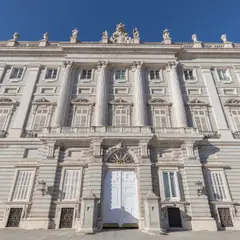
The façade onto the avenue is organised around the Velázquez Door, a great six-column portico that does not end in a triangular pediment but in a rectangular attic with a frieze. On that frieze, sculpted by Ramón Barba from 1831, Ferdinand VII appears as protector of the sciences, the arts and technology, and along the façade are stone medallions of Spanish painters, sculptors and architects. It is the public face of an Enlightenment project: the building Villanueva conceived for natural history.
In front stands the statue of Velázquez, by Aniceto Marinas on a pedestal by Vicente Lampérez, unveiled on 14 June 1899 with a dedication from Spanish artists and the Círculo de Bellas Artes. It came to replace the monument to Daoíz and Velarde, and completes a trio of guardians: Mariano Benlliure’s Goya and Sabino de Medina’s Murillo watch over the other doors.
Portico, frieze and statue tell three different stories separated by more than a century, including the museum’s passage from the Crown to the Nation. How the three fit into a single façade is revealed by listening to the narration in front of the bronze painter.
The roof that was melted into bullets
Statue of Goya
Summary of this stop
Beside the north façade, Mariano Benlliure’s statue of Goya faces an entrance that was left raised when the ground was lowered and forced the building of a stairway in 1882. From here the fragility of the building can be read. During the War of Independence, almost finished, it served as cavalry barracks, was left practically in ruins, and the lead sheets of its roofs were melted down to make bullets.
The war took paintings too. In his flight of 1813, Joseph Bonaparte carried off more than two hundred paintings from the Royal Collection; Wellington’s troops intercepted them after the battle of Vitoria and Ferdinand VII gave them to the duke, including Velázquez’s The Waterseller of Seville, which now hangs in Apsley House in London. In 1891 came another blow, this one made of paper: the journalist Mariano de Cavia published on the front page of El Liberal a fire that had devastated the Prado. It was fictional, but many Madrilenians rushed over in alarm and the news forced urgent improvements in a building with staff living inside and firewood stored for the stoves.
According to a documented tradition, in 1961 a thief tried to get in through the roof, fell into the void and died with a note in his pocket that already set out the terms for returning the paintings he meant to steal. What that ransom, written in advance, said is told by the narration before the statue of Goya.
A cloister taken down stone by stone
Cloister of the Jerónimos
Summary of this stop
Behind the Villanueva building, beside the church of San Jerónimo el Real, rises the volume of Rafael Moneo’s extension. He won the competition of 1998, it was built between 2001 and 2007 and it opened on 30 October 2007, with 15,715 new square metres, 50% more floor space for the museum.
Inside waits a piece that is not Moneo’s: the 16th-century cloister of the Jerónimos, taken down stone by stone and rebuilt within the new building, where it now serves as a sculpture room. The extension did not cover the past, it kept it inside. And the whole ensemble, from the museum to the avenue and the Retiro, has formed part since 2021 of the landscape of the arts and sciences inscribed on the World Heritage List.
Why a Renaissance cloister ended up inside a 21st-century museum is revealed by listening to the narration among its arches.
The cross of Santiago that a king may have painted
Room 12 of Las Meninas
Summary of this stop
On the upper floor of the central block, a room with a basilican plan and an apse, Room 12, is presided over by Las Meninas, painted by Velázquez in 1656. Beneath that same space, Moneo’s renovation placed the Room of the Muses, with the sculptures that belonged to Christina of Sweden: two superimposed floors, painting above and marble below.
Velázquez portrayed himself in the canvas, and on his chest shines the red cross of the Order of Santiago. That cross postdates the painting: the painter was not admitted as a knight until 1659. As early as 1724 Palomino recorded that, according to some, Philip IV himself painted it, and tradition even says the king did so after Velázquez’s death in 1660, although no official proof supports it and the story remains disputed.
Who may have given that brushstroke, and what it would mean for a king to have added it, is revealed by listening to the narration in front of Las Meninas.
Copyists in the gallery of 1819
Central Gallery
Summary of this stop
The Central Gallery, long and vaulted, crosses the Villanueva building with large-format Venetian works by Titian, Tintoretto and Veronese, and Flemish painting. Here it all began: the museum opened on 19 November 1819 with 311 Spanish paintings in just three rooms. It was promoted from 1814 by Queen Isabel of Braganza, second wife of Ferdinand VII, after she found documents of Charles III addressed to the painter Anton Raphael Mengs; she died in 1818, a year before the opening. The building, designed for two independent institutions, the Academy of Sciences and the Royal Cabinet of Natural History, had stairs only at the ends, and the central staircase was not opened until 1925.
Among the paintings the copyists, once called “copiantes”, are still at work, present since the opening. At first they came in every day except holidays, while the public could only visit on Wednesdays; in the 1960s there were as many as fifty at once and today the quota is sixteen. The rules are strict: Las Meninas, the Majas and The Garden of Earthly Delights may not be copied, and each copy must differ from the original by at least five centimetres per side, so that nobody can pull a switch. Through these rooms passed, with their easels, Courbet, Sargent, Sorolla and Picasso.
How a museum that opened almost in hiding stays alive among easels and gazes is revealed by listening to the narration in the gallery.