Former Royal Site
Retiro Park Audio Guide (Parque del Buen Retiro)
Madrid's great park is the surviving backdrop of a court: Philip IV's pleasure garden, where comedies premiered and naval battles were fought on the pond, handed to the city by a revolution in 1868. Nothing is left of the palace within the grounds, but the water of the rowing boats still keeps its secrets.
- 40 min of audio
- Former royal garden
The Buen Retiro palace was built between 1630 and 1640, promoted by the Count-Duke of Olivares for Philip IV beside the Royal Quarters of the Jerónimos, and its gardens, which came to occupy some 145 hectares, were born at the same time. Charles III opened it to the public in 1767 with dress rules, Napoleonic troops turned it into headquarters during the War of Independence and a decree of 6 November 1868 passed it to the City Council as the Parque de Madrid.
In 2001 the Great Pond was drained to be waterproofed and its bed returned an unusual inventory of the city: 192 terrace chairs, about 50 mobile phones, shopping trolleys, a chewing-gum machine, funerary urns and an open, empty safe. Among the thousands of carp rescued there was one with a name of its own, “Margarita”, of about 12 kilos and around a metre long.
Highlights
- Great Pond — Stage of Calderón's comedies and naumachias in the 17th century, with public rowing boats since 1867
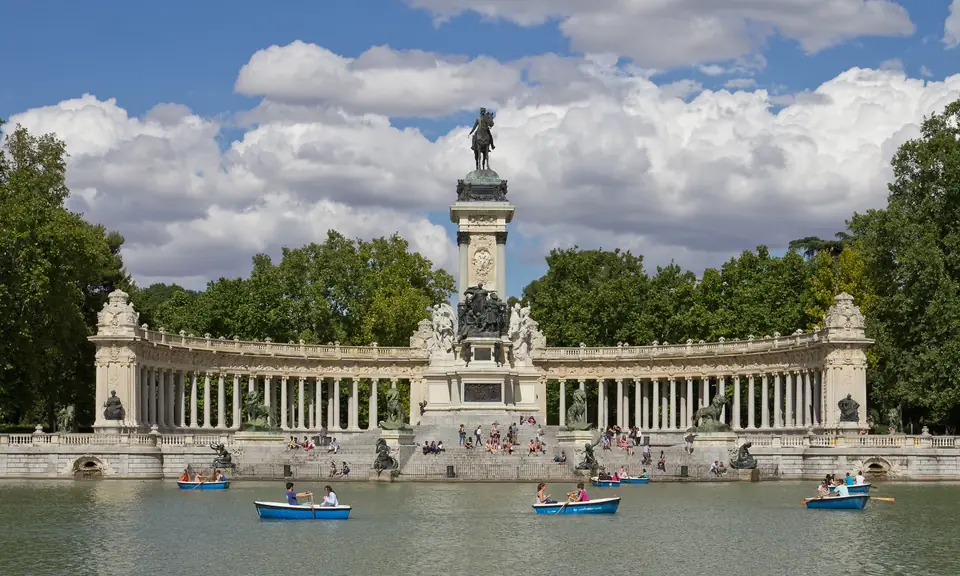
- Monument to Alfonso XII — A 30-metre-high colonnade, finished in 1922 over the old Royal Landing Stage
- Crystal Palace — An iron and glass conservatory of 1887, with a 22.60-metre dome
- Fountain of the Fallen Angel — Ricardo Bellver's bronze Lucifer, unveiled in 1885
- Paseo de Coches — The former navigable canal of the Río Grande, home of the Book Fair since 1967
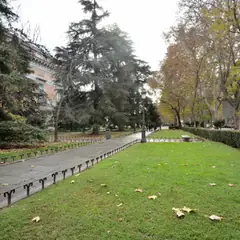
Retiro Park, officially the Parque del Buen Retiro, was born as the pleasure garden of a court. Between 1630 and 1640, the Count-Duke of Olivares built the Buen Retiro palace for Philip IV beside the Royal Quarters of the Jerónimos, and its gardens, which came to occupy some 145 hectares, grew at the same time as the building. It was a private stage: on its Great Pond comedies with stage machinery were performed and naval battles were simulated, and the Royal Site came to have its own fleet of gondolas and barges. Today it is part of the Landscape of Light, and its area is put at between 118 and 142 hectares depending on how the boundary is drawn.
The history of Retiro Park is that of a garden the city won from the crown. Charles III opened it to the public in 1767, though with dress rules and areas closed to strollers. During the War of Independence (1808-1814) Napoleonic troops turned it into their headquarters and damaged and plundered palace and gardens. After the Revolution of 1868 and the fall of Isabella II, a decree signed on 6 November of that year by the minister Laureano Figuerola handed it to the City Council under the name Parque de Madrid, the same one still read on the Puerta de España. Along the way the Retiro even had a zoo: in 1830, on the instruction of Ferdinand VII, the Casa de Fieras, heir to the one Charles III had founded in 1774, was moved to its eastern sector, and the animals lived here until their transfer to the Casa de Campo in 1972. The pavilion of La Leonera is now the Eugenio Trías Municipal Public Library.
The architecture of Retiro Park reads in layers: the French garden of the Parterre, the 17th-century Great Pond, the landing stage of 1926, the Ionic colonnade of the monument to Alfonso XII, Velázquez Bosco’s pavilions, the Velázquez Palace of 1884 in brick and tile and the Crystal Palace of 1887, and the Fountain of the Fallen Angel. In between lie corners with their own stories. A popular legend says Philip IV hid his treasure beneath the Egyptian Fountain, on the south shore of the pond, although the fountain, designed by Isidro González Velázquez in 1819, was not inaugurated until 1850, two centuries after that king. Beside it rests since 1982 an anchor that tradition attributes to the frigate “Villa de Madrid”, though the piece was cast in 1930 for a passenger motor ship of the same name. And in the Reservado, the Artificial Mountain is known to Madrilenians as the “Cats’ Roller Coaster” for the stone felines that decorate it.
What to see in Retiro Park is arranged in five stops, from the Parterre where the palace began to the roundabout of the Fallen Angel. It is also a garden of memory: the Forest of Remembrance, the last garden created in the Retiro, was planted in 2005 in tribute to the victims of the attacks of 11 March 2004. What the park hides beneath its paths, its ponds and its absences is better understood by walking it with the audio guide.
On its western edge, the Prado Museum shares with the park the inscription of the Landscape of Light, and less than a kilometre away lies Plaza de Cibeles.
A French garden for a lost palace
Parterre Garden
Summary of this stop
The Parterre is a French garden that lacks its reason for being: the palace for which it was laid out. Philip IV’s Buen Retiro, built between 1630 and 1640, was damaged and plundered during the Napoleonic occupation, when French troops made the grounds their headquarters. Of that whole complex only the Casón and the Hall of Realms survive, outside the present park; the Casón peers out from the Parterre itself, already beyond the grounds.
In the garden stands the Montezuma cypress, a thick-trunked tree catalogued as a singular tree. Tourist tradition gives it some 400 years and places it here since 1630, but recent studies lower its age to about 200 years; the oldest tree in the park would today be an olive tree of about 627 years transplanted beside the Puerta del Ángel Caído.
From this point the park reads as the shadow of a palace: born for a king, razed in a war and handed by decree to the city in 1868. How the plan of that court can still be recognised in the layout of the garden is revealed by listening to the narration beside the Montezuma cypress.
Comedies and naumachias on the water of the boats
Retiro Great Pond
Summary of this stop
The Great Pond, the large rectangular sheet of water of the 17th century, was the court’s main theatre. In 1635 Calderón de la Barca’s “El mayor encanto, amor” was performed on its waters, with stage machinery by the scenographer Cosme Lotti, and even the fishmongers on the shores were part of the set. Naumachias were also held, simulated naval battles with scale ships and fireworks. A gilded gondola ordered by Charles II in Naples in 1686 for that royal fleet is now kept in the Museum of Royal Barges in Aranjuez.
The water was opened to the public a year before the park passed to the city: on 16 August 1867, under Isabella II, the rowing-boat service was inaugurated, with professional oarsmen. The present landing stage, on the north shore, is the work of Luis Bellido and dates from 1926; the previous one, of 1917, burned in January 1920.
Beneath the boats lay another inventory. When the pond was drained in 2001 because it was losing some 5,000 litres a day, chairs and tables from nearby bars, fences, mobile phones, skateboards, bladed weapons, funerary urns and an open, empty safe appeared on the bottom, along with thousands of carp, among them “Margarita”, who fed the jokes about a pond monster. What is known about that safe, and what is not, is told by the narration at the landing stage.
A stone king above a demolished landing stage
Monument to Alfonso XII
Summary of this stop
On the eastern shore of the pond rises the monument to Alfonso XII: a colonnade of Ionic columns with the king’s equestrian statue, stone lions and sirens at the base. José Grases Riera’s project won the competition called in 1902 by the regent María Cristina and the work was finished in 1922, 30 metres high, 86 long and 58 wide.
Its scale hides a loss. To build it the Royal Landing Stage of 1817, which occupied that same spot, was demolished: the park is rewritten over its own absences. And it is not the pond’s only transformation. In 1964 it was drained to serve as the set for “Circus World”, the Hollywood blockbuster starring John Wayne.
What was left of the kings’ landing stage and how the heart of the Retiro became a film set is told by the narration from the steps of the monument.
The Philippines conservatory and its shadow
Crystal Palace
Summary of this stop
The Crystal Palace is an iron and glass pavilion built in 1887 by Ricardo Velázquez Bosco, with a central dome reaching 22.60 metres, ceramic friezes by Daniel Zuloaga and a pond in front with swamp cypresses. It was born as a great conservatory for plants arriving from the Philippines and is now an exhibition hall of the Museo Reina Sofía, like the nearby Velázquez Palace, by the same architect.
The diffuse light of the glass coexists with an uncomfortable history. The building was raised for the General Exhibition of the Philippine Islands of 1887, which occupied 14 hectares of the park and included a human zoo.
How that colonial exhibition was built and what the conservatory it left behind says today about the Retiro is addressed with restraint in the narration in front of the palace.
The bronze devil above the king’s canal
Fountain of the Fallen Angel
Summary of this stop
The Fountain of the Fallen Angel shows Lucifer in bronze, contorted and entwined by a serpent, on an octagonal pedestal with devils’ masks spouting water. Ricardo Bellver modelled the plaster in Rome in 1877 and won with it the First Class Medal at the National Exhibition of 1878; the piece was cast in bronze in Paris and the fountain, with a pedestal by Francisco Jareño, was inaugurated in 1885 near where the Royal Porcelain Factory stood.
Around the roundabout circulates a figure: it stands at 666 metres above sea level. The coincidence feeds the idea that the fountain would be a homage to Lucifer or the only statue of the devil in the world, but that height is the average altitude of Madrid and other sculptures of Lucifer exist, such as the one in Turin.
Very close runs the Paseo de Fernán Núñez or de Coches, opened in 1874 over the Río Grande, a navigable canal dug between 1638 and 1639 whose square-cornered layout can still be recognised. Vehicles travelled along it until 1981, and since 1967 it hosts the Madrid Book Fair every spring, except in 1979 and 1980, when it moved to the Casa de Campo. How the king’s canal became the promenade of books closes the route in the narration beside the fountain.