Colonial fortress
A Famosa Audio Guide (Porta de Santiago)
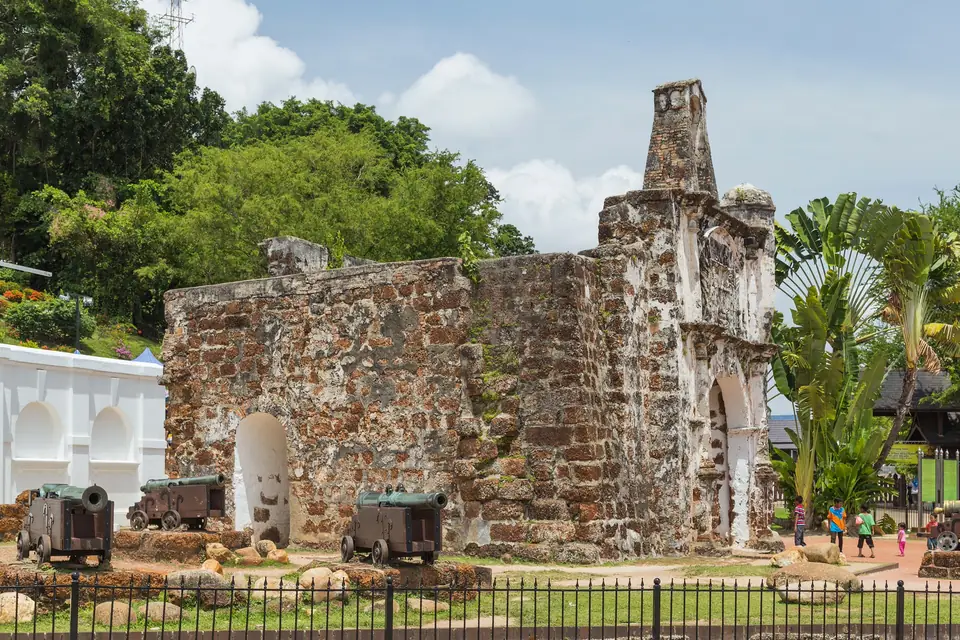
An arch of reddish stone beside St. Paul’s Hill is all that remains of the fortress Portugal built in 1511 and Britain blew up with gunpowder in 1807: the gate nobody carried off.
- 20 min of audio
- Fortress of 1511
After conquering Malacca in 1511, Afonso de Albuquerque ordered a hill by the sea to be ringed with a fortress that would secure the port on the route to China. It went up in about five months, with forced labour, on the site of the city’s mosque and with stone torn from it and from the tombs of the old sultans. For almost three centuries it withstood sieges and changed hands only twice; today its only surviving remnant is the Porta de Santiago.
The gate that can be seen bears the signature not of those who built it but of those who took it from them: above the arch, the inscription ANNO 1670 and the relief of the Dutch East India Company. And its survival was almost accidental: in 1807 the British dynamited the walls so that no rival power could use them, and when the demolition stopped only this arch was left.
Highlights
- Porta de Santiago — the only gate still standing of the Portuguese fortress of 1511
- ANNO 1670 inscription — the date of the Dutch renovation carved above the arch
- VOC relief — a galliot, a soldier with a crown on his sword and an armed angel
- Vault of the arch — the thickness of a fort that in three centuries fell to assault only once
- Back face and St. Paul’s Hill — the void where the walls ran and the tower rose
In the historic centre of Malacca, at the foot of St. Paul’s Hill, a gate of reddish stone stands alone, without a metre of wall around it. It is the Porta de Santiago, and it is all that survives of A Famosa, the fortress the Portuguese began to build in 1511, just after defeating the Sultanate of Malacca. There was a stone fort on this spot from 1512 to 1807: in those three centuries it withstood sieges such as those of 1551, 1568, 1575 and 1586, changed hands only twice and was taken by assault only once, by the Dutch in 1641.
The history of A Famosa is that of an entire fortified city made from other people’s stone, signed by its conquerors and dynamited by those who feared another might use it. Its architecture is barely hinted at today in the thickness of the arch and in the relief that crowns it, but every stone drags an episode behind it: the mosque on whose site it was built, the siege that left thousands dead, the demons that according to the labourers defended its walls and the explosion a witness compared to thunder.
What to see at A Famosa, and why this squat gate deserves a long stop, is what the audio guide unpacks in twenty minutes, from the façade to the inside of the arch and from there to the back face, facing the gap the fortress left.
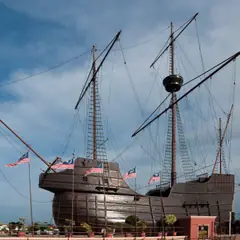
The fortress was born of the conquest of 1511, the same one whose loot was carried off by the ship now recalled by the Malacca Maritime Museum; on top of the hill stand the roofless walls of St. Paul’s Church, and a few steps away rises the Stadthuys, seat of Dutch power inside the walls.
A squat gate with a tower’s name
A Famosa
Summary of this stop
The route begins in front of the gate, and with a paradox: “A Famosa” was not originally the name of this arch. It was first borne by the great keep, then by the whole fortress, and today it designates above all the one surviving gate, the Porta de Santiago. In Malaysia it is usually pronounced “Ay Famosa”, reading the Portuguese article as the English letter.
The fortress was born in a hurry. After the victory of 1511, Afonso de Albuquerque ordered it raised at once around a natural hill by the sea, to secure the port on the route to China. It rose on the site of the city’s mosque and with stone torn from that mosque, from other religious buildings and from the tombs of the old sultans, plus stone brought from elsewhere, because there was none in Malacca. The citadel was built in about five months with forced labour, and many workers died from the heat and lack of food. Where exactly that mosque stood, and why it should not be sought beneath the arch, is made clear in the narration, in front of the gate.
ANNO 1670: the conqueror’s signature
VOC relief above the arch
Summary of this stop
Above the arch, two details tell who won. The inscription ANNO 1670 recalls the Dutch renovation of the gate, and above it is preserved the relief with the emblem of the Dutch East India Company, the VOC. Sources do not agree on how much of the Portuguese work remains: some present it as a Portuguese gate damaged in 1641 and renovated afterwards, others maintain that what is seen today is mostly Dutch improvements.
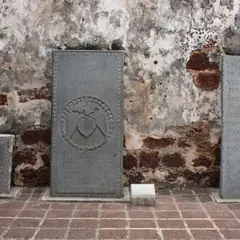
Behind that signature lies an atrocious siege. The Dutch, with help from Johor, besieged the city for five months; the besieged ended up eating cats and rats, and on 14 January 1641 the attackers entered through the Santo Domingo gate, with more than 7,000 dead from hunger, disease and fire. After the conquest, the new owners dug up old Portuguese gravestones to thicken the fort’s walls.
The relief also holds a famous misunderstanding. Munshi Abdullah, who grew up in Malacca, was convinced as a child that the fort was Portuguese, and his proof was some Portuguese-looking stucco figures above the gate. In 1848 the Briton J. T. Thomson drew them and pointed out the confusion: the date was Dutch and the coat of arms that of the VOC, with a galliot in the centre, a soldier or burgher holding a crown on the point of a sword and what appears to be an angel with a flaming sword, among trophies of arms.
The fortress that frightened its demolishers
Vault of the Porta de Santiago arch
Summary of this stop
Under the vault of the arch the thickness of the stone can be appreciated, and with it the final paradox of A Famosa: an almost impregnable fort condemned by its own owner. Under British occupation, in 1805 it was ordered that Malacca’s population be moved to Penang and the fortress destroyed so that no rival power could use it. Some attributed the demolition to the Dutch, but the documentation places it in the hands of the British government of Penang. Most sources date the blast to 1807, although one speaks of 1811.
Before the gunpowder, according to a tradition recorded by Munshi Abdullah, there were three months of panic. The labourers William Farquhar set to hacking at the wall could not break a single stone and told one another they were convinced the fort was full of evil spirits: they dreamed that Satan slapped them, demanding their blood, and the word in town was that demons made them vomit blood. Not even a raised daily wage brought them back to work, and Malacca came to believe that not even the English could defeat the fortress.
In the end, in 1807, Farquhar blew up the walls. Abdullah, a witness as a child, related that it sounded like thunder and that pieces of wall as big as elephants and houses flew through the air and fell into the sea. What Abdullah himself concluded about those spirits, with unexpected irony, is one of the moments of the route best heard beneath the arch.
Alone where the walls once ran
Back face of the Porta de Santiago
Summary of this stop
From the back face, the one that looked into the compound, the gate is seen as it is: an isolated fragment. Around it there is not a stretch of wall left nor a trace of the great tower that watched from the hill. That tower, the work of Tomás Fernandes, had four storeys and served as the captain’s residence; according to one source, the city’s first captain, Rui de Brito Patalim, added a fifth up to some 130 palmos in height, although others give different measurements and dates. Behind the gate the path now climbs towards the ruins of St. Paul’s Church.
That the arch is still standing is linked to Stamford Raffles, who in 1808, on sick leave in Malacca, wrote against the destruction of public buildings and the removal of the population, and both were halted. His role, however, is disputed: some sources credit him with saving the gate and others believe the order to stop arrived when only the Porta de Santiago was left. The fortress’s red stone, it is said, ended up in neighbours’ houses, at the bottom of the river and on ships bound for Batavia and Riau, and Lord Minto went so far as to call the demolition “a most useless piece of wanton mischief”.
The fortress has not had its last word: in late November 2006, works on a 110 m revolving tower accidentally uncovered remains of the Middelburg bastion, built by the Dutch in 1660; the tower was moved to another site and the bastion was restored. With what image Munshi Abdullah bid farewell to the lost fortress, the most quoted line about A Famosa, is kept for the last stop, facing the void it left.