Malacca’s Chinatown
Jonker Street Audio Guide (Jalan Hang Jebat)
Some 500 metres of shophouses and clan houses with three names, one for each power that passed through Malacca, a Malay tomb beside a Chinese temple and a night market its traders defended with a human barrier.
- 60 min of audio
- Weekend night market
Jonker Street is the main street of Malacca’s Chinatown, between the Tan Kim Seng Bridge and the Tamil Methodist Church. The Dutch called it Jonkerstraat from 1641, the British kept the name after the treaty of 1824, and after independence it officially became Jalan Hang Jebat. In the nineteenth century it became the centre of the Chinese community, with the seat of the Hokkien Huay Kuan, surname associations and shophouses with narrow façades and very deep plots.
The official name honours Hang Jebat, the warrior who rebels against the sultan in the Hikayat Hang Tuah; but the tomb the street guards, beside the small Chinese temple Thean Teik Keong, is attributed to Hang Kasturi, the rebel of the main versions of the Malay Annals. And the weekend market, born in 2000, began with a street so empty that, according to one trader, the only person strolling among the stalls was its founder, a bodybuilder.
Highlights
- Gate by the Tan Kim Seng Bridge — 2,026 lanterns at the 2026 Lunar New Year
- Shophouses and five-foot way — shutters, plasterwork and tiles of the 19th and 20th centuries
- Statue of Gan Boon Leong — founder of Jonker Walk, Mr Asia in 1956, among the Chinese zodiac
- Makam Hang Kasturi — tomb attributed to a fifteenth-century warrior, door to door with a Chinese temple
- Tamil Methodist Church — a church of 1908 shared by four communities
Across the Melaka River, opposite the Stadthuys square, a narrow street begins that has changed owners and names more often than almost any other in Malacca. Under the Dutch administration, begun in 1641, it was Jonkerstraat; the most accepted interpretation links the word to the Dutch jonkheer, a “young knight” of the lesser nobility, in contrast to the neighbouring Heerenstraat, the street of the lords, although a popular explanation derives it from Chinese junks. After the Anglo-Dutch treaty of 1824, the British kept it as Jonker Street, and the street consolidated as the commercial axis of the Chinese merchants. With Malaysian independence it received its present official name, Jalan Hang Jebat.
The history of Jonker Street reads along some 500 metres of shophouses, clan houses, temples and antique shops. Some listings attribute seventeenth-century houses to the street, but other sources reserve the Dutch period for a few buildings and place most of them in the late nineteenth and early twentieth centuries. In 1914, the Federated Malay States Railways’ travellers’ brochure dismissed it as “a pale copy” of Heeren Street; today it is the other way round. Since 19 June 2000, every weekend the street is closed to traffic and becomes Jonker Walk, the night market its traders came to defend with a march and a human barrier.
What to see on Jonker Street, and why each stretch hides a different story, is what the audio guide tells over an hour’s walk from end to end: from the gate by the river to the five-foot way of the clan houses, from the statue of a bodybuilder to a Malay tomb next to a Chinese temple, to the arch where the traders stood their ground.
A few steps away, the Cheng Hoon Teng Temple is the oldest Chinese temple in use in Malaysia, and on the parallel street, Heeren Street, the Baba Nyonya Heritage Museum preserves the peranakan mansion of the Chans.
One street, three names by the river
Tan Kim Seng Bridge
Summary of this stop
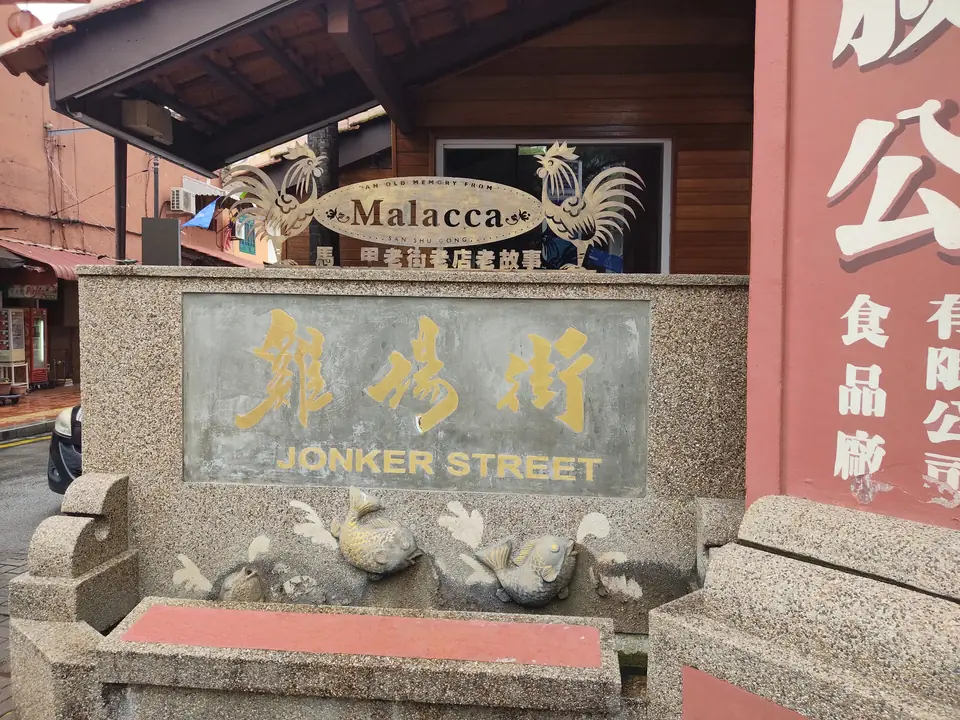
The route begins at the Jonker Walk gate, beside the Tan Kim Seng Bridge, the eastern entrance of the street for those crossing the river from the Stadthuys square. Here the layers overlap: the Dutch name given by the administrators of the East India Company, the one the British kept, the Malay of the official signs and a fourth, the Chinese, which the sign at the other end of the street displays: 鸡场街, Jī Chǎng Jiē, “chicken yard street”. The popular explanation is that cockfights were once held here, a question that remains open.
This gate is also the street’s showcase at Lunar New Year, when it hosts the great figure of the year’s zodiac animal. For 2026, Jonker Walk hung a record 2,026 lanterns, on the 36th anniversary of the city’s decoration tradition, with almost a million ringgit of private funds and a 5.49-metre horse at the entrance; in 2024 there had been 1,000 and in 2025, 2,025. What those three names say about who ruled Malacca in each era is better understood listening to it right there, with the river at your back.
Narrow façades, heirlooms for sale
Five-foot way and Hokkien Huay Kuan
Summary of this stop
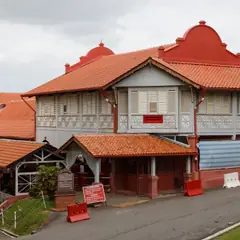
A few steps further on, the continuous five-foot way, the five-foot way, links the rows of shophouses under the upper floor. The façades are narrow and the plots very deep, with wooden shutters, plasterwork and tiles; most of the decorated houses date from the nineteenth and early twentieth centuries, younger than they look. In this stretch stands the seat of the Hokkien Huay Kuan, the association of the Hokkien community, which also serves as a clan temple. In the nineteenth century the street became the centre of the Chinese community, with surname associations such as those of the Tan and the Lee nearby, and today the Teochew Hui Kuan and the Hainan association are still there.
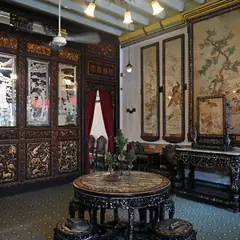
Jonker Street’s fame as a street of antique dealers has a less kindly origin than its shop windows suggest. According to documented tradition, in 1936 T. J. Kuthy, an Indian Muslim from Kerala, opened the street’s first junk shop: many Baba families had lost their fortune in the collapse of the rubber price during the Great Depression and had to sell their heirlooms to survive, and Kuthy bought those treasures. What lies behind each piece of porcelain or furniture in these shops is the question the narration raises in front of the five-foot way.
The bodybuilder who strolled alone
Taman Warisan Dunia Jonker Walk
Summary of this stop
In a small paved square, the Taman Warisan Dunia Jonker Walk park, opened in 2010, stands an unexpected monument: the sculpture of Gan Boon Leong (1937-2022) with the muscular torso of his bodybuilding days, surrounded by figures of the Chinese zodiac animals. Gan, an MCA leader in Malacca, was Mr Asia in 1956 in Jakarta and honorary Mr Universe in 2000.
That same year, 2000, Jonker Walk was born. The Malacca state government launched it on 19 June as a cultural and tourist street combining history, commerce and tourism, and soon after the local press ran the headline that Jonker Walk “is not a night market”. Who fathered the idea is disputed: a 2004 academic study presents it as a state government initiative, while the press and the committee itself credit Gan and the MCA, who still run it. What nobody disputes is the difficult start: in its first months the street was so empty that, according to one trader, the only person strolling among the stalls was Gan himself. Today the market runs Friday, Saturday and Sunday from 6 pm to midnight with the street closed to traffic, and in 2013 it brought together some 300 traders. How an empty street ended up full every weekend is the small success story told at the foot of the statue.
The tomb of the wrong rebel
Makam Hang Kasturi
Summary of this stop
Behind a gate with a Jawi inscription, wedged against a shophouse, appears the Makam Hang Kasturi: a two-tiered tomb flanked by eight short pillars with a triangular motif. It is attributed to the warrior Hang Kasturi, from the time of Sultan Mansur Shah (1456-1477), and shares its neighbourhood with the small Chinese temple Thean Teik Keong: a Chinese shrine and a Malay tomb door to door. The mausoleum attributed to Hang Jebat is in another nearby lane; both tombs are traditional attributions of figures from the Malay epic.
Here lies the street’s paradox. Its official name honours Hang Jebat, Hang Tuah’s companion who, in the Hikayat Hang Tuah, rebels against the sultan, occupies the palace and dies at the hands of his friend with the keris Taming Sari. But in the main versions of the Malay Annals that role of rebel belongs to Hang Kasturi, precisely the warrior whose tomb is seen here. Tradition puts in Jebat’s mouth a phrase still quoted in Malaysia, “Raja adil raja disembah, raja zalim raja disanggah”: a just king is revered, a tyrant king is defied. How that defiance ended, and what punishment the sultan reserved for his house and family, is discovered in the narration before the gate.
Jonker Walk, not Jonker Drive
Tamil Methodist Church
Summary of this stop
The walk ends at the west end, beside the Jonker Walk arch and the Tamil Methodist Church. The church was built in 1908 as the Kubu Methodist Church and was shared by four communities: Chinese, English, Baba and Tamil; in 1954-1955 the peranakan and Mandarin speakers left for churches of their own and it remained a Tamil church.
Towards this arch some 100 traders marched at night in June 2013, chanting “Jonker Walk forever”, after the state government of Idris Haron ordered the street opened to traffic on weekends too. The following Friday they formed a human barrier to stop cars entering, and the Tourism Minister, Nazri Aziz, retorted that the street is called “Jonker Walk” and not “Jonker Drive”. The government justified the measure by weekend jams as far as the Ayer Keroh toll and denied wanting to close the market; the opposition and part of the press presented it as political retaliation after the 2013 elections. In July 2014, after a year of uncertainty, Idris Haron promised the traders at his official residence, Seri Bendahara, that Jonker Walk would not be closed. What it means to look back along the whole street from this point, knowing what it cost to keep it, is understood on hearing the route’s close beneath the arch.