Flor de la Mar replica
Malacca Maritime Museum Audio Guide (Muzium Samudera)
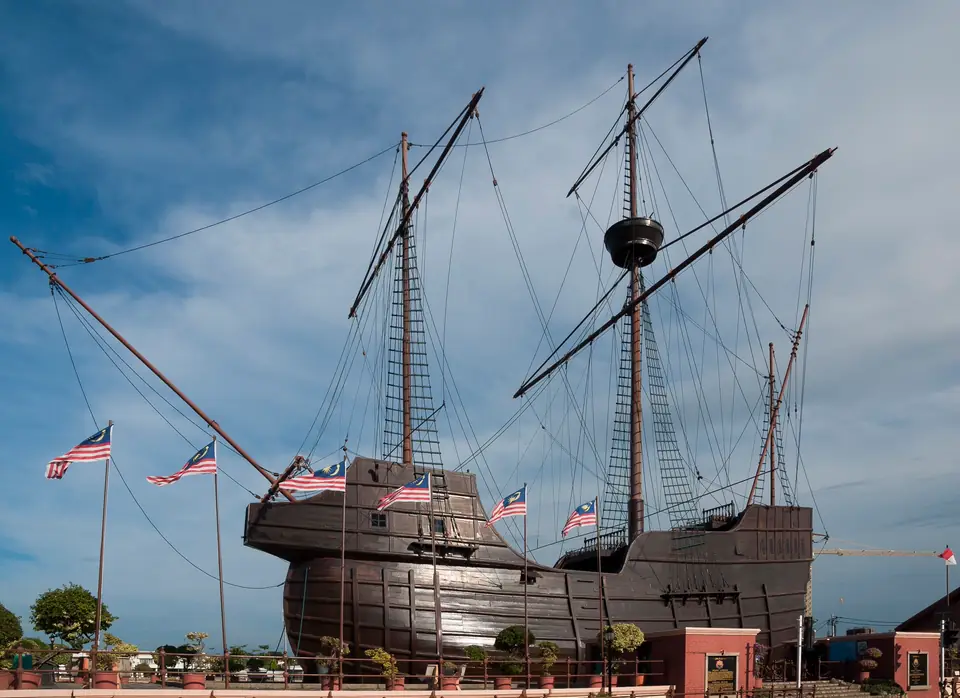
A 34-metre-high Portuguese nao stranded forever beside the Melaka River: the replica of the Flor de la Mar, the ship that in 1511 carried off the city’s treasure and sank with it off Sumatra.
- 60 min of audio
- Maritime history
The Muzium Samudera occupies a replica of the Flor de la Mar whose construction began in early 1990 and which Prime Minister Mahathir Mohamad inaugurated on 13 June 1994. It is 34 metres high, 36 long and 8 wide, and beneath its look of a wooden carrack it hides a concrete hull: it was designed as a museum building, not as a seaworthy ship. Inside, the exhibition tours Malacca as the “Emporium of the East”, from the sultanate to the Japanese occupation.
The irony is plain to see: the city has turned into a museum the ship that came to conquer it. The original nao, built in Lisbon in 1502, sailed from Malacca laden with the treasure of the sultan’s palace and sank in a storm off Sumatra with more than 400 people aboard. Its wreck has never been found, and Portugal, Indonesia and Malaysia dispute the salvage rights.
Highlights
- Flor de la Mar replica — 34 metres high with a concrete hull beside the Melaka River
- Galleries below deck — maps, models and the Portuguese conquest of 1511
- Wooden deck — views of the river and Jalan Quayside
- Former Guthrie warehouse — the Ocean and Mankind exhibition, opened in 1998
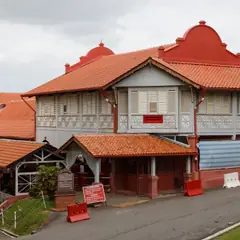
- Royal Navy Museum — a patrol boat on stilts and a WASP helicopter
On Jalan Quayside, beside the mouth of the Melaka River, a galleon with high castles looks about to slip its moorings. It is the Muzium Samudera, the Malacca Maritime Museum, housed in a replica of the Flor de la Mar: the 400-ton nao that left Lisbon in 1502, formed part of the armada of Afonso de Albuquerque that took the city in August 1511 and sank a few months later with its loot. Work began in early 1990 and Mahathir Mohamad inaugurated it on 13 June 1994. By around 2015 it was already the most visited museum in the city, with some 20,000 visitors a month.
The history of the Malacca Maritime Museum is not that of a ship, but of a city that was the emporium of the strait and lost it. The exhibition by the Perbadanan Muzium Melaka tells it bluntly and with an explicit thesis: to lose political power is to lose everything. Around the replica are spread a former colonial warehouse turned into a second hall and, across the street, the Royal Malaysian Navy Museum, included in the same ticket.
What to see in the Maritime Museum, and why this hull says more about Malacca than about Portugal, is what the audio guide unfolds over an hour of walking: from the quay in front of the bow to the galleries below deck, from the railing that looks out to the strait to the patrol boat stranded on stilts.
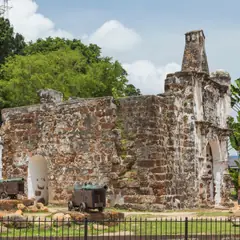
Of the fortress Portugal built after that conquest a single gate still stands, A Famosa, and across the river the Stadthuys keeps in its courtyard a statue of the Chinese admiral Cheng Ho.
A concrete carrack beside the river
Muzium Samudera
Summary of this stop
From the quay the whole silhouette can be seen: 36 metres long, 8 wide and 34 high, with a forecastle and a tall sterncastle. The architecture of the Maritime Museum, however, hides a trick. Some guides describe it as an enormous wooden ship, but the outer hull is concrete; only the interior and decks are wood, because it was never conceived as a seaworthy carrack but as a museum building.
The official date places the start of works in early 1990, although some heritage blog takes them back to the 1980s. What is not in dispute is whom that silhouette imitates: the ship that carried off the city’s treasure. Why Malacca chose precisely that shape for its maritime museum is the first question the route answers, with the hull in front.
The city that held Venice by the throat
Galleries of the Malacca emporium
Summary of this stop
Below deck, the galleries gather ship models, old maps, paintings and panels about the Malacca that was the “Emporium of the East”. The reason for so much greed was summed up in 1515 by the Portuguese apothecary Tomé Pires in his Suma Oriental: whoever was lord of Malacca would have his hand on the throat of Venice, the city that dominated the resale of spices in Europe. Albuquerque’s armada, of about 18 ships, attacked on 25 July 1511, returned to the assault on 10 August and took the city on 24 August.
Among the figures in the halls appears Panglima Awang, the “Malay Magellan”, and his story is full of question marks. Everything suggests he was a slave whom Magellan made his own in Malacca, probably during the conquest, baptised Enrique and taken as an interpreter on the circumnavigation of 1519. His real Malay name is unknown, that of Panglima Awang comes from a 1957 novel and his origin is disputed among Malaysia, the Philippines and Indonesia. What became of him after he stayed in Cebu in 1521, and why he may have completed the first circumnavigation without anyone seeing him arrive, is told in front of the display case.
Royal loot bound for the bottom of the strait
Wooden deck of the replica
Summary of this stop
On the upper deck, between wooden railings, the view opens onto the river and the bank of Jalan Quayside. Towards there, heading for the strait, the original Flor de la Mar set out: a nine-year-old nao that was leaking and whose own crew was reluctant to sail. Laden with the treasure of the sultan’s palace, it sank in a storm off Timia Point, in the kingdom of Aru, in Sumatra, with more than 400 people aboard. The most quoted date is the night of 20 November 1511, although another historiographical tradition puts the wreck in 1512.
According to documented tradition, the hold carried the trousseau of a court: a gilded palanquin, a table with golden legs, the queen’s throne, jewels and, among the cargo, Malay slaves. Albuquerque was saved on an improvised raft and what he regretted most were the sultan’s bronze lions, which he wanted for his own tomb. The figures for the loot in circulation are considered possibly exaggerated, and the wreck has still not appeared despite those who claim to have located it; Portugal, Indonesia and Malaysia claim salvage rights. No piece of the original ship is displayed on board, and it is that absence that the narration turns into the protagonist at the foot of the railing.
Malacca’s other ship
Muzium Tentera Laut Diraja Malaysia
Summary of this stop
The route ends across the street, in the Royal Malaysian Navy Museum, which was previously at the Lumut naval base in Perak and opened in Malacca on 28 October 1995. There a decommissioned patrol boat rests on stilts, beside naval guns and a WASP MK1 helicopter. To one side stands the former warehouse of the Guthrie company, today part of Sime Darby, which since 23 May 1998 has housed the museum’s second phase, with models of fishing boats and dioramas of fishing villages.
Facing the invader’s ship, Malacca has its own legendary vessel: the Mendam Berahi of the Hikayat Hang Tuah. According to local tradition, disputed by historians, Hang Tuah is said to have had it burned out at sea so that the Portuguese armada would not seize its secrets, and that is why its wreck has never appeared. The city has been announcing a replica for years that never quite arrives. What emerged from the mud of Pulau Melaka in October 2025, and why it changes the way of looking at the Flor de la Mar, is the finale the audio guide reserves for this last point.