Malaysia’s oldest Chinese temple
Cheng Hoon Teng Temple Audio Guide
A temple of Guanyin wrapped in incense smoke that for centuries was also the court, office and archive of Malacca’s Chinese Kapitan, and whose tablets still summon the great-grandchildren of those who crossed the sea.
- 30 min of audio
- Buddhism, Taoism and Confucianism
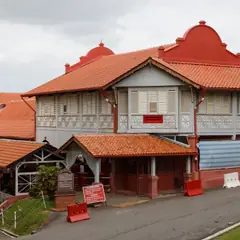
On Jalan Tokong, Cheng Hoon Teng is regarded as the oldest Chinese temple in use in Malaysia. It began in the seventeenth century on the initiative of Kapitan Tay Kie Ki, in 1673 it grew with materials brought from China under Kapitan Li Wei King, and in 1801 Kapitan Chua Su Cheong rebuilt the main hall on the scale it keeps today: curved roofs of cut porcelain, two red masts seven metres tall and a compound of about 4,600 m².
The columns of the main hall bear golden calligraphy in grass-script style written by a Dutch diplomat, Robert van Gulik, and in the rear hall two tablets from the 1720s, rediscovered in 2015, avoid naming the Qing emperor and are dated with a “flying dragon”: a loyalty to the Ming written in the midst of Dutch rule.
Highlights
- Columns of the main hall — golden grass-script calligraphy by Robert van Gulik
- Two red masts seven metres tall — rare in Chinese temples and surrounded by a disputed legend
- Central altar of Guanyin — beside Mazu, protector of sailors, and Guan Gong
- Stele of 1685 — the temple’s oldest relic, gratitude for the Bukit China cemetery
- Tablets of the 1720s — dated with a flying dragon out of loyalty to the Ming
On a narrow street in Malacca’s old town, incense smoke drifts from a temple that has been in use for more than three centuries. Cheng Hoon Teng, the “temple of the blue-green cloud”, is considered the oldest active Chinese temple in Malaysia, and its history is that of the Hokkien community that arrived by sea. It was founded in the seventeenth century on the initiative of the Chinese Kapitan Tay Kie Ki, also called Tay Hong Yong, although the exact date remains disputed: some place it in 1645, some speak of 1646 and a refugee called Li Kup, and some invoke an inscription of 1600 for an even earlier origin. The 350th anniversary the temple celebrated in 2023 counts from 1673, the year Kapitan Li Wei King raised new structures with materials brought from China and the temple became the main place of worship of Malacca’s Hokkien.
But the history of Cheng Hoon Teng does not fit in a single shrine. Until 1824 it was the office and court of the Chinese Kapitan, and afterwards of the temple’s leaders, who went on arbitrating disputes until the early twentieth century. On its altar Buddhism, Taoism and Confucianism coexist. In the neighbourhood it is also called Kwan Yin Teng and, in Malay, Kebun Datok, “the garden of the gods”. The restoration of the main hall, between late 1999 and early 2001, earned it an Award of Merit in the 2002 UNESCO Asia-Pacific Heritage Awards.
What to see at Cheng Hoon Teng, and why every column and every tablet holds a proper name, is what the audio guide unfolds over half an hour of documented walking: from the street of the three religions to the courtyard of the red masts, from Guanyin’s altar to the hall where the memory of the founders is kept.
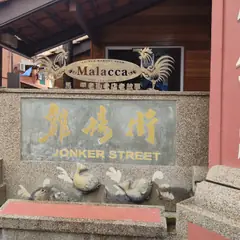
The temple is a step away from Jonker Street, the main street of the Chinese quarter, and a few minutes away the Baba Nyonya Heritage Museum opens the house of a peranakan family from the same neighbourhood.
One street, three religions and a cloud of merchants
Jalan Tokong
Summary of this stop
The route begins at the temple door on Jalan Tokong. The street continues as Jalan Tukang Emas, known as “Harmony Street”, and there two unexpected neighbours appear: the Kampung Kling Mosque, founded in wood in 1748 by Indian Muslim traders and rebuilt in brick in 1872, and the Sri Poyatha Moorthi Hindu temple, raised in 1781 by the Chitty community on land granted by the Dutch. A Chinese temple, a mosque and a Hindu temple thus share the same street.
The temple’s name has a story of its own. It is often associated with Admiral Cheng Ho, but the “Cheng” of Cheng Hoon Teng (青) and that of Cheng Ho (鄭) are different characters that coincide only in transcription, and the temple’s steles are not the inscription the admiral brought. The inscription of the 1801 reconstruction explains instead Qing Yun, “blue-green cloud”, as an emblem of merchants: wealth was meant to rise like a cloud. Almost a century later, another inscription of 1894 proposed a very different reading, and what changed between one and the other is told in front of the same door.
Hidden immortals and a mast with a secret
Red masts before the main hall
Summary of this stop
Instead of the guardian gods who usually watch over the doors of Chinese temples, Cheng Hoon Teng places the Eight Taoist Immortals. On the outer gate they appear mounted on their animals; at the entrance to the main hall they become almost invisible, turned into four-clawed dragons clutching their attributes: a flute, a knife, a lotus, a fan. On the roofs, the curved ridges are topped with dragons, phoenixes and figures made of cut porcelain fragments, in the style of southern China.
The outer columns of the main hall carry golden characters in grass script, cao shu, the work of Robert van Gulik (1910-1967), a Dutch diplomat and sinologist. In front rise two red masts seven metres tall, one on each side, an uncommon element in temple architecture. It is said that one of them holds the remains of two of the three Kapitan who paid for the temple, although another version of the same tradition places those remains in the wing of ancestral tablets and the most widespread reading today speaks only of a pair of masts, with no human remains. What lies behind that legend, and what international prize the restoration of the hall the masts guard won, is revealed between the two red poles.
Guanyin presided over the Kapitan’s court
Central altar of Guanyin
Summary of this stop
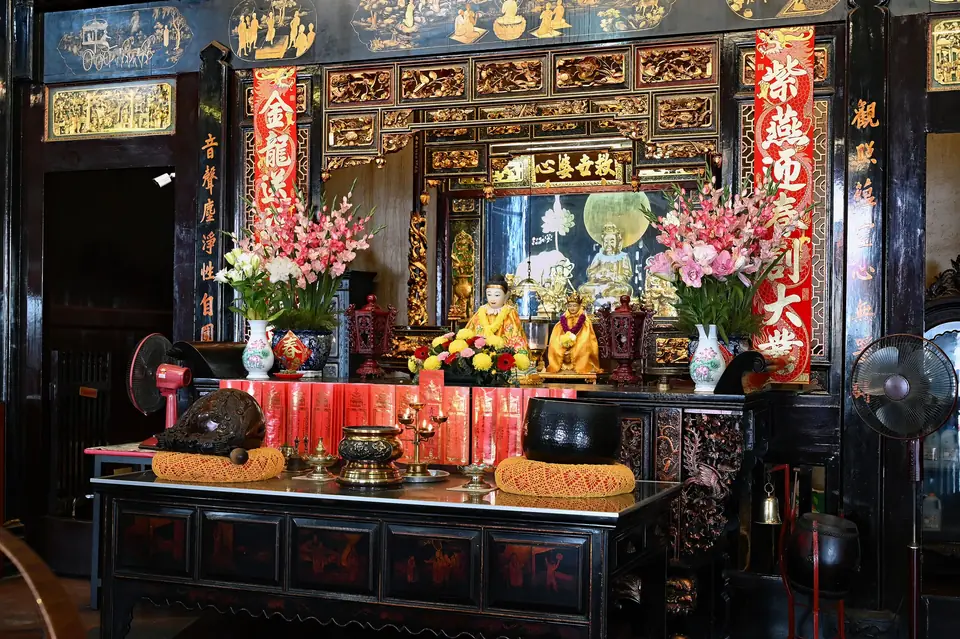
On the central altar sits Guanyin, accompanied by Mazu, protector of fishermen and sailors, by the goddess of births and by Guan Gong. On the walls, behind glass, the painted Eighteen Luohan have almost faded away beneath centuries of incense smoke. The hall was built by Kapitan Chan Ki Lock in 1704 and rebuilt in 1801 by Kapitan Chua Su Cheong, the eighth Chinese Kapitan of Malacca.
This shrine had a double life: here the Kapitan held office and here the disputes of the Chinese community were arbitrated. According to Chan Ki Lock’s stele, that Kapitan acted as father and judge at once: he gave money to those who knew how to trade but had no capital, forbade gambling to those hooked on it and bought plots on the hill to bury the dead who had no family. When the British abolished the Kapitan system in 1824, a board of trustees took over the temple, and in 1949, on the initiative of Tun Sir Tan Cheng Lock, it was constituted by its own act. How a prayer hall functioned for generations as bank, court and charity is better understood before the altar.
Tablets of Ming loyalty under a Dutch flag
Hall of tablets and portraits
Summary of this stop
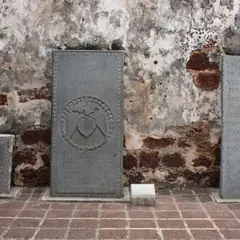
Behind the main hall, a hall of honour gathers ancestral tablets and portraits of the founders. The compound preserves the temple’s oldest relic, a stele of 1685 thanking Kapitan Li Wei King for donating the Bukit China land as a cemetery for the Chinese community. And here too are two wooden tablets from the 1720s, rediscovered in 2015, which instead of being dated by the Qing reign use the formula “longfei”, flying dragon: a sign of loyalty to the Ming among Malacca’s Chinese under Dutch rule.
Those tablets record a collection, and their list of donors still betrays who paid and who took the credit. In October 2023, for the 350th anniversary, the temple’s manager and his team combed through records more than a century old to recover commemorations that had not been held since 1933; some 500 devotees then arrived from the United States, the United Kingdom, China, Taiwan and Singapore, many looking for traces of their great-grandparents. What those names reveal, and why a whole people filled a tablet with their surname, closes the route.