Peranakan house museum
Baba Nyonya Heritage Museum Audio Guide (Muzium Warisan Baba & Nyonya)
A Heeren Street mansion that the Chan family neither sold nor emptied: it opened its doors with the furniture, the wedding costumes and the altar in place, and the family still returns to pray in it.
- 60 min of audio
- Peranakan culture
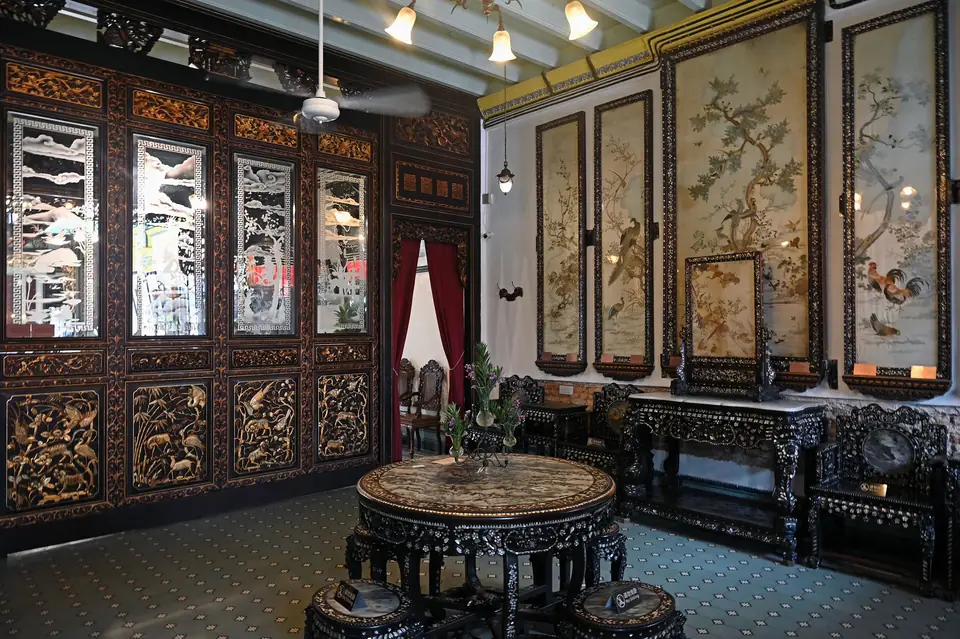
On the old Heerenstraat, today Jalan Tun Tan Cheng Lock, the peranakan Chan family joined three adjoining lots into a single house in 1861. Chan Cheng Siew, a rubber millionaire, moved in in 1896, and four generations lived there until his grandson Chan Kim Lay opened it as a museum, in March 1985 according to the museum itself. It is a tunnel house with no side windows, breathing through its courtyards open to the sky and spreading its luxury across embroidered silks, black wood inlaid with mother-of-pearl and a golden staircase.
Behind the splendour lies a very strict order: the great hall was for men only, and the women of the house watched from the dark hall through the slits of a wooden screen. Upstairs, a bolted hatch closed off the upper floor at night against thieves, children and the husband who came home late.
Highlights
- Thia besar — 5-metre silk embroideries and black wood furniture inlaid with mother-of-pearl
- Cenggal staircase — gilded, carved with the Eight Immortals and without a single nail
- Openwork screen — the slits from which the women of the house watched
- Bridal chamber — Qing-style wedding costumes of 1917
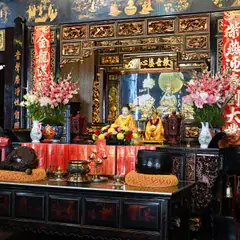
- Altar of the thia abu — where the Chan family still prays seven times a year
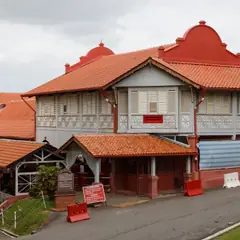
At numbers 48 and 50 of Jalan Tun Tan Cheng Lock, the street the Dutch called Heerenstraat, a façade with two painted lanterns conceals the home of one of Malacca’s richest peranakan families. The Chans acquired three adjoining lots here in 1861; in 1896 Chan Cheng Siew, who had gone from gambier to rubber, moved in, and the house never left the family. The adjoining number 52 was the servants’ house. Sources do not agree on everything: Wikipedia speaks of a house built in 1896, and the date of the present façade is not fixed in open sources.
The history of the Baba Nyonya Heritage Museum is that of a house that never stopped being a home. Four generations lived in it before Chan Kim Lay, the patriarch’s first grandson, opened it to the public. The museum, the Malaysian press and the 40th anniversary celebrated in July 2025 place the opening in March 1985, although some encyclopaedias give 1986. Since 2012, under Henry Chan, it has been restored from termites and leaks, and artists have remade part of the openwork wooden screens stolen after the Second World War. In November 2009 Chinese President Hu Jintao toured it, according to the official itinerary, and took home a 200-year-old plate as a souvenir.
What to see in the museum, and what each room says about who commanded and who watched, is what the audio guide unfolds over an hour of documented walking: from the lanterns at the entrance to the great hall of silks, from the courtyard open to the sky to the nail-free staircase, from the bridal bed to the altar the Chans keep returning to.
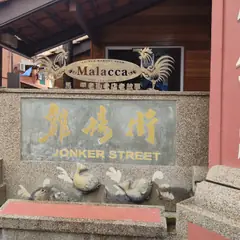
One street away, Jonker Street gathers the shophouses and clan houses of the same neighbourhood, and the Cheng Hoon Teng Temple was for centuries the shrine and court of Malacca’s Chinese community.
Two lanterns with a name on Heeren Street
Baba & Nyonya Heritage Museum
Summary of this stop
The visit begins on the pavement, before a façade that introduces itself. The two hand-painted lanterns at the entrance announce their owners: the one on the left bears the name of the family business, Swee Hin, and the one on the right the surname Chan. They were lit with candles until electricity reached the street in the 1920s.
Four generations lived behind that door. Between the 1950s and the 1980s the house stood mostly closed: the family came back for the prayers and, every Chinese New Year, to clean it. Turning it into a museum was the idea of the elder brother, Chan Kim Lay. His younger brother, Henry Chan, believes their father “probably would not have accepted it”, but by then only their mother was consulted. Which corner of the upper floor served the brothers as a home photographic darkroom is one of the details told in front of the façade.
The plaque of 1896 and the women’s screen
Reception hall (thia besar)
Summary of this stop
In the reception hall, above the door, hangs the wooden plaque Chan Cheng Siew received on moving into the house in 1896, commissioned from the Quan Shun shop, which congratulates him on “a glorious and magnificent house”. The honouree, nicknamed Towkay Cermin Mata, “the boss with the glasses”, on the plantations, was a justice of the peace, a member of the Chinese Advisory Board and a founding director of the Atlas Ice factory.
The thia besar displays that success without shame: silk embroideries about 5 metres high, with the Three Abundances to the north and the phoenix to the south, and beneath them symmetrical furniture of Chinese black wood with mother-of-pearl and marble. But that hall was for men only. The women of the house went no further than the thia gelap, the dark hall, and followed what happened through the slits of an openwork wooden screen. What was seen, and what was not, from the other side of that partition is better understood standing in front of it.
A staircase without nails under the open sky
Courtyard well and golden staircase
Summary of this stop
The plots on this street, laid out during the Dutch occupation, measure 160 feet deep by 55 wide. The house has no side windows: it receives light and air through three well courtyards, the chim che, open to the sky, where rain falling inside was taken as a sign of wealth.
At the foot of the courtyard begins the solid cenggal wood staircase, gilded and carved with the Eight Taoist Immortals. It is made without a single nail, because in the family the only nail allowed is “the last nail of the coffin”. At the top awaits a nineteenth-century security system: a folding bolted hatch that shut off the upper floor against thieves, children who wanted to come down at night and the husband who came home late. Who was most often left on the other side of that hatch is the part of the story that makes people smile at the foot of the steps.
The 1917 bridal bed and a sudden death
Bridal chamber and wedding costumes
Summary of this stop
In the former main bedroom are preserved the Qing-style wedding costumes of Chan Seng Kee and Ho Joo Suan, married in December 1917, ordered, as was customary, in Shanghai or from a Shanghainese tailor in Singapore. The bridal bed preserves a documented tradition of domestic rites: a boy of the family, chosen by his Chinese zodiac sign, rolled on the mattress to bless the couple with many children, and at the newlyweds’ first meal a game was played under the table to decide who would rule the house.
Two years after the wedding, the house changed tone. Chan Cheng Siew, the patriarch of the ronggeng nights of wine, women and song, died suddenly in 1919, aged 54, leaving his wife Chee Gee Geok Neo, “Mak Gemuk”, three concubines and a single legitimate son. On 25 November 1919 his funeral procession left this house at 11:45 for the family cemetery at Peringgit, beneath one of the most expensive canopies seen in Malacca in ten years. What role two lit candles played at the couple’s first meal is left for the narration in front of the bed.
The altar the Chans keep returning to
Altar of the ancestral hall (thia abu)
Summary of this stop
The route ends in the thia abu, the ancestral hall, presided over by the portrait of Chew Poye Yan (1845-1903), mother of Chan Cheng Siew. The museum still functions as an ancestral house: the Chan family prays here seven times a year, on the birthdays and death anniversaries of ancestors, at Chinese New Year and at the Hungry Ghosts festival.
The paradox is that the family left because of a noodle seller. Chan Seng Kee, fed up with the night-time noise of the tok-tok mee hawker, built himself a house by the sea, finished in 1932, and took his family there; the mansion remained as an office and rumah abu. But they never left it entirely, and every eve of Chinese New Year a bowl of rice decorated with spring onion and ixora flower is placed on the altar. What that bowl announces on the fourth day, and why visitors come to look at it that day, is the last secret revealed before the altar.