Dutch colonial heritage
Stadthuys Audio Guide
A seventeenth-century Dutch town hall that was white under the Dutch, turned red under the British and keeps beneath its courtyard what is believed to be the buried Portuguese city.
- 60 min of audio
- Seventeenth-century Dutch architecture
The Stadthuys was the heart of Dutch East India Company power in Malacca: the office and residence of the governor and deputy governor, built by soldiers and slaves between 1641 and 1660 inside the fortress. Its name is the old Dutch spelling of “town hall”, and according to popular sources it reproduces the old town hall of Hoorn, in West Friesland. Today it closes one side of Red Square and houses the History and Ethnography Museum.
Under Dutch rule it was white, like all the VOC’s administrative buildings in Southeast Asia. In the twentieth century the British painted it salmon red along with neighbouring Christ Church, and nobody knows for certain why: mud splashed by the rain or betel spat in protest are explanations that circulate without documentary support.
Highlights
- Red façade on Red Square — windows, solid doors with iron hinges and louvred shutters
- Double staircase with balcony — a stone balustrade leading to the museum entrance
- History and Ethnography Museum — from the founding of Malacca around 1400 to independence in 1957
- Inner courtyard — a statue of Admiral Cheng Ho and the so-called Portuguese Well beneath a grille
- Clock tower of 1886 — Tan Jiak Kim’s tribute to his father, white before it was red
In 1641 the Dutch fleet took Malacca from the Portuguese, and that same year soldiers and slaves began to raise the building that would govern the city. The Stadthuys was finished in 1660, although many sources give 1650 as the year it was built as the office of the governor and deputy governor of the Dutch East India Company (VOC). The figures wobble because the work lasted almost twenty years. It is also debated whether it is, as is often repeated, the oldest Dutch building in the East: some sources take it for granted and others only as something believed.
The history of the Stadthuys is that of a city that changed owners several times without changing town halls. The Dutch built it inside the walls of the fortress, facing the north gate and across the river; the British pulled those walls down in 1807, used it as a Treasury, post office and residence for senior officials, and gave it the colour by which it is known today; after independence it housed the Malacca state government until 1979, and since 1982 it has been a museum. Portuguese below, Dutch in the walls, British in the paint: what to see in the Stadthuys, and how to read each of those layers, is what the audio guide unfolds over an hour of walking, from the square to the staircase, the rooms and the inner courtyard.
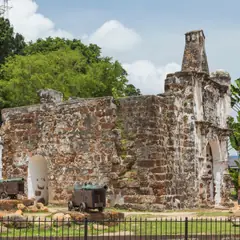
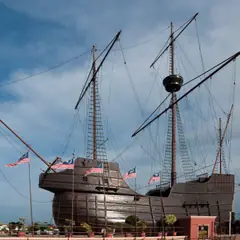
Of the fortress that surrounded the town hall a single gate still stands, A Famosa, a few steps away; on top of the hill, St. Paul’s Church was the Dutch place of worship, and beside the river the replica of the ship that carried the loot of 1511 houses the Malacca Maritime Museum.
Three centuries of white under the red
Dutch Square
Summary of this stop
The route begins beneath the clock tower, in the square everyone knows as Red Square. From here the long garnet front of the Stadthuys can be taken in, with Christ Church beside it and Queen Victoria’s fountain in the middle. It is the most photographed postcard in Malacca, and yet its colour is a late addition: under Dutch rule the town hall was white, like all Dutch administrative buildings in Southeast Asia, and it was the British who, in the twentieth century, painted it salmon red along with the neighbouring church.
When exactly this happened is disputed: some sources speak of 1911, another of the 1920s, and there are photographs that show the building still white in that decade and red in the next. The 50-foot clock tower itself followed the same path. It was raised in 1886 by the philanthropist Tan Jiak Kim in memory of his father, Tan Beng Swee, who died in 1884, and it too was white before turning red under British administration. The present shade has a modern signature: in 2014 Dulux repainted 26 heritage buildings and monuments in the city together with the state government, and in a later campaign it developed a red of its own for the Stadthuys and the square. Why that colour was chosen remains without documented answer, and the theories in circulation say as much about the city as about the building; the narration puts them in their place at the foot of the tower.
A town hall from Hoorn without its fortress
Double staircase with balcony
Summary of this stop
At the foot of the double staircase, with its stone balustrade rising to a small balcony, the Stadthuys shows its European origin. According to popular sources it reproduces the old town hall of Hoorn, in West Friesland in the Netherlands, although no architectural study details that lineage. What is documented is who built it: soldiers and slaves in the service of the VOC, from the very year of the conquest.
The most eloquent thing about this spot is what cannot be seen. The Stadthuys stood enclosed within the fortress of Malacca, facing its north gate, and nothing remains of those walls beside the building. In August 1807 Penang authorised the resident William Farquhar to demolish them. According to a widespread tradition, Farquhar left standing only the Santiago gate, besides the Stadthuys and Christ Church; other versions credit him with saving more buildings, or place the gate’s rescue in a late intervention by Stamford Raffles.
The demolition also left one of the liveliest chronicles of Malacca. According to the tradition recorded by the young scribe Abdullah bin Abdul Kadir, many Malaccans believed evil spirits lived in those walls; the rumour went round that they slapped the workmen and made them vomit blood, and even when the pay was doubled nobody went back to the job. How Farquhar broke the spell, one morning on horseback with a fuse in his hand, is the episode the audio guide tells beside the staircase.
Thick walls to keep power safe
Rooms of the History and Ethnography Museum
Summary of this stop
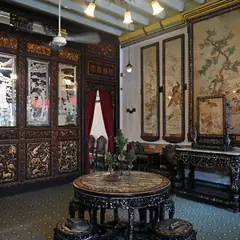
Inside, the building explains its own function. The interior has two floors and is 30 metres wide, and in the rooms the thick masonry walls, high ceilings and heavy timber beams are still in view. Walls, ceilings and large floor tiles kept the air cool and dry, so much so that the spacious rooms served as an archive for official documents despite the tropical climate. It was a building made to last and to command: after the handover to the British it continued as a Treasury, post office, government offices and apartments for senior officials, and after independence it housed the state government until 1979.
Since 1982 these rooms have held the History and Ethnography Museum, which traces the history of Malacca from its founding around 1400 to independence in 1957. The display cases show the life of the Malays, Chinese, Indians, Portuguese, Baba-Nyonya and Chitty, with traditional wedding costumes, porcelain, weapons, stamps and old coins. Among the panels there also appears the less friendly side of the Dutch citadel: a curfew that closed the compound from six in the evening and a cannon shot at eight announcing that the drawbridges were being raised. What happened to those who met a sentry at night is better understood within these same walls.
A Portuguese well beneath the Dutch
Courtyard of the Cheng Ho statue
Summary of this stop
The route ends in the inner courtyard, surrounded by the wings of the building and presided over by the statue of Admiral Cheng Ho (Zheng He), recalling his visit to Malacca in the days of the sultanate. This courtyard was the centre of a complete citadel: besides the governor’s residence, the complex held the secretary’s office, a prayer hall, dining hall, guesthouse, slave quarters, the chief merchant’s house, a prison, the trade office, warehouses and a separate bakery.
In the middle of the garden, a grille covers a hole they call the Portuguese Well. It is attributed to the Portuguese, was almost forgotten and came to light by chance during the restoration of the building. Later excavations suggest that beneath the Dutch town hall there was a Portuguese settlement, with its well and drainage system, and remains of A Famosa, the fortress the Portuguese built on taking Malacca, are believed to lie buried nearby. Where exactly they might be, and what that well says about the city the Dutch buried, is the finale the narration reserves for the courtyard.