Colonial ruin on the summit
St. Paul’s Church Audio Guide
Four roofless walls atop the old hill of the sultanate that have been a Portuguese sailor’s vow, a Jesuit church, a Calvinist temple, a powder magazine and Francis Xavier’s stopover grave, whose marble statue watches over the façade without its right hand.
- 30 min of audio
- Portuguese, Dutch and British
St. Paul’s Church crowns the old Bukit Melaka, the hill where the sultanate’s palace and mosque stood until the Portuguese tore them down in 1511. In 1521 Captain Duarte Coelho built a chapel to the Virgin here; in 1548 it passed to the Society of Jesus, grew a second floor and a tower, and after the Dutch conquest of 1641 became the Bovenkerk, the upper church of the Reformed community, before ending up as a powder magazine.
In March 1553 the body of Francis Xavier, who had died on Shangchuan Island, reached this summit, and here it lay buried until its transfer to Goa in December. Four centuries later, in 1953, a marble statue was raised in front of the façade, and it has now lost its right hand, while the interior fills with enormous Dutch gravestones carved from a stone that does not exist in the area.
Highlights
- Statue of Francis Xavier — marble of 1953, without its right hand
- Open-air nave — Portuguese chapel of 1521, Dutch church and powder magazine
- Dutch tombstones of 1640-1795 — lined up along the walls in 1932
- Maria van Riebeeck plaque — her original gravestone travelled to Cape Town in 1915
- Chancel pit — marked as Francis Xavier’s provisional grave
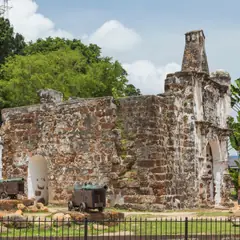
At the very top of Malacca’s old town, on the hill that during the sultanate was called Bukit Melaka, the four walls of a roofless church still stand. In 1511 the Portuguese tore down the palace, the mosque and their surroundings there, and the hill came to be called Mary’s Hill; ten years later, in 1521, Captain Duarte Coelho built a chapel to the Virgin on the summit to give thanks for having escaped a Chinese fleet during a storm in the South China Sea. Since then the building has changed owner, creed and name several times, and the hill remains a lookout over the Strait of Malacca.
The history of St. Paul’s Church is told in layers. It was a votive chapel, a Jesuit church with a college alongside, a Calvinist temple of the Dutch East India Company and, from 1744, a powder magazine, a use the British kept when they occupied Malacca in 1824. Not even its original dedication is clear: sources speak of Nossa Senhora da Graça, of the Annunciada or of Nossa Senhora do Oiteiro, Our Lady of the Hill. Nor is there agreement on the age of what is seen: some sources describe a chapel enlarged without interruption, another maintains that it was demolished in 1566 and that the present building dates from between 1566 and 1590, so its reputation as the oldest church in Southeast Asia is still in dispute. Even the name of the hill is a matter of debate, since the Melaka government proposed restoring the Malay Bukit Melaka in place of St Paul’s Hill.
What to see at St. Paul’s Church, and why each wall bears the mark of a different owner, is what the audio guide unfolds over half an hour of walking on the summit: from the statue of the saint in front of the façade to the nave open to the sky, from the Dutch tombstones to the pit in the chancel. Beneath the hill, moreover, runs a centuries-old legend of a secret tunnel, with a dragon-shaped guardian and perhaps part of the sultanate’s gold, which in 2017 the Melaka Museums Authority went so far as to declare confirmed, at least as far as the tunnel is concerned.
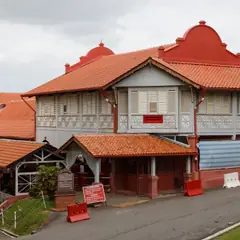
At the foot of the hill survive the last gate of the Portuguese fortress, A Famosa, and the red town hall of the Dutch, the Stadthuys.
A marble saint without a right hand
Statue of Francis Xavier
Summary of this stop
In front of the façade stands a white marble figure in a Jesuit cassock with a cross in his left hand: Francis Xavier. The statue, about 5.5 feet tall and weighing some 1,000 pounds, was unveiled on 22 March 1953, exactly 400 years after his body reached Malacca, in ten days of festivities that drew about 10,000 people. For those celebrations a bone from his right arm was brought from Macao, the same arm whose forearm had been separated from the body as a relic in 1614.
The first thing that draws attention is the truncated right arm. Popular versions of its loss circulate, such as a casuarina tree that fell on it the day after the consecration or a lightning strike, but a 1961 Filem Negara Malaysia documentary shows the statue with both arms, and around 1967 the press reported that the fingers had vanished, torn off by visitors who took them for good-luck charms. Today the whole hand is missing.
The serenity of the marble also hides a harsh episode, one that history still debates. In 1552, on his way to China, Xavier clashed with the captain of the city, Álvaro de Ataíde, son of Vasco da Gama, who blocked his expedition; according to the story, the Jesuit excommunicated him and summoned him before the tribunal of God. How that contest ended and what it had to do with the return of his corpse to this hill is what the narration reveals right here, before the statue.
Four lives under the same open sky
Open-air nave
Summary of this stop
On crossing the entrance the nave appears: a long rectangle of roofless stone walked from the door to the chancel. These bare walls are the sum of several uses. They began as Duarte Coelho’s votive chapel in 1521; the Portuguese enlarged it with a second floor in 1556 and added a tower in 1590, and the church came to be called Igreja de Madre de Deus. Nothing remains of that bell tower: its absence is part of what must be read in the ruin.
After the Dutch conquest of 1641, the temple was consecrated to Reformed worship as St. Paul’s Church or Bovenkerk, the upper church, and was the main church of the Dutch community until the Benedenkerk, today Christ Church, was finished at the foot of the hill in 1753. From 1744 it served as a powder magazine, and it remained one under the British from 1824. How each of those owners left a mark without entirely erasing the previous one is better understood walking the nave with the audio guide.
Gravestones of a stone not from here
Dutch tombstones on the walls
Summary of this stop
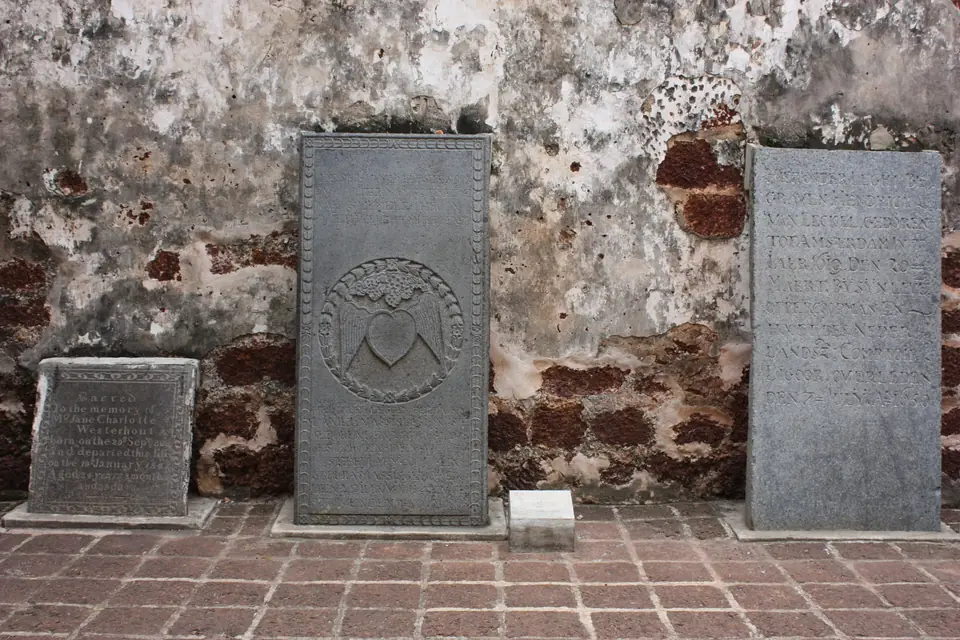
Along the inner walls large burial slabs with coats of arms and Dutch inscriptions lean upright. They are the Dutch gravestones of 1640 to 1795: enormous, decoratively worked and carved from a type of stone that does not exist in the area, which is plain to see against the porous stone of the wall. The oldest on the hill, by contrast, is Portuguese, from 1568. They lay scattered around the church until 1932, when they were lined up along the walls and the main door was reopened; years earlier, Robert Norman Bland had photographed them for his book Historical Tombstones of Malacca, published in 1905.
Among them is a plaque linking Malacca with the other end of the world: that of Maria van Riebeeck, wife of Jan van Riebeeck, founder of the Cape settlement, who died here on 2 November 1664 at the age of 35. Her original gravestone was taken to Cape Town in 1915. And beneath the chancel floor, according to documented tradition, a crypt for notable people was opened in 1592, where a Jesuit bishop who once sat before Toyotomi Hideyoshi is said to rest. Who he was and why his journey ended on this hill is one of the revelations of the route.
The empty tomb of Francis Xavier
Francis Xavier’s pit
Summary of this stop
In the chancel a rectangular hollow opens in the floor, fenced off, marked as Francis Xavier’s provisional grave. The link with this church predates his death: in 1548 the bishop of Goa, João Afonso de Albuquerque, handed the chapel to the Society of Jesus, Xavier received the deeds and that same year the College of St. Paul opened beside it. He died in 1552 on Shangchuan Island; his body was buried here on reaching Malacca in March 1553 and in December of that year was moved to Goa.
Documented tradition describes that burial as abrupt and hurried, in a pit that turned out too short, and says that months later the body left here at night and in secret. There is no agreement on how long it really spent underground nor any historical proof tying this particular hollow to the saint; even so, since 1922, when Father Jules François, parish priest of the Church of St. Francis Xavier, began it, a Mass has been held in the ruins every early December with a makeshift altar behind the empty tomb, and in 2024 more than 500 worshippers and 12 priests climbed up. What happened that night in the pit is reserved for the narration, beside the chancel.