UNESCO oral heritage
Jemaa el-Fnaa Audio Guide
An open expanse with no walls or façades to enclose it, born in 1070 before a fortress and named after a mosque that was never finished. What keeps it alive is not stone, but the voices of those who fill it every night.
- 60 min of audio
- Oral and intangible heritage
The story of Jemaa el-Fnaa begins with Marrakech itself: in 1070 the Almoravids cleared an open space for markets beside the Ksar el-Hajjar fortress, and for centuries the front of a palace made it the stage for parades, festivals and public executions. It has no architecture to define it, yet in 2001 it was the square that led UNESCO to proclaim, for the first time, the oral and intangible heritage of humanity.
Its name hides a ruin. Popular legend speaks of an assembly of the dead and of displayed heads, but a chronicler from Timbuktu wrote in the 17th century that the great mosque of Sultan Ahmad al-Mansur, abandoned half-built, came to be called the mosque of ruin. According to historians, its footprint is still traced in a block of shops north of the food stalls.
Highlights
- Halqa circles — storytellers in Darija and payment left voluntarily at the end
- Souk Jdid — the footprint of the unfinished mosque that gave the square its name
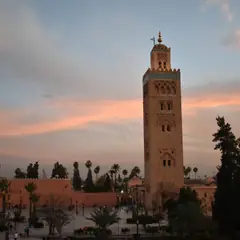
- Koutoubia minaret — 77 metres over the site of the Almoravid palace
- Café Argana — scene of the 2011 attack, with a memorial in the square
- Perimeter terraces — the stage where Hitchcock filmed in 1955
Jemaa el-Fnaa has never had a formal architectural boundary: no arcades, no façades enclosing it, no monument presiding over it. It was born in 1070, with the Almoravid founding of Marrakech, as a market esplanade before the Ksar el-Hajjar fortress, and its first name was Rahbat al-Ksar, “the square of the fortress”. Since then it has seen military parades, executions, a mosque abandoned half-built, a gunpowder explosion in 1864, an attack in 2011 and the earthquake of 2023.
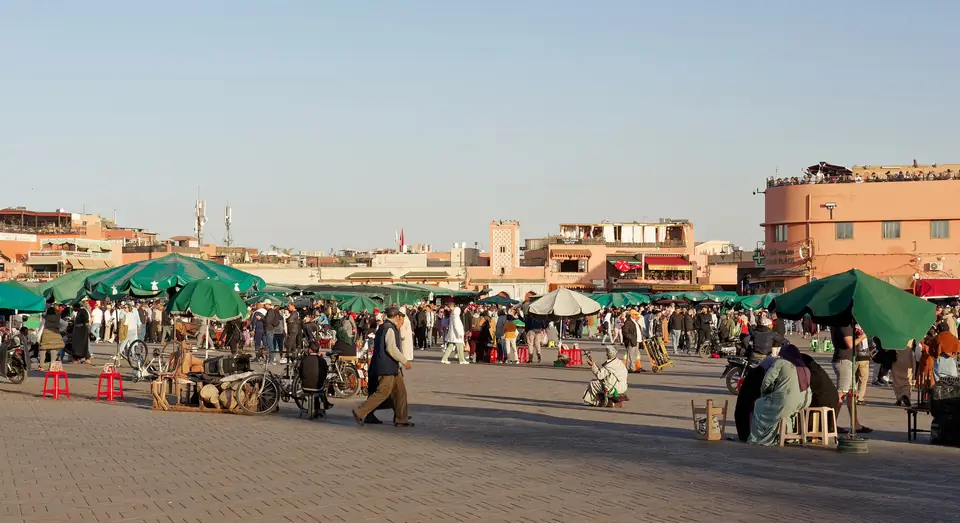
The history of Jemaa el-Fnaa is not read in stone, but in what happens on it every day. From morning to the small hours come orange-juice stalls, water-sellers in fringed red hats, snake charmers, storytellers ringed by circles of listeners and, as evening falls, the smoke of the cooking fires. In 1922 the French Protectorate passed the first laws to protect this cultural space, and in 2001 UNESCO included it in its first proclamation of Masterpieces of the Oral and Intangible Heritage of Humanity.
What to see at Jemaa el-Fnaa, then, depends on knowing how to read an emptiness. The audio guide walks it from west to east in five stops, from the Koutoubia minaret to the terraces from which the whole square can be seen, with a researched narration checked against historical sources that is best enjoyed on the spot, amid the sound of flutes and the smell of embers.
From the square, the minaret of the Koutoubia Mosque lies a few steps to the west; through the souks you reach the Mouassine district and Le Jardin Secret, and to the south-east, the Bahia Palace.
An esplanade at the feet of Almoravid power
Koutoubia minaret seen from the square
Summary of this stop
On the western edge, the horizon is dominated by the 77-metre minaret of the Koutoubia. That tower stands on the site where the Almoravid emir Ali ibn Yusuf, who reigned from 1106 to 1143, built a palace with a monumental stone gate opening onto the esplanade, beside the old Ksar el-Hajjar fortress before which the square had been born.
That palace front changed the fate of the place. What had begun as waste ground for temporary and weekly markets became, for centuries, the stage on which power showed itself to the city: military parades, festivals and public executions. That is why this edgeless esplanade is not a leftover gap between buildings, but the square of the fortress of the first Marrakech. How each piece of that vanished city fits with what is seen today from this point is something the narration reveals on the spot.
The halqa: the circle where you pay at the end
Halqa circles
Summary of this stop
In the centre of the square, the halqa circles form and dissolve throughout the day: rings of spectators, standing or squatting, around a storyteller, a group of Gnawa musicians, some acrobats or a snake charmer. The storytellers speak in Moroccan Darija to a local audience that returns night after night for the next episode. In 2001 the square was in operation from 7 in the morning to 2 at night, every day of the year, and nobody was obliged to pay: each spectator gave what they wished at the end.
The craft demands memory. Abderrahim El Makkouri, in the square since the age of 10, travelled to Fez to learn by heart the tale that won him his place, and the filmmaker Thomas Ladenburger began filming him in 2000 as one of the last of his trade.
The scene has very deep roots. Around 1650, the scholar al-Hasan al-Yusi left the first written description of a storyteller’s circle in Marrakech: on a great esplanade he joined an imposing ring of onlookers and found at its centre an old man telling comic stories. Almost four centuries later, the picture has barely changed.
Souk Jdid and the mosque of ruin
Souk Jdid
Summary of this stop
North of the food stalls stands the Souk Jdid, an apparently ordinary block of shops. Its plan, however, has the same orientation as Saadian mosques and matches the layout of the great Friday mosque that Sultan Ahmad al-Mansur, who reigned from 1578 to 1603, began to build in the middle of the square. The work was abandoned, probably because of plague epidemics, and its ruined walls could still be seen in the 19th century.
There the key to the name may lie. The Timbuktu chronicler Abderrahman as-Sa’di wrote in his Tarikh al-Sudan that the mosque was first called jamaa al-hna, “mosque of tranquillity”, and that when it was left unfinished at the sultan’s death it came to be called jamaa al-fana, “mosque of ruin”: the first written appearance of the name, in the 17th century.
Its origin is still disputed. The popular explanation translates it as “assembly of the dead” because of the executions and displayed heads; other readings derive it from a word meaning courtyard or esplanade. Historians lean towards the Saadian mosque, although it is not certain that as-Sa’di’s text refers to this one and not to another that has vanished. What separates legend from document is told, step by step, in front of its shops.
Café Argana: two explosions by the mouth of the souk
Café Argana
Summary of this stop
On the north-east corner, beside the souk entrance through which the square connects with the medina’s commercial axis, stands the two-storey Café Argana. The constant bustle of the area contrasts with what this corner has lived through. On 28 April 2011, at 11:50, two pressure-cooker bombs exploded in the café and killed 17 people, 14 foreigners and 3 Moroccans. The perpetrator was sentenced to death and a memorial to the victims was raised in the centre of the square.
It was not the first explosion in Jemaa el-Fnaa. On 24 January 1864, a fire in a funduq on the square set off 500 quintals of gunpowder hidden there to evade a government inspection. The blast damaged houses and shops over a wide radius and caused some 300 deaths. Two tragedies separated by almost a century and a half, a few steps from the bustle of the souks.
From the terraces, a shrinking square
Café de France
Summary of this stop
Facing the Café de France, the rooftops around the perimeter allow the whole square to be taken in like a stage. From above, the battle that has marked it in recent decades becomes clear. In 1997, a UNESCO meeting with Moroccan intellectuals in Marrakech defined the concept of oral heritage of humanity out of the defence of this place, driven by the Barcelona-born writer Juan Goytisolo, a resident of the medina, who delivered the opening speech of the first proclamation on 15 May 2001. Goytisolo argued that the square could be destroyed by decree, but that another like it could not be created by the same means.
Today its open surface is around 2.7 hectares, against more than 20 in the past. A civic appeal, signed among others by the storyteller Mohamed Bariz, described a square split into three thirds, commerce, restaurants and, last of all, performance, and asked that at least two thirds be reserved for the halqa. The 160-million-dirham renovation begun in May 2025 fuelled the debate: the authorities present it as a heritage enhancement, and thousands of critics compare its paving and street furniture to those of a supermarket.
These rooftops also hold a cinema episode. In May 1955, Alfred Hitchcock shot scenes of “The Man Who Knew Too Much” here, with James Stewart and Doris Day, with armed soldiers on the rooftops and racing against the clock because of a condition set by the pasha of Marrakech. At exactly what moment of the shot the director himself slipped in is the detail the audio guide reserves for this viewpoint.