Saadian palace
El Badi Palace Audio Guide (Palais El Badi)
Ahmad al-Mansur built it to dazzle ambassadors after defeating Portugal in 1578; a century later, another sultan dismantled it piece by piece. What remains is a 135-metre courtyard of bare rammed earth, crowned with storks, that measures the lost splendour with its emptiness.
- 60 min of audio
- Monumental ruin
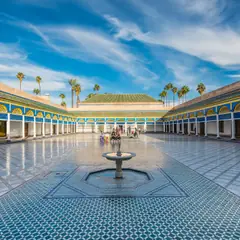
The story of El Badi begins with a victory. In December 1578, a few months after the Battle of the Three Kings (Wadi al-Makhazin), the Saadian sultan Ahmad al-Mansur launched the works for a palace of receptions paid for, probably, with the enormous ransom of the defeated Portuguese. Sugar exported to Europe and, from 1590, gold from the trans-Saharan trade did the rest. Its architecture took the riad scheme to a scale never seen: a courtyard of 135 by 110 metres, a central pool of more than 90 metres, four sunken gardens and four facing pavilions that enlarge the model of the Court of the Lions at the Alhambra.
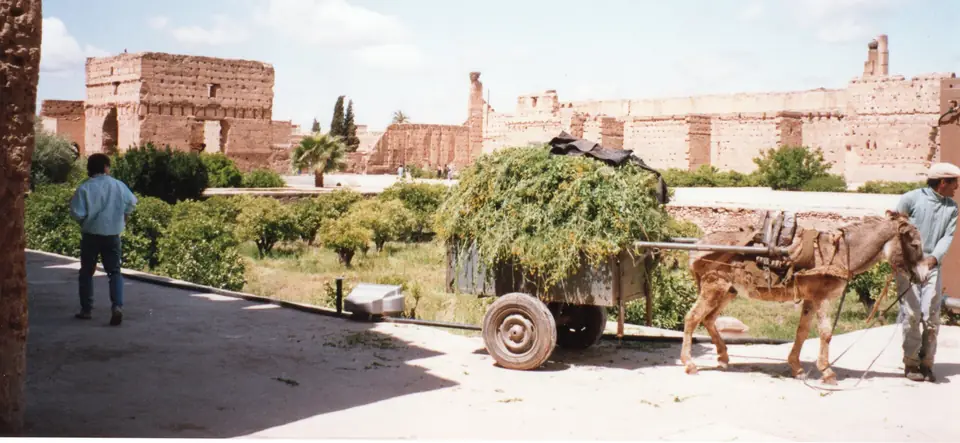
The contrast is brutal. Columns carved in Italy from Pisa marble, gilded ceilings and fountains with silver beasts covered walls of plain rammed earth. When Moulay Ismail ordered in 1707-1708 that its materials be carried off to Meknes, only the rammed earth was left. Legend has it that a jester had already foretold it to the sultan at the inaugural feast.
Highlights
- Great central pool — 90.4 by 21.7 metres on the axis of a 135 by 110 courtyard
- Four sunken orange-tree gardens, rediscovered in the 1953 excavations
- Qubba al-Khamsiniya — the throne room where the sultan received embassies
- Almoravid minbar of the Koutoubia, commissioned from a Córdoba workshop in 1137
- Rammed-earth walls crowned with white stork nests
Few palaces have been so large and lasted so little. El Badi, “the Incomparable”, was born of the Battle of the Three Kings in 1578, which gave Ahmad al-Mansur the throne, glory and, probably, the ransom that paid for the work. The name has its own enigma: al-Badi is one of the 99 names of God in Islam, although other versions attribute it to a wife of the sultan or to the zellij that covered its walls. Workers and craftsmen came to build it from many regions, Europe included, along with marble from Italy and lime and plaster from Timbuktu. The Portuguese plan of 1585 already shows it complete, but the sultan kept buying marble until 1602, a year before he died: the exact date when it was deemed finished is still debated.
A century later, the Incomparable was a quarry. The story of El Badi is that of a Saadian splendour turned into building materials for the Alaouite dynasty, and in that absence lies its strength. Today the visitor treads an immense courtyard of rammed earth where every gap has something to tell, from the 90-metre pool to the old throne room, by way of the underground galleries and the hall where the Koutoubia minbar is kept. Followed with the audio guide, stop by stop, it turns that emptiness into a palace that fills up again.
Very close by, the Bahia Palace preserves the zellige, plasterwork and painted cedar of the Alaouite viziers, and in the northern medina the Ben Youssef Madrasa holds the city’s other great Saadian work.
Storks over the ransom palace
El Badi Palace
Summary of this stop
The tour starts high on the north-east wall, near the entrance, from where the whole courtyard opens before the eye. From here the first key to the place is clear: all this was raised from December 1578, barely a few months after the Saadian victory at Wadi al-Makhazin, and was probably paid for with the ransom handed over by the defeated Portuguese. To the money of war were added the Moroccan sugar sold in Europe and, after the conquest of Timbuktu and Gao in 1590, the gold of the Sahara.
The work was a small city in itself. Ahmad al-Mansur gathered workers and craftsmen from many regions, Europeans among them; beside it a thriving market arose to supply them, and the sultan even organised the care of the workers’ children so that nothing would distract them.
Of all that bustle, the only inhabitants left are the storks that nest on the rammed earth. In Morocco they are held to be sacred birds, and an old Berber belief, older than Islam, holds that they are human beings turned into birds. In Marrakech there is even a story of a neighbour punished with that metamorphosis; who he was and what he did to deserve it is something the narration keeps for this viewpoint.
A ninety-metre pool
Great central pool
Summary of this stop
By the northern edge of the great pool, the original scale of the palace becomes tangible. The sheet of water measures 90.4 by 21.7 metres and occupies the axis of a courtyard of 135 by 110. At its sides four symmetrical gardens planted with orange trees sink down, and four other pools of about 30 by 20 metres complete the composition: a riad multiplied to the extreme, with four facing pavilions that enlarge the scheme of the Court of the Lions at the Alhambra.
That geometry was not always in view. It was the archaeological excavations of 1953 that brought to light the general structure of the palace and the sunken gardens. Among the finds appeared fragments of zellij with twenty-pointed stars, a geometry more complex than that of earlier periods.
The courtyard, moreover, has never ceased to be a stage. It has hosted the Marrakech Folklore Festival, and on 29 April 2019 Dior held its first show in Morocco here, with an enormous runway lit by dozens of floating candles beside the pool. Ahmad al-Mansur conceived it for festivities, and the festivities keep coming back.
The throne of the silver lions
Qubba al-Khamsiniya
Summary of this stop
In the western pavilion stood the Qubba al-Khamsiniya, the hall “of the Fifty”, named for its roughly 50 cubits or for its 50 columns. It was the throne room where Ahmad al-Mansur received foreign embassies. The sultan sat in a niche beneath a black marble inscription, against white marble walls, and at the centre a fountain was fed by jets from leopards, lions and pythons of silver. The court poet Abd al-Aziz al-Fishtali dedicated a poem to it bearing its name.
Today there remain the bare walls, the niche and, in front, the remains of a pool lined with zellij. The luxury came from afar: columns carved in Italy from Pisa marble, lime and plaster from Timbuktu, all on rammed-earth walls reinforced with lime. In July 1581, passing through Pisa, Michel de Montaigne saw the marble workers preparing for the “king of Fez, in Barbary” the materials of a sumptuous building with fifty marble columns. It is often repeated that the marble was paid for with sugar, weight for weight, but Montaigne’s passage says nothing of sugar.
A legend also weighs on this hall. It is said that at the grand inauguration, before European ambassadors and sheikhs from across the kingdom, the sultan asked his jester what he thought of the palace. What he replied turned out, in time, to be a prophecy, and the audio guide tells it exactly where it was spoken.
The Crystal Pavilion that is no more
Ruins of the Crystal Pavilion
Summary of this stop
On the east side the Qubbat az-Zujaj, the Crystal Pavilion, no longer stands. In its place appear the channels and vaults of the underground hydraulic network that fed the pools. It is a visible absence, and perhaps the best point from which to understand how the palace was emptied.
The decline began early. After the fall of the Saadians, Moulay Rashid, the first Alaouite sultan, lived in El Badi in 1668-1669, and according to a documented tradition he died in 1672 in one of its riads, in the palace gardens, the day after a triumphal banquet and in circumstances that give another reading to the orange trees of the courtyard. Less than ten years later, Moulay Ismail no longer let ambassadors visit it: looted and without water, it was a source of fevers that he called “dar umm mildam”, the house of fever.
In 1707-1708 Moulay Ismail ordered it demolished and its materials and decorations taken to his new capital, Meknes. The date and duration of the plunder are debated, and recent historiography sees it as a gradual process that began earlier and went on afterwards; so is the motive, which some accounts attribute to jealousy of the Saadian work and others to the palace having become a refuge for rebels. What is certain is that the ambassadors’ hall was left as waste ground where cattle grazed and dogs and owls took shelter, and that Saadian pieces ended up in Moulay Ismail’s mausoleum in Meknes, in the zawiya of Moulay Idris II in Fez and even in Algiers. Its rubble was scattered across the country: no city in Morocco was left without some remnant of El Badi.
The pulpit that found refuge in the ruin
Koutoubia minbar
Summary of this stop
The last stop leads to a hall on the south side, beside the pavilion, where the emptied palace keeps a treasure older than itself: the Almoravid minbar of the Koutoubia. Ali ibn Yusuf commissioned it from a Córdoba workshop in 1137; it stands 3.86 metres high and combines cedar, marquetry, ivory and calligraphy. It was in use in the mosque until 1962, was restored in 1996-1997 by the Metropolitan Museum and the Moroccan Ministry of Culture, and has been displayed here ever since.
The ruin, for its part, is still alive and wounded. The Al Haouz earthquake of 8 September 2023 opened cracks and caused localised collapses at El Badi, which reopened on 9 October of that year. Its restoration, of 18 months and 31.7 million dirhams, was 40% complete in September 2025. How a 12th-century Córdoban pulpit and a dismantled Saadian palace speak to each other is the closing the narration reserves for the end of the tour.