Saadian art
Ben Youssef Madrasa Audio Guide
A courtyard of marble, pink plaster and cedar that a Saadian sultan raised in 1564-65 to sign his faith, and around it more than a hundred bare cells where students from the Atlas lived for four centuries.
- 45 min of audio
- Saadian architecture
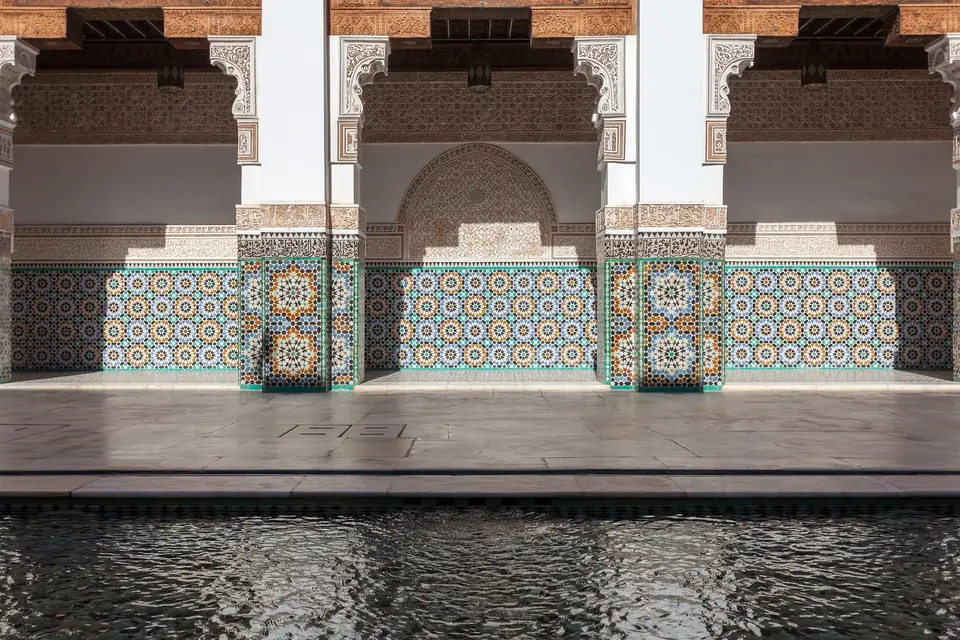
The Ben Youssef Madrasa was the largest residence for Quranic students in Morocco and the Maghreb: a plan of about 40 x 43 metres, rooms on two levels and room for some 800 residents. The Saadian sultan Abdallah al-Ghalib commissioned it in 1564-65, on the site of an earlier Marinid madrasa, and borrowed the name of the neighbouring Ben Youssef Mosque, founded by the Almoravid Ali ibn Yusuf more than four centuries earlier. Its architecture reads in three layers: zellige below, carved plaster in the middle and Middle Atlas cedar beneath the green-tiled roof.
The contrast says it all: the same building that presents itself on its lintel as the work of a sultan asking for prayers for himself was for four centuries the austere home of Berber-speaking boys who slept, cooked and ate in tiny cells. In the prayer hall there is also a marble basin carved in Córdoba around the year 1000, older than Marrakech itself.
Highlights
- Central courtyard — 21.90 x 16.50 m of white marble with a pool, zellige, plaster and cedar
- Cedar lintel — the sultan Abdallah’s foundation inscription above the bronze door
- Medina Azahara basin — Córdoban marble of 1002-1007 carved for the son of Almanzor
- Cut-tile frieze — the Hijri date 972 written at eye level
- Student cells — tiny rooms on two floors, inhabited for four centuries
In the heart of the medina, beside the old Almoravid great mosque, a bronze door opens onto a building that holds three eras. The history of the Ben Youssef Madrasa adds up a 12th-century name, a Marinid madrasa of around 1350 that no longer exists and a Saadian work dated 1564-65 by the sultan Abdallah al-Ghalib. For some four centuries it was the largest university residence in the Maghreb; it closed in 1960, reopened restored as a monument in 1982 and, after Mohammed VI’s visit to the medina in 2017, closed again between November 2018 and April 2022 for a full restoration with traditional craftsmen.
What makes it fascinating is the distance between the decor and the life it housed. The courtyard dazzles with its marble, pink plaster and cedar; the cells, by contrast, barely fit a loft and a mat. Between the two extremes lie a misquoted welcome phrase, a Granadan legend that does not survive analysis and a piece of marble that arrived from Córdoba. Even cinema passed through here: its interiors served as a set for scenes of “Hideous Kinky”, with Kate Winslet. Followed with the audio guide, the visit sorts out all those layers, from the threshold to the upper cells.
Very close by, in the northern medina, Le Jardin Secret shows how the city’s elite lived, and to the south, the El Badi Palace completes the portrait of the Saadians with what remains of Ahmad al-Mansur’s palace.
The bronze door and the half welcome
Ben Youssef Madrasa
Summary of this stop
The visit begins before crossing the threshold. A square vault of plaster muqarnas covers the entrance, and the door leaves, plated in bronze with geometric interlace, support a cedar lintel with the foundation inscription. In it the building speaks in the first person: it declares that it was raised “for the sciences and for prayer” by Abdallah, “descendant of the seal of the prophets”.
That same threshold holds the genealogy of the place. The name comes from the adjoining mosque, founded by the Almoravid sultan Ali ibn Yusuf (r. 1106-1142); the present building replaced an earlier madrasa that the Marinid sultan Abu al-Hasan had built around 1350, although sources debate whether the Saadian work was a new construction, an extension or a renovation.
Over this door circulates a phrase of welcome repeated to every visitor, a good wish for whoever enters. The full text of the lintel, however, tells a different story, and knowing to whom those “highest hopes” were really addressed changes completely the way the wood is seen. The narration reveals it on the spot, in front of the inscription.
Three layers of wall and a Granadan legend
Central courtyard and pool
Summary of this stop
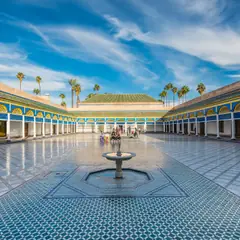
After a dim corridor, a vestibule with a star-patterned cedar ceiling and a large cedar screen beneath a plaster arch, the space bursts into light. The central courtyard, paved in white marble, measures 21.90 x 16.50 metres, a fifth of the building, and at its centre a rectangular pool collected rainwater from the roofs. Beneath its galleries, students recited the Quran in unison, seated cross-legged.
The architecture of the Ben Youssef Madrasa reads here in three registers: zellige dados 3 cm thick, calligraphic friezes at eye level and, above, gebs, a pinkish plaster from a quarry at Asni, applied in layers of 3 to 4 cm and chiselled in situ, without a mould. Higher up, eaves and beams of Middle Atlas cedar. Among the motifs appear pine cones, a signature of Saadian art, and to the right of the prayer-hall façade a frieze of cut-tile ceramic writes the date in an almost poetic formula: the year 972 of the Hijra.
It is inevitable to think of the Alhambra, and from that comparison comes the story of Granadan craftsmen summoned to work in Marrakech. Analysis of the ornamentation points to a different genealogy, that of the Marinid madrasas of Morocco; the audio guide explains which details of the wall tip the balance.
The prayer hall and the marble from Córdoba
Prayer hall and mihrab
Summary of this stop
The prayer hall has three aisles, four pink marble columns whose capitals repeat praises of the sultan, a pentagonal mihrab with a muqarnas dome and an octagonal ceiling of painted cedar. The wooden cupboards in its side aisles served as a library for the residents, because the main classes were not held here but in the neighbouring Ben Youssef Mosque: the madrasa was, above all, a residence.
The unexpected find is in a corner: an ablution basin of marble carved at Medina Azahara, near Córdoba, between 1002 and 1007 for Abd al-Malik, son of Almanzor, with vegetal scrolls and, at one end, two eagles and quadrupeds. It is older than the foundation of Marrakech. Who brought it is still debated: the official website points to Yusuf ibn Tashfin and another hypothesis to Ali ibn Yusuf. It spent centuries embedded in a wall of the ablution room, where inspector Jean Gallotti pointed it out in 1921; later it travelled to the courtyard and to the Dar Si Said museum, and since 2022 it has been back in this hall.
Among tour groups a custom persists: saying something aloud to test the echo, with an explanation about hundreds of pupils following lessons beneath the dome. The irony of that explanation is better understood on hearing the full story of the hall.
The cells of the boys from the Atlas
Student cells
Summary of this stop
From the vestibule, stairs climb to the upper cells. Small two-storey patios, with carved and painted wood, give access to tiny rooms with bare walls, some with a sleeping loft; a furnished cell reconstructs what life was like for its occupants, and from the cells above the galleries the courtyard peeks out behind the screens. The exact number of rooms varies by source, between about 130 and 136, and the capacity is given as between 800 and 900 students.
Its inhabitants, the tolba, came mostly from the Atlas and the Souss, Berber-speaking regions, after memorising the Quran in their village madrasas. They entered on the recommendation of their teachers, the institution paid for their place and each one slept, cooked and ate in his cell. So it was for some four centuries, until the closure of 1960.
The walls kept traces of that life: inscriptions carved by students, from at least the 19th century. The rehabilitation completed in 2022 covered them with layers of paint and replaced old doors with sinuous motifs with plainer ones. What those cells say about the true price of the courtyard’s splendour is left for the end of the tour.