Medina palace and garden
Le Jardin Secret Audio Guide
Behind a discreet door on Rue Mouassine lie two gardens, a 19th-century palace and a 17-metre tower that the medina left forgotten until 2016.
- 45 min of audio
- Islamic garden and riad
The story of Le Jardin Secret begins in the second half of the 16th century, when the Saadian sultan Moulay Abd-Allah laid out the Mouassine district. That Saadian palace fell at the end of the 17th century; what is visited today is the residence a caid built around the middle of the 19th over the old layout, with pointed-arch porticoes, cedar ceilings, carved stucco and tadelakt walls.
Between 1934 and 2007 the estate was split again and again among the heirs of its last great owner, until some 130 relatives claimed plots of a few square metres. In 2000 it was a site of rubble, rubbish and small dwellings; the restoration brought to light, beneath the 19th-century garden, another Saadian garden of the 16th.
Highlights
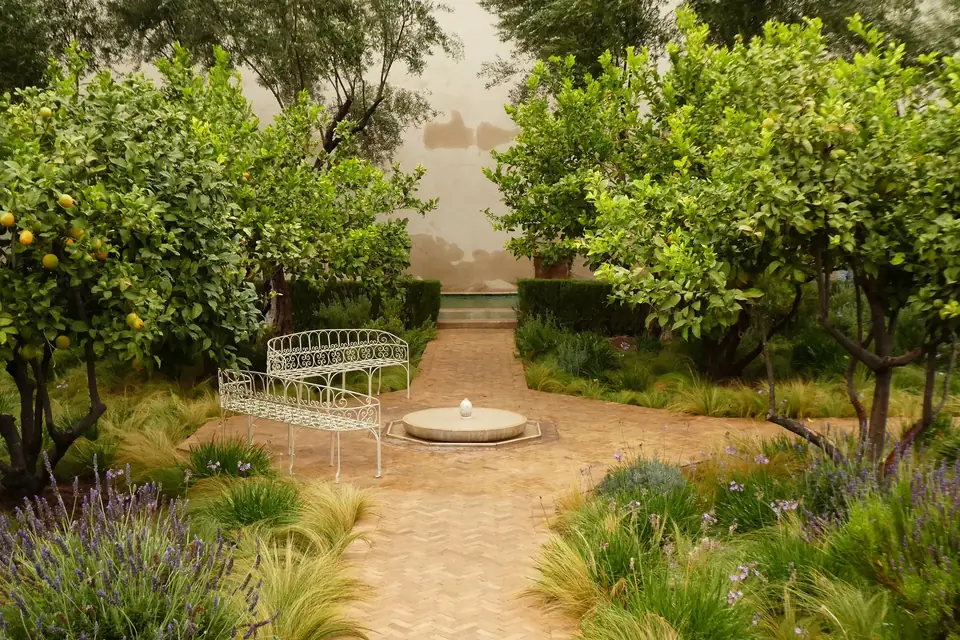
- Islamic garden — four beds with fruit trees and a marble basin at the crossing
- 17-metre tower — the height of a minaret, with views of the medina, the Koutoubia and the Atlas
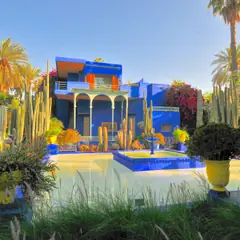
- Exotic garden — agaves, aloes, cacti and a large jacaranda
- Water paths — channels and fountains that run by gravity, without pumps
- Red pavilion — the only passage between two gardens of two eras
At number 121 Rue Mouassine, a couple of steps from the mosque of the same name, a modern reception building lets the greenery show only in glimpses. Behind it lies an enclosure of roughly an acre in the heart of the medina: two gardens, a palace-riad, a private hammam with its qubba and a tower that rivals the city’s minarets in height. The name was given by the Italian developer Lauro Milan for a simple reason: almost nobody knew it existed behind its walls.
The history of Le Jardin Secret spans four centuries. It starts around 1560 with the Saadian development of the district, continues with the palace that a caid built in the mid-19th century, reaches its splendour with a watchmaker and chamberlain to the sultan between 1912 and 1934 and then sinks into an inheritance split that came to pit some 130 relatives against one another. In 2016 the complex opened to the public daily, restored with private money and with the garden redesigned by the British landscape designer Tom Stuart-Smith. Many guides present it as a Saadian palace over 400 years old; the house’s official history places the visible buildings in the 19th century, although beneath them a 16th-century garden did turn up. What to see at Le Jardin Secret, and why every corner says something about power in the medina, is what the audio guide unpacks stop by stop, on the ground.
A few minutes away lie the Ben Youssef Madrasa and, down through the souks, Jemaa el-Fnaa; outside the walls awaits another, very different garden, the Majorelle Garden.
A garden hidden behind Rue Mouassine
Le Jardin Secret
Summary of this stop
The first contrast comes a few metres from the entrance: the din of the street fades and what remains is birdsong and dripping water. The tour opens with the exotic garden, the smaller courtyard, with winding paths among agaves, aloes, euphorbias, yuccas, cacti and grasses, and a large jacaranda as its centrepiece. They are plants from all over the world chosen for sharing a climate similar to Marrakech’s.
That the garden looks untouched forever is no small feat. In a medina where lorries cannot enter, the restoration was carried out as in another century, according to those who documented it: donkeys carried out the rubble, which left at night, when the alleys were calm, and the mature trees that give shade today also came in during the small hours. When a material was missing, it was made anew by copying the originals unearthed on the site itself. The whole process, from first contact to the end, took two and a half years.
The origin of the place is much older than that work: it goes back to the second half of the 16th century, when the Saadian sultan Moulay Abd-Allah undertook the development of the district beside the Mouassine mosque and fountain. How that past fits with what is trodden today is something the narration reveals on the spot.
The red pavilion that hides a garden
Red passage pavilion
Summary of this stop
Between the two courtyards stands a pavilion painted intense red. It is the only passage from one garden to the other and is designed to hide one from the other until the last moment. It looks like a contemporary idea, and in part it is: the pavilion is new, but it rests on old foundations.
Archaeology justified its existence. Before the restoration, excavations found a 16th-century Saadian garden hidden beneath the remains of the 19th-century one, as well as evidence of a division between the two gardens and of an old building at this point. That is why it was decided to separate them again.
The paradox of the place is condensed here. The Saadian palace that occupied the site was destroyed at the end of the 17th century, after the dynasty’s decline, and what is seen is not Saadian: around the middle of the 19th century the caid al-Hajj Abd-Allah U-Bihi took the land and built a new palace that respected the layout of the old complex. What is Saadian, however, remains underneath. What that inheritance betrays in the very form of the gardens is told by the audio guide on crossing the red threshold.
The watchmaker’s lost kiosk
Central marble basin
Summary of this stop
The Islamic garden is the larger of the two courtyards and was restored to its probable 19th-century layout: four sunken beds, separated by two raised walkways that cross at a marble basin surrounded by green, blue, yellow, black and white zellij. In the beds grow olive trees, pomegranates, fig trees, date palms and citrus, and small channels water them from the paths. The canopied pavilion that now covers the basin is a recent addition for events.
It occupies the spot where the carved-wood kiosk of al-Hajj Muhammad Loukrissi once stood, former head of the Marrakech watchmakers’ guild and, from 1908, chamberlain to the sultan Moulay Abd al-Hafiz. In 1912, when the sultan went into exile, Loukrissi exchanged his house in Fez for this palace, property of the qadi Moulay Mustapha, and lived here until his death in 1934. He assembled a notable collection of clocks and spent every afternoon making fine watches in the middle of the garden. He shared the house with three wives, all former slaves, and numerous offspring: the Hbiqa pavilion, with its gauze curtains, bears the name of one of them. In those twenty years the estate took on the layout seen today.
Even the colour of the ground has a history. The walkways are paved with sea-green glazed tiles laid in herringbone, and that tone did not come from a catalogue: the new tiles were made to match old ones found in another corner of the house. Where that surviving sample turned up is one of the details kept for the narration.
Water of its own, the invisible luxury
Water paths
Summary of this stop
The constant murmur of the garden takes on a different meaning at this stop. In the medina, water was wealth and rank. In the second half of the 11th century the Almoravids built Marrakech’s first khettara, an underground gallery that draws water from the aquifer for mosques, hammams and fountains. Some large houses also received it, and this was one of them: having your own supply was a rare privilege and a sign of power.
The water paths preserve visible traces of the original system: pipes, tanks and linked channels, beside an exhibition devoted to the khettara. In Loukrissi’s time the water came down from the Atlas through pipes and tanks to the neighbouring Mouassine mosque and from there to the palace’s two enclosures.
That circuit stopped working. According to the house’s official information, the open pool is today filled from a deep well, although some travel guide maintains that the garden drinks from a restored original khettara. What is not disputed is that channels, basins and fountains still run by gravity, without pumps. How this feat of silent engineering is achieved is explained in the audio guide, in front of the conduits themselves.
A tower as a private minaret
Tower of Le Jardin Secret
Summary of this stop
The tower that dominates the Islamic garden is 17 metres high, the same height as many of the city’s minarets, and that was no accident: it expressed the owner’s wealth. Its upper rooms were used to receive important guests, and an opening in the roof allowed smoke signals to be sent to other elite families in times of danger. It is visited with a separate ticket and from the top the medina, the Koutoubia and the Atlas can be seen. In Marrakech these towers are called mesneh, and their original function is still debated: some say they served to watch for the arrival of water, others that they let the judge-owner communicate with the mosques of his jurisdiction, and others consider them small observatories for fixing prayer times.
From above, the rise and ruin of the house can also be read. Its builder, the caid U-Bihi, did not enjoy it for long: suspected of power intrigues in the eyes of the sultan Muhammad IV, he died from poisoned tea shortly after raising it, and the palace passed to the qadi Moulay Mustapha. After Loukrissi’s death in 1934, the estate was fragmented among his descendants for over seventy years, until in 2007 it returned to a single hand.
Amid poison, inheritance and oblivion, the tower witnessed everything. Which version of its past is more convincing is left for the end of the tour, when the narration climbs to the top.