19th-century palace
Bahia Palace Audio Guide (Palais Bahia)
Two grand viziers, father and son of slave descent, built a labyrinth of marble courtyards and painted cedar halls house by house. The sultan they served emptied it in a few hours.
- 60 min of audio
- Zellige and painted cedar
The Bahia Palace was born in 1866-1867 with the Great Riad of the grand vizier Si Musa and grew between 1894 and 1900 under his son Ba Ahmed, de facto regent of Morocco, who kept buying land until he had absorbed some 60 houses and 16 orchards. The result is a labyrinthine plan, all on the ground floor, where zellige, plasterwork and painted cedar sum up the Marrakech that came before the Protectorate.
The rooms are seen today almost bare, and it is no neglect: hours after Ba Ahmed’s death, in May 1900, the sultan Abdelaziz ordered everything of value to be carried off. Legend disputes who arrived first, the sultan’s men or the women of the harem, and in 1917 there was still, beside the favourite’s apartment, a low padlocked door that everyone called the Vizier’s Treasure Door.
Highlights
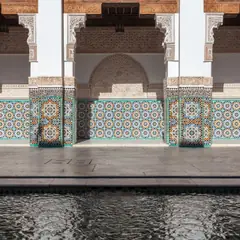
- Great Courtyard — 50 x 30 metres of Carrara marble and 52 painted wooden columns
- Small Riad — Ba Ahmed’s diwan and Lyautey’s residence from 1912
- Hall of Honour — an Atlas cedar ceiling painted with saffron, pomegranate and henna
- Great Riad — the oldest core, with inscriptions of 1866-1867
- Some 80 harem rooms around a single courtyard
The history of the Bahia Palace is that of a family that rose out of slavery to govern Morocco. Si Musa’s father was born a slave of the sultan Moulay Slimane and became his chamberlain; Si Musa was chamberlain and then grand vizier, and around 1866-1867 he built the Great Riad, the core of the complex. His son Ba Ahmed went further: in 1894 he secured the throne for Abdelaziz, a boy of about 16, and ruled the country from these halls until his death on 17 May 1900.
What to see at the Bahia Palace goes far beyond the decoration: it is a plan with no unified design, grown by purchases, with materials brought from all over Morocco (marble from Meknes, cedar from the Middle Atlas, tiles from Tétouan) and an abrupt end, the looting ordered by the sultan. Then came the Glaoui, the resident-general Lyautey, the novelist Edith Wharton, who in 1917 called it the most beautiful and fantastic of Moroccan palaces, and a film scene with Jean-Paul Belmondo. Today it is the most visited monument in the country, and the audio guide goes through that history courtyard by courtyard, in the order in which the palace tells it.
A short distance away, the El Badi Palace shows what remained of the great Saadian palace, and in the Mouassine district, Le Jardin Secret shows another 19th-century elite house.
The door that was not the original
Bahia Palace
Summary of this stop
The tour begins with an abrupt step from noise to silence: a horseshoe-arch gateway and a long path among plants leading to the present visitors’ entrance. It is not the door the viziers used; the original opened onto the Riad Zitoun el-Jedid district, and the change already says a lot about a building that never had a plan.
Between 1894 and 1900, Ba Ahmed expanded his father’s palace piece by piece as he bought land: some 60 houses and 16 orchards, a good part of the district north of the Mellah, whose streets were left crooked for ever. Everything was built on the ground floor, probably because the vizier, short and obese, had difficulty climbing stairs.
The name also has an owner. Al-Bahia, “the Brilliant One”, was the name of Lalla al-Bahia al-Rahmaniya, Ba Ahmed’s favourite wife, although another version attributes it to a favourite of the sultan. What that path announces about the rest of the palace is better understood on hearing the narration there.
From this garden Morocco was ruled
Small Riad
Summary of this stop
The Small Riad is a square garden divided by two crossing walkways, with galleries of painted wooden eaves and rooms with decorated ceilings. Here Ba Ahmed had his diwan, the hall where he received statesmen and governed the country in the name of an adolescent sultan.
The road to that power is one of the darkest episodes in Moroccan history, recorded by documented tradition: in June 1894 the sultan Hassan I died on campaign, in the Tadla region, and his chamberlain concealed the death while the royal procession kept marching as if nothing had happened. Only on reaching near Settat did he announce that the heir was the youngest son and set himself up as regent; he then had the two brothers who dominated the government arrested and kept the grand viziership for himself.
The same rooms changed hands several times. Around 1906-1908 Madani el-Glaoui, brother of the pasha of Marrakech, moved in and added over this riad the palace’s first floor to entertain foreign guests. In 1912 it became the private residence of Hubert Lyautey, the first French resident-general, and the vizier’s diwan received heating, fireplaces, a telephone and the first electric light.
Fifty-two columns for a harem
Great Courtyard
Summary of this stop
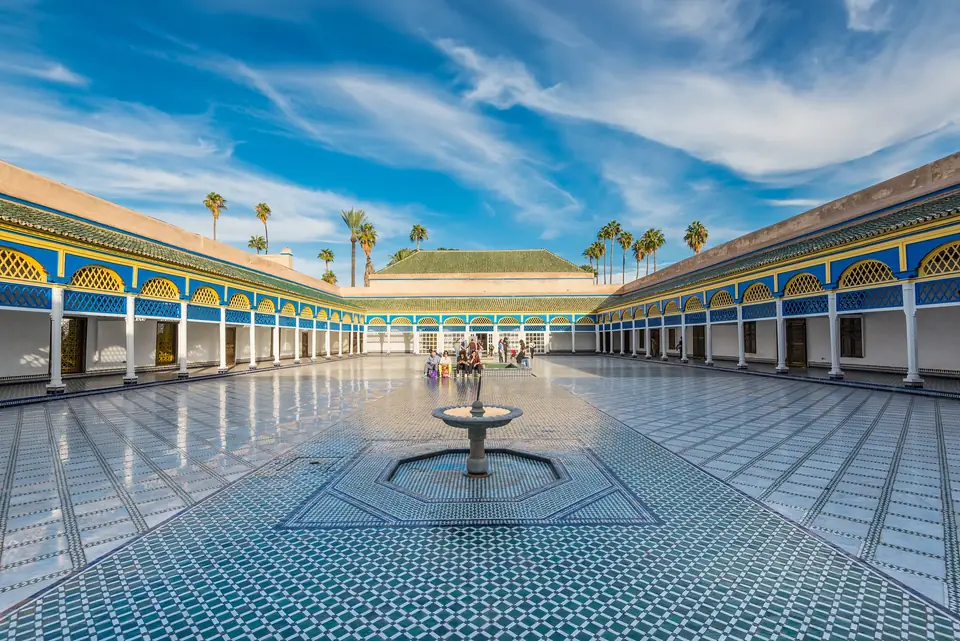
The Great Courtyard, or Court of Honour, dated 1896-1897, changes the scale of the tour: 50 by 30 metres paved with Carrara marble and zellige, three fountains and a painted wooden gallery held up by 52 columns. At the far end the minaret of the palace mosque peeks out above the rooftops.
Behind the doors of that gallery lie some 80 rooms that housed Ba Ahmed’s harem: four official wives, 24 concubines and their children. The vizier’s fortune became proverbial, and tradition cites these works as proof: around a million and a half gold francs in thirteen months to extend some wings, in years when half the country complained of his taxes.
The courtyard also had its moment in film. In 1964 the final scene of “Cent mille dollars au soleil”, by Henri Verneuil, was shot here, with Jean-Paul Belmondo and Lino Ventura. What lies behind that figure in gold francs and how the courtyard is read today is left for the narration.
A saffron ceiling over an empty hall
Hall of Honour
Summary of this stop
At the eastern end of the Great Courtyard opens the Hall of Honour, 20 by 8 metres, probably the palace’s last great extension. Its high ceiling holds one of the finest paintings on wood in the complex: Middle Atlas cedar carved and painted with colours obtained from natural products such as saffron, pomegranate, henna and egg.
Below, almost nothing. The bareness of the rooms is the mark of the looting: at Ba Ahmed’s death the palace passed to the Crown, and barely a few hours later the sultan Abdelaziz, by then with full power, ordered all valuables to be carried off.
Legend, disputed, complicates the official version. According to some, the vizier’s concubines got ahead of the sultan’s men with the most precious things; according to others, it was the wives who dismantled the house on royal orders, or the women of the harem, by then free, who emptied it without damaging a single wall. Some add the motive: no palace could outshine the sultan’s. Who really emptied these rooms remains an open question, and the audio guide poses it in front of the ceiling.
Dar Si Moussa, where it all began
Great Riad
Summary of this stop
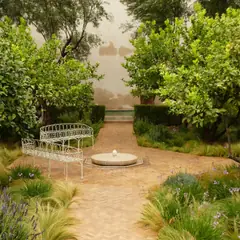
The tour ends at the beginning. The Great Riad, or Dar Si Moussa, is the largest garden of the palace, with 19th-century trees and two halls whose inscriptions date their construction to 1866-1867, under the sultan Muhammad ibn Abd al-Rahman, although some sources place the dates and the sultan differently. It was built by Si Musa, son of a slave of the sultan who rose to chamberlain and, himself, to grand vizier.
Its halls combine carved wooden lintels, painted ceilings and coloured glass; it is said that the Bahia was the first building in North Africa to use stained glass as decoration, a popular belief that is unproven. The Al Haouz earthquake of 8 September 2023 opened cracks and partly brought down this riad and the upper floor; the palace reopened a month later and the full restoration was planned with a year-long study.
The palace is still alive. After independence it became a royal residence again for Mohammed V, Hassan II handed it to the Ministry of Culture to open it to the public and the king still uses it at times to receive foreign dignitaries. Between January and April 2019 it received 410,141 visitors, more than any other monument in Morocco. The close of the viziers’ story, in the very place where it began, is heard in the narration.