Almohad architecture
Koutoubia Mosque Audio Guide
A mosque built twice in a decade, a street of booksellers that gave it its name and a 77-metre minaret that crossed the Strait to become the model for the Giralda.
- 30 min of audio
- 12th-century minaret
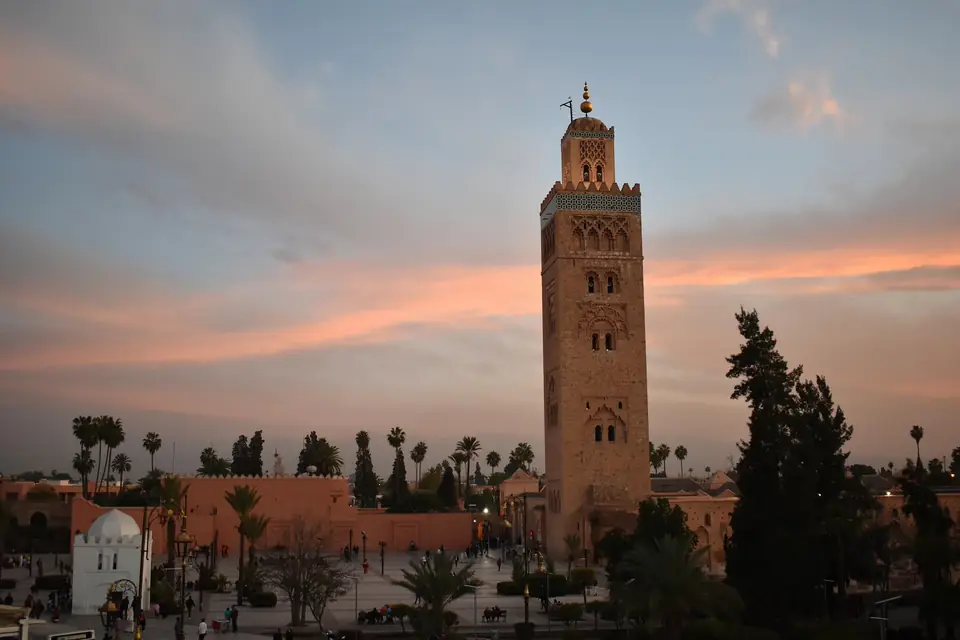
The Koutoubia is the great Almohad mosque of Marrakech and remains the city’s main active mosque. Abd al-Mumin founded it after taking Marrakech from the Almoravids, over the ruins of their stone fortress, and shortly afterwards built a second, almost identical mosque beside the first. Its minaret, some 77 metres to the tip of the finial, set the pattern for the Hassan Tower in Rabat and for the Seville minaret known today as the Giralda.
The second mosque was built with a turn to the south that left it even further from Mecca than the first, and nobody has fully explained why. Inside the tower there are no stairs, but a ramp up which the muezzin could ride on horseback; and on the esplanade, among the ruins, a small white dome shelters a saint said to turn into a dove at night.
Highlights
- Almohad minaret — some 77 metres to the finial, with a 55.68-metre shaft
- Interior ramp with no stairs — the muezzin could ride up on horseback
- Band of white and green zellige — Morocco’s oldest dated example, 12th century
- Ruins of the first mosque — foundations, pillars and mihrab in view on the esplanade
- Model for the Giralda — the same pattern as the Hassan Tower in Rabat
From almost any rooftop in Marrakech the same sandstone tower rises. It is the minaret of the Koutoubia, the great mosque that the Almohad caliph Abd al-Mumin founded in 1147, the year he took the city from the Almoravids, over the ruins of the Qasr al-Hajar, their stone fortress. Around 1158 he built a second, almost identical mosque beside the first, and the complex ended up as twin mosques with a single minaret. The chronology, though, is disputed: a recent reading pushes the first back to 1158, following the arrival in Marrakech of the Quran of Uthman from Córdoba, and places the start of the second before 1163.
The story of the Koutoubia is that of a mosque built twice, of a city of booksellers and of a tower that served as the model for the Giralda. Today non-Muslim visitors walk around it from the outside, and from the outside is where it reads best: the faces of the minaret, the ruins of the first mosque on the esplanade and the gardens from which the whole tower can be taken in. What to see at the Koutoubia, and why each architectural detail tells something, is what the audio guide unpacks stop by stop, in thirty minutes of walking.
A few steps away, Jemaa el-Fnaa grew in the shadow of the same minaret, and outside the walls, in Gueliz, the Majorelle Garden shows the other face of the city, that of the Protectorate.
A mosque named after a bookshop
Booksellers’ façade
Summary of this stop
The east façade, with its side doors and the green-tiled roofs above the naves, holds the origin of the name. Koutoubia comes from kutubiyyin, “the booksellers”: in its early centuries the mosque was surrounded by some hundred stalls of books and manuscripts lined up right in front of this side, where archaeology has located the shops. Today none remain.
What has not gone is religious life. The Koutoubia is still Marrakech’s great active mosque: during Ramadan it takes in between 25,000 and 30,000 worshippers, and close to 100,000 on the night of the 27th. Here the bay’a, the oath of allegiance, was proclaimed to the Alaouite sultans Sidi Mohammed ben Abdallah in 1757 and Moulay Mohammed ben Abderrahmane in 1859. And the rule that leaves so many visitors at the door hides an origin that few suspect, which the narration reveals on the spot.
A tower to ride up on horseback
Koutoubia Mosque
Summary of this stop
At the foot of the minaret, the tower can be read from bottom to top like a machine. The main shaft reaches 55.68 metres on a square base 12.81 metres a side, a proportion of a little over five to one that made it taller and slimmer than earlier North African minarets; with the lantern and finial it reaches some 77 metres, although the figures vary according to how it is measured. Abd al-Mumin began it and Yaqub al-Mansur may have completed it around 1195, although the sources do not agree on its authorship.
Each of the four faces carries a different set of blind-arch panels, and its windows sit at different heights for a practical reason: inside there are no stairs, but six stacked chambers surrounded by a broad ramp up which the muezzin could ride on horseback. At the top, under the battlements, a band of white and green tiles is the oldest securely dated zellige in Morocco, from the 12th century; on the arches beside the windows survive traces of Almohad paint in ochre with Kufic medallions proclaiming that power belongs to God.
Around 1352 the Tangier-born traveller Ibn Battuta climbed this tower, which he described as tremendous and prodigious, and summed up what he saw in a single sentence. What could be seen from the top also fed a legend that the audio guide tells at the foot of the minaret.
The mosque that twisted twice
Ruins of the first mosque
Summary of this stop
On the esplanade to the north-west, at an angle different from that of the present building, the foundations, the pillar bases and the outline of the mihrab and qibla wall of the first mosque are still visible, known from excavations begun in 1923. Beside them appear remains of the Almoravid fortress of 1070 and of the palace of Ali ibn Yusuf, completed in 1126. Its origin has something of a command about it: after defeating the Almoravids, the Almohads refused for three days to enter Marrakech because Ibn Tumart, their Mahdi, had ordered them not to until it was purified; the jurists ruled that another mosque should be built, and Abd al-Mumin pulled down Ali ibn Yusuf’s and raised his own beside the palace.
That first Koutoubia hid a contrivance: an engineer from Málaga, al-Hajj Yaish, built a six-sided wooden maqsura, with room for over a thousand men, which rose from the floor when the caliph entered and folded away when he left. Excavations have confirmed the pit of the mechanism. And then there is the irony of the orientation: Mecca lies almost due east of Marrakech, but the first mosque faced 154° and the second, set against it with a turn to the south, about 160°, even further off. Why the second was built remains unresolved, and the hypotheses range from correcting the qibla to a growing population.
Among the ruins rises the white dome of Lalla Zohra. According to tradition, the saint who rests there was a woman by day and by night a dove that flew over the city and knew all its secrets. Marrakchi mothers still bring their daughters to her tomb, and why some women do not eat pigeon is left for the narration at that point.
The elder sister of the Giralda
Koutoubia gardens
Summary of this stop
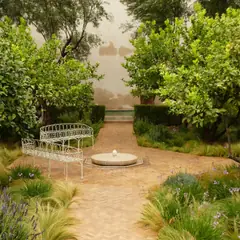
From the rose garden to the south-west of the mosque the whole minaret can be taken in, with its lantern and the finial of copper spheres. That silhouette travelled far: the Koutoubia was the forerunner of two other Almohad towers built to the same pattern in the late 12th century, the Hassan Tower in Rabat, which was never finished, and the minaret of the great mosque of Seville, preserved as the Giralda.
The tower also had a distinguished painter. After the Casablanca conference of January 1943, Winston Churchill painted it at sunset with the Atlas behind and gave the picture to Franklin D. Roosevelt; it was the only one he finished during the Second World War, and in 2021 it sold at Christie’s for £8,285,000, a record for one of his works. Eighty years later, the earthquake of 8 September 2023 opened cracks in the minaret; after works costing 24 million dirhams, the mosque reopened to worshippers on 16 March 2024.
In Arabic the tower has a nickname, the “index finger of Marrakech”, given to it by Muhammad ibn Ibrahim, the Poet of the Red. Almost all of his work was lost, and the story of how that name survived closes the tour.