Garden and museum
Majorelle Garden Audio Guide (Jardin Majorelle)
A cobalt blue invented by a painter who ruined himself for his garden, and that two strangers saved from becoming a hotel: the Majorelle Garden is the story of an obsession that outlived its creator.
- 60 min of audio
- Botanical garden and Berber art
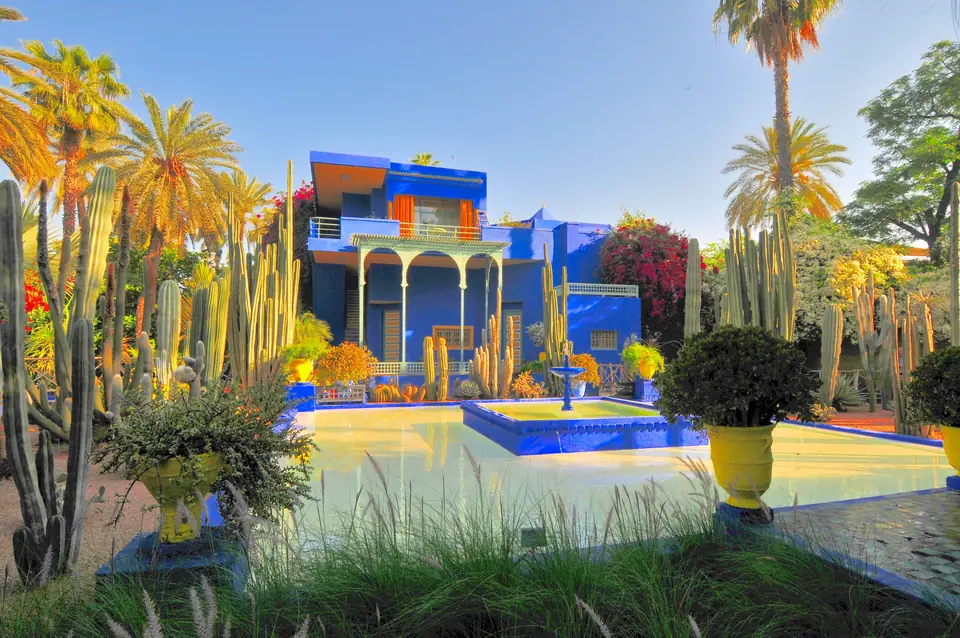
In 1923 the French painter Jacques Majorelle bought a plot of palm grove north-west of the Marrakech medina and began to plant. Around 1931-1932 the architect Paul Sinoir built him a Cubist Art Deco villa-studio, and in 1937 Majorelle coated it in an intense ultramarine blue that now bears his name. Bamboo, cacti, pools and painted pots make up one of the most photographed gardens in North Africa.
The garden finished off its author: Majorelle had to charge admission, sell off plots and, ruined, hand over his share in 1961. In 1980, when it was about to be sold to build a hotel, it was bought by Yves Saint Laurent and Pierre Bergé, who had discovered it almost empty fourteen years earlier. The couturier’s ashes were scattered in the villa’s rose garden, and in the old blue studio the museum of Berber arts now lives.
Highlights
- Majorelle blue — the colour created by the painter in 1937, inspired by Tuareg indigo
- Paul Sinoir’s Art Deco villa-studio, now the Musée Pierre Bergé des Arts Berbères
- Cactus garden — some 300 plant species after the 1980 restoration
- Yves Saint Laurent memorial — a Roman column brought from Tangier
- Bamboo tunnel with initials carved by countless visitors
Few Marrakech postcards are as recognisable as the cobalt-blue wall of the Majorelle Garden, in the Gueliz district. Behind that colour lie four decades of obsession: Jacques Majorelle, settled in the medina since 1919, bought the land in 1923, built first a Moroccan-style house and, around 1931-1932, an Art Deco villa-studio. He gathered some 135 plant species from five continents, opened the garden to the public in 1947 to be able to pay for it and ended up losing it. The history of the Majorelle Garden continues with Yves Saint Laurent and Pierre Bergé, who rescued it in 1980 from a hotel project, and with a museum that now brings together the art of the Amazigh peoples from the Rif to the Sahara. What to see at the Majorelle Garden, from the bamboo to the painter’s studio, makes more sense followed with the audio guide, stop by stop.
In the medina awaits a very different garden, the four-part one of Le Jardin Secret, and on the way, the minaret of the Koutoubia Mosque marks the entrance to the old city.
From Gueliz asphalt to the bamboo tunnel
Bamboo grove
Summary of this stop
Just past the entrance, the noise of the street fades behind the wall and the gravel path sinks into a dense bamboo grove that forms a tunnel of shade. It is the garden’s first coup de théâtre: a refuge that Majorelle planted from 1923 over an old palm grove, on the outskirts of the city of the time.
That refuge came at a price. In 1947 the painter opened its gates with an admission fee, because the upkeep was already ruinous for him, and he even sold plots to keep financing it. Almost two decades later, in 1966, the garden was still open but had barely any visitors when two newcomers began to stroll through it almost daily: Yves Saint Laurent and Pierre Bergé.
On the canes along the path another trace appears: according to a custom as widespread as it is unauthorised, countless visitors have carved their initials into the stems. What this first stretch says about the painter’s character is told in the narration, right there.
A blue invented in 1937
Central pool and blue villa
Summary of this stop
The long central pool, with water lilies and lotuses, organises the garden and leads the eye to the villa-studio that the architect Paul Sinoir built for Majorelle around 1931-1932. Sources do not entirely agree on the date or the authorship: some place it in 1932 and attribute it to the firm Robert Poisson & Paul Sinoir. The Cubist volume held below an enormous studio for the painter’s large decorative panels and, above, his living quarters.
In 1937 Majorelle created the intense ultramarine blue with which he painted the façade, the doors, the pergolas and the walls. It is no exotic whim: it recalls the indigo-dyed textiles of the Tuareg and the cobalt-blue glazed tiles of southern Morocco. The architecture of the Majorelle Garden reads thus as a manifesto both modern and Moroccan.
Against this blue a phrase attributed to Saint Laurent is often repeated: Marrakech supposedly taught him colour, and before that everything was black. The myth has a crack that is better heard in front of the villa, with the dates in hand.
Cacti against the hotel that was never built
Cactus garden and aloe avenue
Summary of this stop
Cacti, agaves, yuccas and an avenue of aloes make up the garden’s most sculptural zone. A good part of this collection was expanded from the 1980s, when the place began a second life: in 1980 Saint Laurent and Bergé learned that the estate was to be sold to build a hotel, bought it and moved into the house, which they renamed Villa Oasis.
The restoration installed automatic irrigation, assembled a team of 20 gardeners and took the collection from some 135 species to some 300. After Saint Laurent’s death, the landscape designer Madison Cox added numerous native Moroccan succulents and covered the paths with pink gravel, the dominant colour of Marrakech, among pots painted blue and yellow.
How that gravel reconciles Majorelle’s blue with the red city is one of the threads the audio guide untangles at this point.
A column from Tangier for Saint Laurent
Yves Saint Laurent memorial
Summary of this stop
In the heart of the public garden rises a Roman column brought from Tangier, on a pedestal with a plaque bearing the name of Yves Saint Laurent. The couturier died in Paris on 1 June 2008, and his ashes were scattered in the rose garden of the Villa Oasis, the private part, with separate access.
The day after his death a tomb in the garden was announced that never existed, and for years a version circulated of ashes buried in the villa: the column is a memorial, not a grave. His fate crosses that of Majorelle, who wrote that the garden would take his last years and that he would fall exhausted beneath its branches. After a car accident in 1955, ruined, he handed over his share in 1961, died in Paris on 14 October 1962 and is buried in Nancy, his home town, beside his father, the Art Nouveau cabinetmaker Louis Majorelle.
Two men united by the same garden and separated by their end: the narration tells in front of the column why neither of them rests where expected.
From the painter’s studio to Amazigh art
Musée Pierre Bergé des Arts Berbères
Summary of this stop
On the ground floor of the blue villa, where Majorelle painted his giant panels, a museum of Islamic art designed by the decorator Bill Willis opened after the 1980 purchase. In December 2011 it gave way to the Berber Museum, with more than 600 objects from the Bergé and Saint Laurent collection: jewellery, weapons, carpets, decorated doors and musical instruments from the Rif to the Sahara. Since 2020 it has been called the Musée Pierre Bergé des Arts Berbères.
The circle between garden, fashion and Morocco closed quickly. In August 1980, the same year as the purchase, Vogue published a shoot by the photographer Horst P. Horst with a famous image: Saint Laurent reclining in the garden among Berber carpets in rust red, yellow and green, geometric cushions and trays brimming with citrus. What links that photograph with the pieces of this studio is the close of the tour with the audio guide.