Skyscraper and Textile Memory
Coltejer Building Audio Guide (Edificio Coltejer)
The spire crowning Medellín rose over the ruins of the city's great theatre, became the tallest building in Latin America and today bears the name of a textile company that no longer has a single worker.
- 20 min of audio
- Modern architecture
Between 1968 and 1972 the Compañía Colombiana de Tejidos built its headquarters at the corner of Junín and La Playa, on the site of the Gonzalo Mejía building, which the Belgian Agustín Goovaerts had designed in 1922 with the Teatro Junín and the Hotel Europa. The project by Raúl Fajardo Moreno's consortium, winner of a competition entered by eight firms, opened in 1972 at 175 metres by the most widespread figure: the tallest skyscraper in Colombia and Latin America.
The company that touched the sky had been born in 1907 in a workshop on Calle Ricaurte with four machines, twelve workers and a thousand pesos. In January 2023, with its plants shut down for more than a year, Coltejer dismissed its last workers: the tower keeps the name of a factory that no longer makes anything.
Highlights
- Crowning spire — the silhouette seen from the valley slopes that feeds the shuttle myth
- The «buttonholes» near the top — large windows absent from the plans that the manager asked for to see the city
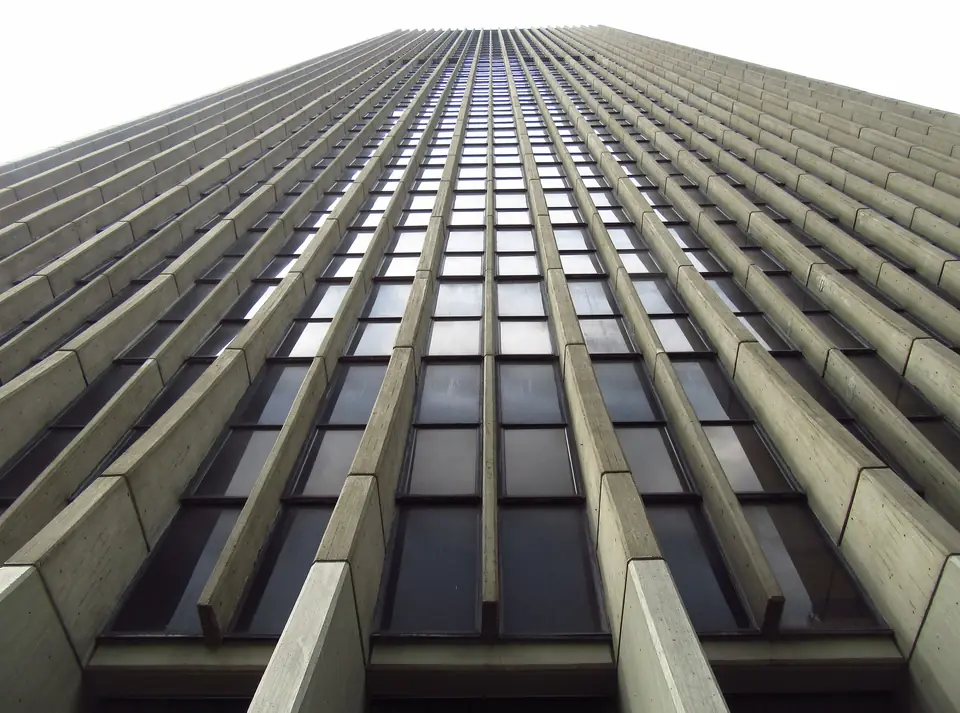
- Slanted columns on La Playa — the great structural challenge of a building using 18,000 cubic metres of concrete
- Teatro Junín corner — the site of the theatre for over 4,000 spectators, demolished in 1967
- Flags at the summit — Antioquia and Colombia, seven by four metres, on poles of about 14 metres
In October 1967 the Teatro Junín screened a film for the last time, «Arizona Colt», and the following week the walls of the building that housed it began to fall. On that site, the textile company Coltejer raised between 1968 and 1972 a 175-metre skyscraper, by the most widespread figure (El Colombiano has published 147, and the number of floors appears as 35, 36 or 37 depending on the source), which on opening stood 5 metres above the Mirante do Vale and 7 above the Edifício Itália, both in Brazil, and 14 above Bogotá’s Edificio Avianca. How long that primacy lasted is another discussion: some stretch it to 1977 and others limit it to 1972 for Latin America, reserving 1977 for the Colombian record.
The tower consumed six million steel nails, 18,000 cubic metres of concrete and 3,800 kilometres of iron rebar for 42,000 square metres of floor area, and debuted the country’s first air conditioning with true climate control in an office building. Its stairs also have a history of their own: on 6 May 1999 the Antioquian bike trials rider Javier Zapata climbed its 761 steps by bicycle, without putting a foot on the ground, in 23 minutes and 17 seconds, a Guinness record, and in May 2025, aged 52, he did it again to teach his sport to his son.
The history of the Coltejer Building, the architecture of its spire and what to see from the street are the thread of the audio guide, documented and checked against historical sources, which tours the tower from outside in four stops: the Junín pedestrian street, the corner of the old theatre, the base of slanted columns and Avenida La Playa, with the summit in view.
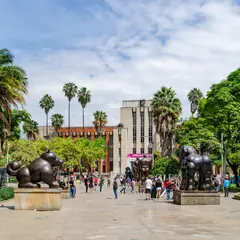
About 230 metres away, Parque Berrío marks the place where the town was born, and 350 metres off the bronzes of Plaza Botero occupy a downtown block demolished between 1999 and 2001; some 2 km to the north, the Medellín Botanical Garden preserves the woodland the city planted in 1913.
From the Ricaurte workshop to the roof of Latin America
Junín pedestrian street
Summary of this stop
From the Junín pedestrian street the tower dominates everything around it, and the disproportion has its origin in a workshop. Coltejer was born in 1907 in a small factory on Calle Ricaurte that Alejandro Echavarría Isaza set going with four machines, twelve workers and a thousand pesos of capital. Six decades later, that company could afford the tallest building in Colombia and Latin America.
The location was no accident. In the sixties, under the management of Rodrigo Uribe Echavarría, Coltejer chose for its new headquarters the corner of Junín and La Playa, less than 100 metres from the seat of Fabricato, the other great Antioquian textile company. Everything suggests the choice had something of a message to the competition.
What that neighbourhood means, seen from the foot of the tower, is better understood by listening to the narration on the same street.
The last film at the Teatro Junín
Junín and La Playa corner
Summary of this stop
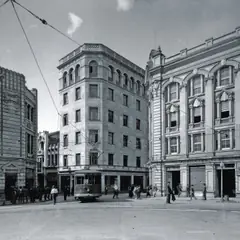
At the corner of Junín and La Playa, what weighs most is an absence. Here stood the Gonzalo Mejía building, designed in 1922 by the Belgian architect Agustín Goovaerts and opened in 1924, which combined the Teatro Junín, the Hotel Europa and shops. The theatre held more than 4,000 spectators for film, opera and zarzuela, and on Sunday mornings offered a free film matinée for people of limited means. According to the tradition collected in the city’s chronicles, it opened on 4 October 1924 with the Italian film «La sombra» and was for 43 years the obligatory stop of Sunday strolls along Junín, Medellín’s «golden mile».
In October 1967 it closed its season with «Arizona Colt» and a farewell festival for the benefit of the Children’s Hospital; with the interior already dismantled, the exterior demolition began the following week. How the city experienced that tearing-down is still debated: one source maintains it generated no controversy, while others describe it as criticised and felt as a sacrilege against heritage.
As compensation, Coltejer built on the same site two screens, Junín 1 and Junín 2, which were Medellín’s first «multiplex». The contrast between the lost theatre and those two little screens is one of the moments the audio guide develops at this corner.
Slanted columns and windows off the plans
Coltejer Building
Summary of this stop
Under the columns of the La Playa facade appears the hardest part of the building work. In 1968 the consortium led by Raúl Fajardo Moreno won the design competition, entered by eight firms, and Fajardo nearly fainted on hearing the verdict; the exact make-up of his team varies depending on who cites it, with names such as Germán Samper and Jorge Manjarrés. For the engineer Javier Echeverri Palacio, one of those in charge of the works, the challenge was these columns, which slant from east to west on the facade and the sides; the rest consisted of repeating the floor plan 36 times up to the spires.
Higher up open the large windows of the east and west sides, which were not on the plans. They were requested by the manager Rodrigo Uribe Echavarría, to whom a building of that height without a window to look out over the city seemed a waste, and the public christened them the «shuttle’s buttonholes». The idea that the whole crown imitates a shuttle or a sewing needle is very popular, but Fajardo denied it in 2007: according to the architect, it answered the manager’s request for an eye-catching crown.
Before filling with offices, the tower had another life. In 1972 it hosted the third and last Coltejer Art Biennial, with some 160 artists, works such as «Flame Orchard» by the MIT team of Gyorgy Kepes, free entry and a little gift book by Jorge Romero Brest titled «What Is Art?». What happened with the prizes and why there was no Biennial in 1974 is left to the narration beneath these columns.
The flags of the man who took over Coltejer
Coltejer summit flags
Summary of this stop
From Avenida La Playa the gaze rises to the summit, where the flags of Antioquia and Colombia fly, seven by four metres, on poles of about 14 metres. They are made of microperforated fabric to let the wind through and were put up some ten years after the opening on the direct order of the industrialist Carlos Ardila Lülle.
The name is no minor detail. According to the account in the chronicles, which not everyone tells in the same way, Ardila Lülle took control of the textile company shortly after the inauguration and removed figures of the Paisa business world from the board; that takeover is said to have pushed Antioquian businessmen to organise in defence of their companies, in what the press called the «Sindicato Antioqueño».
Since 2009 Coltejer has been controlled by the Mexican group Kaltex, and in January 2023 it was left without employees to devote itself to selling and renting its properties in Itagüí. How the flags, the takeover and the factory without workers fit into a single story is the close the audio guide reserves for the end of the route.