Square and Urban Heritage
Plaza Cisneros Audio Guide (Parque de las Luces)
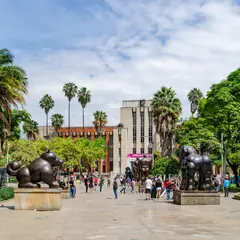
Three hundred light poles rise in downtown Medellín over what was the Guayaquil market, the city's old gateway, between a railway station, two twin brick buildings and a glass library.
- 30 min of audio
- Forest of 300 light poles
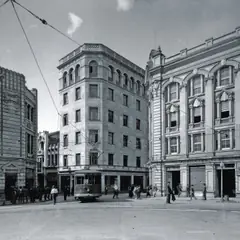
Plaza de Cisneros was born in the Guayaquil district, where in 1894 the covered market promoted by the millionaire Carlos Coriolano Amador opened: 9,000 m² closed by lime and brick walls, with five galleries, eight courtyards and 31 doors. Around it converged the terminal station of the Ferrocarril de Antioquia, the stop of the first electric tram, hotels, workshops and stores. After the death in 1898 of the Cuban engineer Francisco Javier Cisneros, the municipality gave the square his name.
Not a single wall of the great market remains. The fire of 1968, the widening of the streets and the demolition of Pasaje Sucre in 2003 erased the heart of the district, and in 2005 the «Bosque de Luz y Sombra» by Juan Manuel Peláez and the EPM Library by Felipe Uribe de Bedout took its place. The park that now shines at night does so over a void.
Highlights
- Forest of light — 300 concrete and metal towers, seven spotlights on each and computerised lighting that simulates the phases of the moon
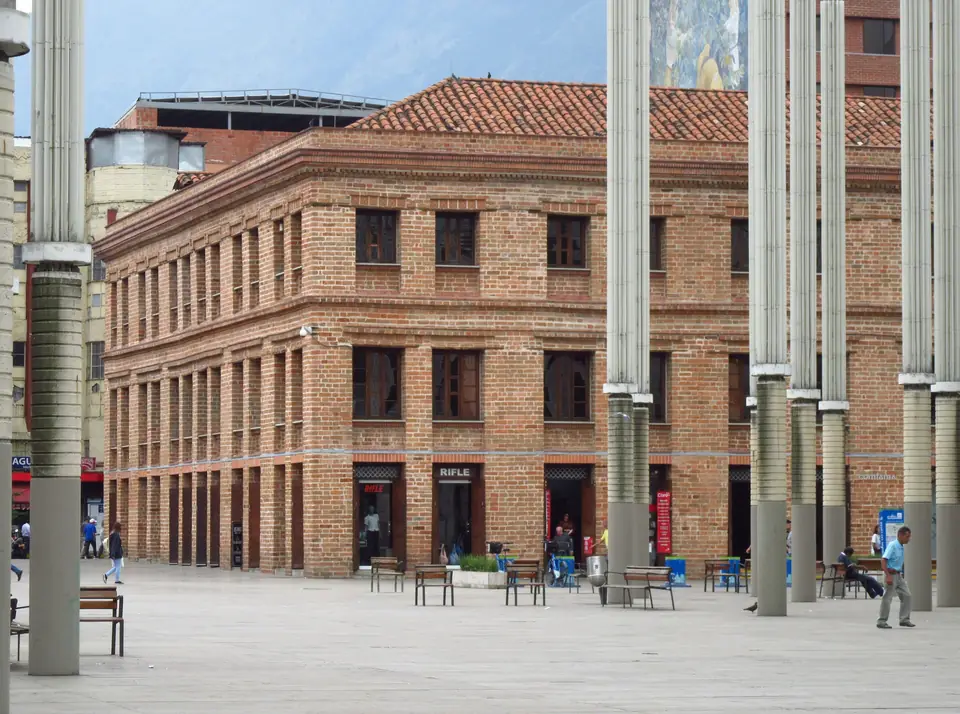
- Vásquez and Carré buildings — the brick twins by the French architect Charles Carré, facing the square from its eastern side
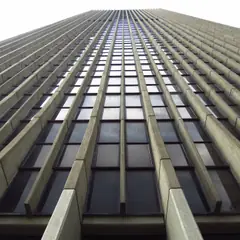
- EPM Library — a glazed, slanting facade as tall as the masts, separated from the square only by a reflecting pool
- Statue of Francisco Javier Cisneros — a bronze by Marco Tobón Mejía, with pencil and plans, facing the old Medellín Station
- Trace of the Guayaquil market — the setting of the 1968 fire and of the first silleteros parade, in 1957
At the end of the nineteenth century, whoever arrived in Medellín entered through Guayaquil. In that district, built on marshy ground, converged the terminal station of the Ferrocarril de Antioquia, the stop of the first electric tram and a covered market opened in 1894, surrounded by hotels, workshops and stores. Today Plaza de Cisneros, which the city also knows as Parque de las Luces, occupies that same ground with 16,000 m² of public space and a forest of 300 light poles.
The name of the district already announced its character. The most repeated explanation links it to the Ecuadorian city of Guayaquil, struck at the same time by yellow fever and beriberi, although some understand it figuratively, as a place of dangerous adventures, and another version moves the christening back to the early nineteenth century. Its fame was not long in coming: according to the documented tradition, from the 1930s the underworld of Guayaquil had a vocabulary of its own, with «buscadores», «bajamanos», «juaneros» and, later, «escaperos» and «cosquilleros». And around it grew from 1952 an informal trade that would come to be known as El Hueco, a nickname which, it is said, ended up registered as a trademark.
The history of Plaza Cisneros, the architecture of its twin buildings and what to see between the poles and the library are the thread of the audio guide, documented and checked against historical sources, which accompanies the route from the old station to the reflecting pool where the market stood.
It is not the only downtown square opened over what was demolished: about 800 metres away, Plaza Botero was won from another block between 1999 and 2001. And Medellín’s urban transformation has another well-known stage in the escalators of Comuna 13.
A conspiring engineer facing the station
Medellín Station of the Ferrocarril de Antioquia
Summary of this stop
The route starts across Calle San Juan, before the former Medellín Station of the Ferrocarril de Antioquia, the building where train travellers arrived. On the little square of its arcade stands a bronze by Marco Tobón Mejía on a carved marble pedestal: an engineer taking a step forward with a pencil and some plans. He is Francisco Javier Cisneros, born in Santiago de Cuba in 1836, who signed the Ferrocarril de Antioquia contract on 14 February 1874 and who also conspired for Cuban independence during the Ten Years’ War. José Martí dedicated to him in 1893 the article «Un cubano real». When he died in New York, on 7 July 1898, the municipality named the square in front of the station after him.
The statue has its own odyssey. It was commissioned in Paris following Ordinance 57 of 1920 and inaugurated in the square on 12 October 1924, 50 years after the railway contract. With the widening of Calle San Juan it was dismantled and stored, and was not raised again until April 1994, at its present site beside the station.
That removal links to a phrase Medellín applies to everything it loses: «the widening took it away», popularised by the novel «Aire de tango» by Manuel Mejía Vallejo. The book portrays a Guayaquil of tango cafés where tough guys drank, although several of the cafés it names, under those names, never existed in Medellín: they are tango titles or Buenos Aires venues. How much of that Guayaquil is memory and how much literature is the question that opens the narration at this point.
Carré’s brick against the metal of the poles
Vásquez Building
Summary of this stop
On the eastern side of the square, facing the forest of light, rise two almost identical brick buildings: the Vásquez and the Carré, the latter of four floors with green windows on every side. They were commissioned by Eduardo Vásquez Jaramillo from the French architect Carlos Emilio Carré, known as Charles Carré, who had come to Medellín to build the metropolitan cathedral. The most cited date places them in the mid-1890s, although another dating takes the Vásquez to 1906, and some also attribute to Carré the plans of the 1894 market itself, something other sources do not record.
The contrast between that nineteenth-century brick and the cold metal of the poles sums up the district of before and of now. The Vásquez building, declared a Cultural Heritage Asset of National Character in 2000, has been a shopping centre, a stopover hotel for railway travellers, a residence for wealthy families, a ruin after a fire and a tenement. Comfama restored it and occupied it from 2003 to 2021; since then it has housed offices of the District government, among them the Secretariat of Culture.
In front of these facades is also told the origin of one of the city’s great festivals. For decades, the peasants of Santa Elena came down on foot with flower «silletas» on their backs to sell them in the Cisneros market, and in 1957 the manager of the square, Efraín Botero Bernal, organised at the mayor’s request the first silleteros parade: 30 peasants set out from here with a musical group. How that first, entirely improvised procession ended is one of the memories the audio guide recovers at this stop.
Three hundred towers and a light that imitates the moon
Forest of light
Summary of this stop
In the middle of the square, the grid of poles works like a hypostyle hall of metal. It came out of the competition «Medellín es luz, un poema urbano», called in 2002 by Luis Pérez’s administration, which chose the project of Juan Manuel Peláez. The budget was 3,260 million pesos, when carrying it out in full cost close to 12,000 million; Sergio Fajardo’s administration built it with cuts for 9,165 million and the new square opened in February 2005.
The cuts show, if one knows where to look. The design foresaw 360 towers of 24 metres, with 4 metres of concrete base and 20 of metal structure, and 300 were raised. The tubes ended up at 18 metres because standard material comes in 6-metre sections, and the costly planned rings were replaced by side fins at 12 and 9 metres high. The «Bosque de Luz y Sombra» adds up to 2,100 spotlights, seven per tower, and 170 ground lamps, run by a computerised system that simulates the phases of the moon, among sheets of water, platforms at several levels and guadua groves at the edges.
Even the light had to adapt: the original lighting, costing 1,800 million pesos, was swapped for low-consumption bulbs because its power would have cost 16 million a month. From here the gaze ends on the glass of the library, which keeps with the masts a relation of heights that is no accident; the why is revealed in the narration.
Glass and water over the lost market
EPM Library
Summary of this stop
On the western side, the glazed facade of the EPM Library slants towards the square and finishes at the same height as the masts of the forest of light; a reflecting pool is the only physical boundary between the two spaces. Beneath that glass and its esplanade stood the covered market of 1894, with its 31 doors. After a first fire in the 1930s, the blaze of the early hours of 7 April 1968, fed by cane and timber roofs, mobilised 43 firefighters and 10 engines for about eight hours. According to the most cited version it destroyed a fifth of the market and left 450 traders affected, with losses of a million pesos, although another version raises what was consumed to a quarter. Afterwards an old pair of trousers and a shirt soaked in petrol turned up at the side entrance where the fire began, and the investigation was left in the hands of the F2.
The aftermath had a lesser-known side. According to the documented tradition, in the following days many fruit and vegetable sellers raised prices on the excuse of the fire and a rumour of a shortage that did not exist went around, until the mayor’s office imposed price controls. The fire marked the market’s decline, whose last vendors were expelled in 1984, when La Minorista opened.
The last remnant standing was Pasaje Sucre, annexed to the market in 1920. In December 2002 it was removed from the inventory of cultural heritage assets and in January 2003 it was demolished to build Felipe Uribe de Bedout’s library, opened on 2 June 2005. The administration cited structural instability and the loss of its original architecture; later critics cite it as a case of «express exclusion» of a heritage asset. What exactly was lost beneath this reflecting pool is the close of the route.