Founding Square
Parque Berrío Audio Guide
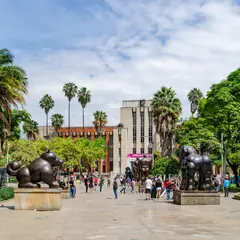
The square where Medellín was born has been churchyard, market, scaffold, banking district and metro station, and in it a marble statesman high on his pedestal and Botero's La Gorda, at ground level, share the view under the viaduct.
- 30 min of audio
- Sculpture and urban life
The old Plaza Principal was born as the forecourt of the La Candelaria church, first built in 1649, and is the founding site of the Villa de Nuestra Señora de la Candelaria, formalised in 1675. Between 1784 and 1892 it housed the town's public market, its executions and its great political events, and in 1895 it took the name of Pedro Justo Berrío when his statue was unveiled. After several fires, the colonial mansions gave way to banks and shops, and since 1995 metro line A has crossed it overhead.
In this little square two ways of raising a statue live side by side. Berrío, sculpted in Rome from only three photographs, looks out from a Carrara marble pedestal; a few steps away, Fernando Botero wanted his Female Torso almost at ground level, with no heroic air, and the city ended up treating it like a neighbour: a meeting point, a charm for those who touch it and the lead in a theatre wedding.
Highlights
- Botero's La Gorda — his first great bronze sculpture donated to Colombia, installed in 1986 almost at ground level so it could be touched
- Statue of Pedro Justo Berrío — sculpted in Rome by Giovanni Anderlini from three photographs, on Carrara marble
- Rodrigo Arenas Betancourt's El Desafío — an 18-metre bronze and concrete monument facing the Banco Popular
- Parque Berrío station — the metro station where the most passengers board, with line A above the square
- Carrilera musicians and tinteras — the circles around the Berrío planter and the thermos coffee of the park
In 2025, with a formal ceremony in Parque Berrío, Medellín celebrated its 350th anniversary. It did not choose the place by chance: here is the founding site of the Villa de Nuestra Señora de la Candelaria, formalised in 1675 with a coat of arms. The exact date the square was born is still debated, because some sources speak of 1646, others tie it to the church of 1649 and others date the church to 1680, but all agree that the city began to grow around this rectangle.
Since then the square has changed its job again and again. It was a churchyard for Mass, a public market, a place of executions, the setting for the handing out of freedom letters to 133 enslaved people, the departure point of horse-drawn carriages and the tram, a financial heart and, since 1995, a metro station. On 23 February 2026 its first full renovation since then began, with an investment of 6,500 million pesos, new Royal Veta marble paving, lighting and utilities, the preservation of its heritage trees and the temporary relocation of 141 informal vendors, lottery sellers and coffee sellers.
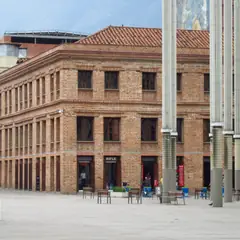
The history of Parque Berrío, the architecture of a frame of banks raised over burned mansions and what to see among its sculptures are the thread of the audio guide, documented and checked against historical sources, which tours the square in four stops, from the churchyard of La Candelaria to the feet of La Gorda. A small, noisy square that, whatever it does, remains the place where Medellín meets itself.
La Gorda has 23 bronze companions some 250 metres away, in Plaza Botero; around the corner, the spire of the Coltejer Building rises over the site of the old Teatro Junín, and a little over a kilometre away the House of Memory Museum keeps the memory of the armed conflict in the city.
From the Mass churchyard to the town scaffold
Basilica of Nuestra Señora de la Candelaria
Summary of this stop
On the eastern side of the park rise the two front towers of the Basilica of Nuestra Señora de la Candelaria. The square was born as its forecourt: it was called Plaza Principal and parishioners gathered in it before and after Mass, since the church was first built in 1649. It is the natural starting point for understanding why the city’s financial centre began as a church courtyard.
Between 1784 and 1892 this same ground housed the town’s public market and was the stage for executions and for great public and political events, while the most prominent families lived around it. Here people bought, punished and governed, all in the same space and in full view.
On 23 October 1850 the square also hosted a very different celebration: the emancipation of enslaved people, in which 133 persons received their freedom letters. What that day meant in front of the churchyard, in the same square of the executions, is one of the moments the narration keeps for hearing on the spot.
A marble governor and music at his feet
Statue of Pedro Justo Berrío
Summary of this stop
In the centre of the park, Pedro Justo Berrío, president of the Sovereign State of Antioquia between 1864 and 1873, stands with arms crossed, looking westward. The statue was unveiled on 29 June 1895 and from then on the old Plaza Principal has been called Parque de Berrío. The Italian Giovanni Anderlini sculpted it in Rome from only three photographs of the governor, and it rests on a Carrara marble pedestal with a shield, a cane, a sword and an inscription honouring him as an incorruptible and modest citizen, referring to Law 155 of 1888.
Beneath his feet lie layers of water history. Where the pedestal now stands there was a stone basin from 1789 to 1853, when the city’s first metal fountain replaced it; when the statue arrived, that fountain was moved to Plaza José Félix de Restrepo.
Life in the park flows at the level of the planter around the pedestal. In 2012 popular musicians had been singing there daily for some 40 years, playing carrilera, parrandera, waltzes and pasillos, always on the north half and never on the south. Among the circles move the tinteras with their thermos coffee, mostly women who head households, whose guild, Asotintos, grouped some 450 people in 2020. How they recovered their place in the park during the pandemic, after months of clashes with the police and an agreement that stirred controversy, is told in front of the statue.
Banks over the ashes of 1916
Arenas Betancourt's El Desafío
Summary of this stop
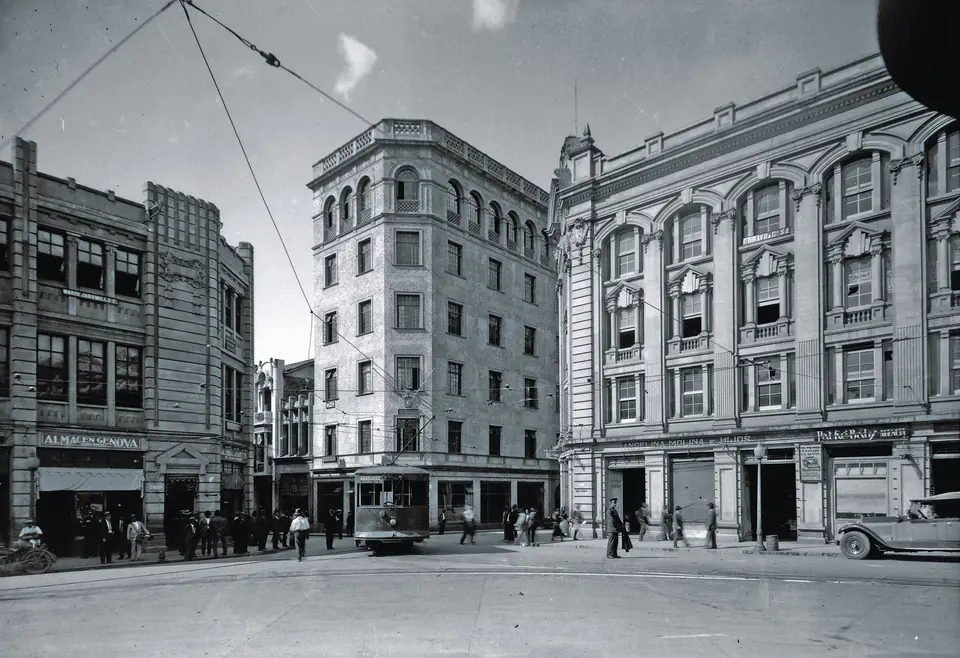
The facades that frame the square today are modern, of banks and shops, and what says most about them is what is missing: the old colonial mansions. In March 1916, according to the chronicle of the time, a fire attributed to two electric cables rubbing together reduced the Lusitania and América hotels to rubble; losses were estimated at 300,000 gold pesos and that night the police arrested 41 people for looting. The usual list of fires speaks of 1917, 1921 and 1922, and it is unclear whether the hotels’ fire is the same as the one dated 1917.
After those fires the mansions were pulled down and gave way to bank headquarters and shops, until the park became Medellín’s financial zone. The exact period of the demolitions is also disputed: some sources link them to the fires of the early twentieth century and others place the modern-style reconstruction in the 1960s and 1970s. The square also lived, according to the chronicles, a dark afternoon on 9 April 1948, when the echo of the Bogotazo reached the city: offices and shops closed, there was a fire near the park and in two days of disturbances some 500 premises in Medellín were looted.
On the south-eastern corner, facing the Banco Popular building, stands the standard of that banking era: Desafío a la raza, known as El Desafío, by Rodrigo Arenas Betancourt, a vertical monument of bronze and concrete 18 metres high, dated 1978 according to the local press, although other sources give 1981 as the year of its donation. What that figure rising over the ruins of the colonial city tells is revealed at the stop.
The Gorda Botero took off the pedestal
Botero's La Gorda
Summary of this stop
The south-western corner, at the crossing of Calle Colombia and Calle Bolívar, was always a place of passage. Before the tram, horse-drawn carriages left the park for the whole city; in November 1921 the first electric tram line arrived, linking the San Pedro cemetery with Parque de Berrío, where all the routes ended up converging. In the late eighties and early nineties the square was redesigned and received deep foundations for the metro station, opened on 30 November 1995 on line A: today it is the station of the system where the most passengers board.
Facing the Banco de la República waits the Female Torso, La Gorda, a bulky, headless bronze on a low pedestal. On 15 September 1986, according to the press, Fernando Botero directed here the installation of what was his first great bronze sculpture donated to Colombia, and he wanted it almost at ground level, without the heroic character of a statue set high. Touching it is said to bring luck, and for decades, before mobile phones, it was the great meeting point of the Centro. The city treats it like a neighbour with a biography of its own: at 20 it was married off to a theatre character, and Botero died in 2023 on the same day of the year he had installed it.
On the morning of its arrival, the crate escorted by police patrols was opened plank by plank before a crowd of onlookers, while Botero ran from side to side directing what he himself called the «operación destape» (unveiling operation). What appeared first, the public’s reaction and the misunderstanding that disconcerted the artist in the middle of the debut close the route at the feet of La Gorda.