Botanical Garden and Heritage
Medellín Botanical Garden Audio Guide (Jardín Botánico de Medellín Joaquín Antonio Uribe)
It was a bathhouse, a woodland planted over pastureland in 1913 and a park with a racecourse and a boating lake; it nearly closed after 1991 and today breathes under the ten timber tree-flowers of the Orquideorama.
- 75 min of audio
- Nature and architecture
In northern Medellín, beside the Universidad metro station, some 13 hectares of green stretch out that look like jungle and are not. On 11 August 1913, for the centenary of Antioquia's Independence, the Sociedad de Mejoras Públicas planted here the Bosque Centenario de la Independencia on the pastures of the El Edén estate. In 1972 it became the Joaquín Antonio Uribe Botanical Garden, and between 2005 and 2007 it was completely renovated with a timber canopy that is now an emblem of the city's architecture.
The great lung of the north almost disappeared: after the 1991 Constitution it stopped receiving direct public funding and spent nearly fifteen years on the brink of closure. And meanwhile, among its herbarium drawers slept an orchid nobody had described, made known in 2022.
Highlights
- Entrance ceiba — the Grandfather Tree, about 110 years old, a survivor from the days of the Bosque de la Independencia
- Francisco José de Caldas Lagoon — the former boating lake of Medellín's great recreation park
- Madremonte sculpture — a work by José Horacio Betancur, with an orchid that covers more than botany
- JAUM Herbarium — the fifth in Colombia, from whose specimens a new orchid emerged in 2022
- José Jerónimo Triana Orquideorama — ten timber tree-flowers over 4,200 m²
At the end of the nineteenth century, this corner of northern Medellín was El Edén, the estate and bathhouse of Víctor Arango. Families came by carriage or on horseback to bathe, eat, close deals and arrange alliances, until the tram was extended to Bermejal and the place declined. Its waters, which ran down from the Campo Valdés hills, even inspired a business ahead of its time: according to the history of the garden, José María Arango, one of the estate’s administrators, tried unsuccessfully to produce here the first fizzy drinks, forerunners of those of Posada Tobón, the future Postobón.
On 11 August 1913, for the first centenary of Antioquia’s Independence, the Sociedad de Mejoras Públicas planted on that land the Bosque Centenario de la Independencia, which for more than 50 years the city came to call simply El Bosque. Its nursery, the country’s first great nursery, left its mark far from here: it is said that one day in May 1939 the industrialist and urbanist Ricardo Olano himself, with five labourers, made the first planting on Cerro Nutibara with trees from El Bosque, and that between 1940 and 1944 the nursery supplied the city with fifty thousand trees, 12,357 of them for that hill.
A Cultural Heritage site of Medellín since 1985, the garden covers 13.2 hectares according to the Mayor’s Office (other sources say 14) and remains the great public space of the north: it hosts the Orchids, Flowers and Crafts show of each Flower Festival and, in 2022, the 16th Book and Culture Festival. What to see at the Medellín Botanical Garden, its history of a woodland lost and recovered and the architecture of its Orquideorama are the thread of the audio guide, documented and checked against historical sources, which tours it from the entrance ceiba to the timber canopy.
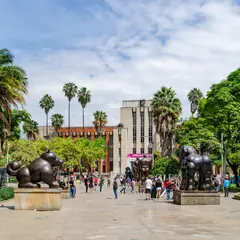
About 2 km to the south, downtown, Plaza Botero gathers outdoors 23 bronzes by the Antioquian painter, and very close by the spire of the Coltejer Building, raised between 1968 and 1972, was in its day the tallest skyscraper in Latin America.
The ceiba that watches the entrance
Entrance ceiba
Summary of this stop
Beside the entrance rises a great Ceiba pentandra of about 110 years, the Grandfather Tree, a survivor from the days of the Bosque de la Independencia. In Medellín it has a second nickname, Guardian Tree, which it earned because the texture of its trunk seems full of open eyes watching whoever arrives; it is also said that its branches spread as far as its roots do underground.
The shade that greets the visitor is not, however, a remnant of jungle. The Bosque of 1913 preserved no earlier forest: it was planted, lush and dense, over a grazing area of the El Edén estate, chosen by Ricardo Greiffenstein, president of the Sociedad de Mejoras Públicas, for its size and its water sources. And the boundary crossed on entering is not the original either: in the 2006 renovation, the perimeter walls gave way to a permeable fence of black steel panels and mesh, by Lorenzo Castro and Ana Elvira Vélez, and Castro also designed the circular concrete pavilion with its reflecting pool, finished in 2008.
What changes the view of the whole garden is understanding who planted this green and why. The ceiba is the only living witness of that history, and the narration tells it at the foot of its trunk.
The boating lake and the first racecourse
Francisco José de Caldas Lagoon
Summary of this stop
On the shore of the Francisco José de Caldas Lagoon, today a calm wetland and wildlife refuge, it is hard to imagine the bustle of other times. This was the lake where people rowed boats in Medellín’s great recreation park. The Bosque de la Independencia, created in 1913 with 235,000 varas of extent, housed the city’s first racecourse, with a double track, a building with bar, restaurant and dance floor, tennis courts, a little train, an incipient zoo and even sales of dogs and cats.
Opposite, in the cloister of the Patio de las Azaleas, the present Salón Restrepo occupies the place of the old skating rink. In the early twentieth century, El Bosque was also the setting for patriotic festivities: rowing and fishing contests, sack races, pole contests, band concerts and theatrical and folk shows in an acoustic shell, with children riding donkeys and the dancing starting at one or two in the afternoon.
Behind that recreation park the memory of the bathhouse, where Medellín society closed deals and alliances, remained alive. How the two lives of the place fit together, that of the spa and that of the public promenade, is unravelled on the shore.
A Madremonte with a modesty orchid
Madremonte sculpture
Summary of this stop
Among the vegetation appears the Madremonte, the sculpture José Horacio Betancur carved in 1953. It embodies one of the most deeply rooted myths of Antioquia: half woman and half forest, dressed in moss and leaves, guardian of rivers, jungles and animals. Legend says she punishes greedy hunters and woodcutters, the unfaithful and those who invade others’ land by erasing their path in the undergrowth, and that when she bathes at the headwaters she muddies the streams and unleashes floods and storms.
The orchid the figure wears has a less botanical story than it seems. The Madremonte was born naked, in the Medellín of the Bachué, the Muisca goddess by the same Betancur that, it is said, firefighters removed almost in secret on a rainy dawn for being scandalous. The sculptor, according to that account, enlarged the orchid until it covered her nipples so he could exhibit her without trouble. His son, the sculptor Miguel Ángel Betancur, even says the Bachué had been conceived for the central lake of the Bosque de la Independencia.
The statue reached the garden when El Bosque had already lost its splendour: after half a century as a great public promenade, the park entered decline around 1963, partly because of the appearance of brothels in its surroundings. The swap of sculptures that brought her here in 1986 is one of the most curious episodes of the route.
The herbarium that endured
JAUM Herbarium
Summary of this stop
Behind the glazed facades and reflecting pools of the 2007 Scientific Building lies the JAUM herbarium, the fifth most important in Colombia, beside the Andrés Posada Arango botanical library. Its drawers hold 1,200 collections described for the first time in the world in the garden itself, and from them came in 2022 a new orchid, Epidendrum sonsonense, endemic to the Páramo de Sonsón, identified when reviewing, between 2017 and 2020, specimens that were already there.
That treasure survived a long fragility. With the 1991 Constitution, the garden, a private foundation with public participation, stopped receiving direct public funding and spent nearly fifteen years on the brink of closure, until Sergio Fajardo’s administration included it in a master plan for the northern zone in exchange for ceding part of its land. The full renovation began on 1 March 2005 and was delivered on 1 December 2007, with 32,000 million pesos for physical transformation alone; the free-admission month that followed drew 96,000 people.
The threat returned one night in 2021. According to the account of the garden’s own management, on 28 May, in the midst of the national strike protest wave, a group of vandals entered the garden, destroyed the reading room, trampled and stole its books and broke the glass; the director, Claudia Lucía García, estimated the losses at about 100 million pesos, and the city responded with the campaign #UnidosPorElJardín. What that night forced Medellín to ask itself is told in front of these windows.
The tree-flowers of the Orquideorama
José Jerónimo Triana Orquideorama
Summary of this stop
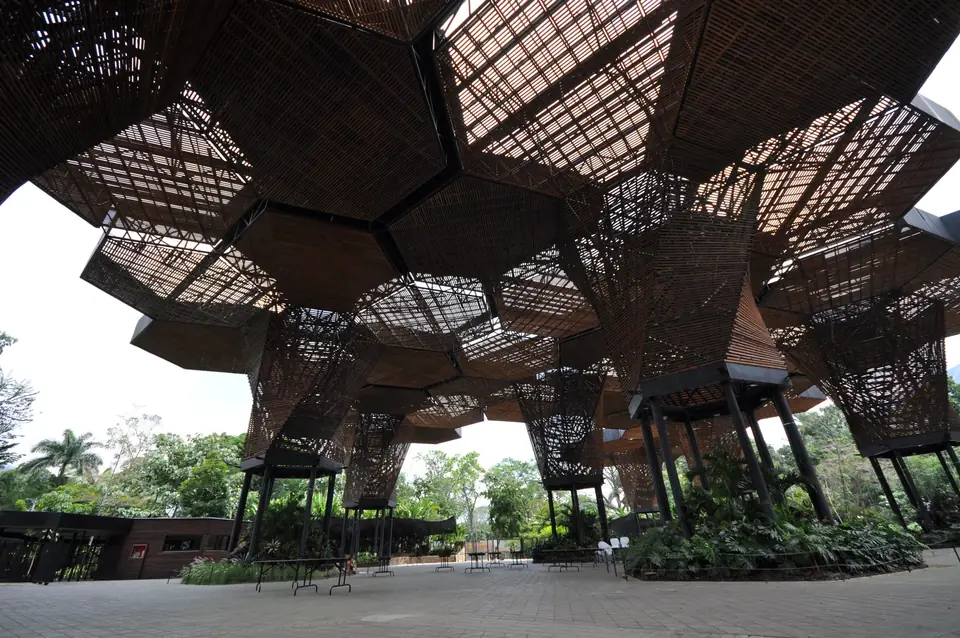
The route ends under the canopy of the José Jerónimo Triana Orquideorama: ten «tree-flowers», modules of seven hexagons of timber slats on metal pillars whose hollow trunks regulate temperature and humidity and collect water. Beneath grow orchids, bromeliads, carnivorous plants and tree ferns beside a small lake, in a 4,200 m² space that also hosts weddings, concerts and fairs. The canopy, designed so it can grow or be replicated, fills the gap left by the foliage the woodland lacked.
The work came from a competition in October 2005 won by Plan B (Felipe Mesa, Alejandro Bernal) and JPRCR (Camilo Restrepo, J. Paul Restrepo), was built between January and August 2006 with a budget of 2.2 million dollars and opened on 25 August 2006. It was raised on the structure of the 1972 orquideorama, the one that saw the garden born.
That foundation also has its history. In 1968, Elena Baraya, president of the Colombian Orchidological Society, returned from Australia with the news that Medellín would host the 7th World Orchid Conference, and on 19 April 1972, before 62 delegations, the Joaquín Antonio Uribe Botanical Garden was inaugurated here, named after the Antioquian naturalist. Under this timber the circle closes on a woodland planted by hand, lost and recovered several times, and the narration saves for the end what still remains to be defended.