Memory and Graffiti
Comuna 13 Audio Guide (Comuna 13 San Javier)
A hillside of houses built by hand by displaced people, the scene in 2002 of Colombia's largest urban military operation, now climbed by outdoor escalators among murals that tell that war.
- 120 min of audio
- History of the conflict
The core of Comuna 13 was founded by peasants fleeing rural violence under the name Las Granjas; in 1946 a housing cooperative turned it into a residential neighbourhood and, on the high slopes, newly displaced people built Las Independencias I, II and III and Nuevos Conquistadores. The comuna climbs to the 1,650 m contour, the limit of the urban perimeter, with slopes of 45 to 60 degrees in some sectors. Until 2002 it was the last militia stronghold in Medellín and a corridor for arms and drugs towards the Vía al Mar.
In the early hours of 21 May 2002, during Operation Mariscal, residents hung white sheets, tablecloths and towels from windows and roofs to ask for the shooting to stop. Nine years later, on 25 December 2011, families tried out outdoor escalators with their Christmas presents, replacing more than 350 concrete steps. Between one date and the other lies almost the whole history of the comuna.
Highlights
- Las Independencias I escalators — six sections with orange frames that in 2011 replaced more than 350 steps
- Mural of the elephants with white flags — a memory of the ceasefire residents begged for in May 2002
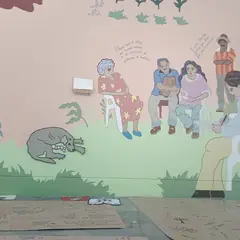
- Graffitour murals — faces of neighbours, violence and resistance where the militias once painted their initials
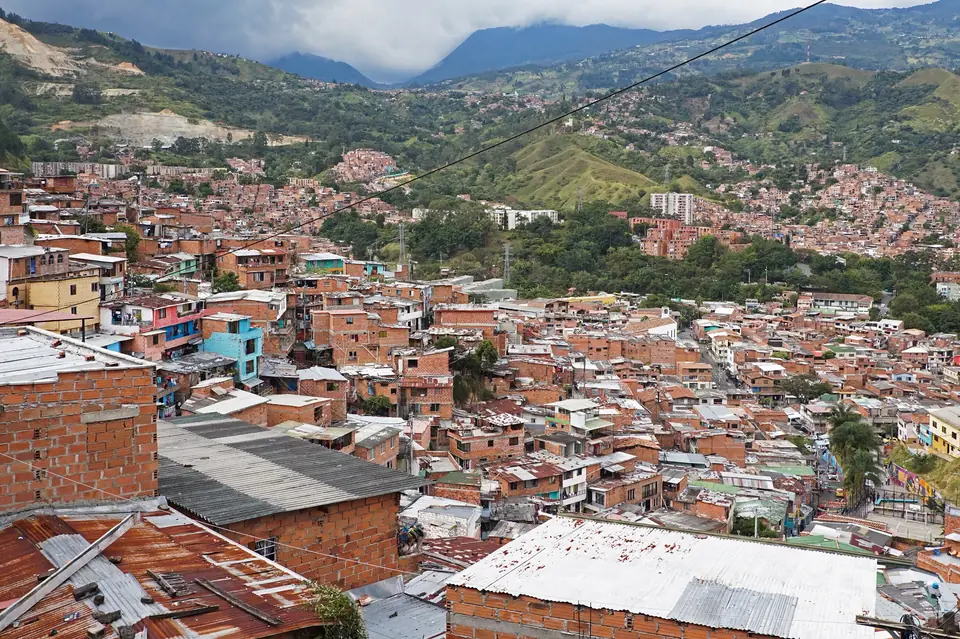
- Brick houses of Las Independencias — the hillside overflown by the helicopters of Operation Orion
- Lookout terrace — the Medellín valley from the top of the escalators, with La Escombrera on the upper slope
In 2025 the outdoor escalators of Comuna 13 received 1,981,579 visitors, more than a million of them foreign, and they remain at the same time the daily access route for more than 12,000 residents. Few places in Medellín are photographed so much, and few carry such a hard history: here, in October 2002, Operation Orion was fought, considered the largest urban armed action of the Colombian conflict, and here the search for disappeared people continues.
The comuna is often associated with Pablo Escobar, but there is no clear proof that the Medellín cartel directly controlled its territory: on these slopes local gangs and militias operated, and later urban guerrillas and paramilitaries. That history, of self-built neighbourhoods, the two military operations of 2002, and the graffiti and hip hop that answered the war, runs along every wall of the tourist stretch. Since 2004, around 17 October, the festival «Revolución sin muertos» has switched the microphones back on for the anniversary of Orion.
The history of Comuna 13, the architecture of its brick houses stacked on the slope and what to see on the Las Independencias route, from the foot of the escalators to a lookout over the valley, are the thread of an audio guide documented and checked against historical sources, which treats with care the episodes where figures and versions still do not agree.
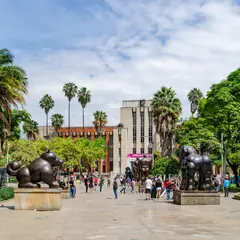
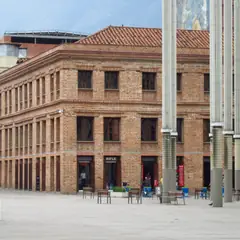
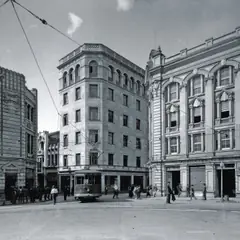
The voices of that urban war have their museum downtown, the House of Memory Museum, and another transformation of public space, that of the old Guayaquil market, stands in the forest of light poles of Plaza Cisneros.
A slope built by hand
Comuna 13 Outdoor Escalators
Summary of this stop
At the foot of the escalators, the hillside asserts itself before any mural. The houses climb without pause towards the 1,650 m contour, the limit of Medellín’s urban perimeter, on slopes that in some sectors reach 45 to 60 degrees. Las Independencias I, II and III are among the city’s high natural-disaster risk zones.
This slope was settled by peasants displaced by another violence, the rural one. The initial core was called Las Granjas; in 1946 a housing cooperative turned it into a residential neighbourhood, and on the high slopes the newcomers built illegal settlements with names that say it all: Las Independencias and Nuevos Conquistadores.
The same geography that offered refuge explains what came next. Until 2002 Comuna 13 was the last stronghold of the far-left militias in Medellín and a corridor for arms and drugs towards the Vía al Mar and western Antioquia; the Milicias América Libre, of the ELN, dominated exactly these neighbourhoods. Why this hillside was so hard to take is understood standing up, looking uphill, while the narration threads its pieces together.
White sheets and initials on the wall
Mural of the elephants with white flags
Summary of this stop
On the route appears a mural of elephants waving white flags. It recalls the early hours of 21 May 2002: at 3 a.m. Operation Mariscal began, which lasted 12 hours, and residents hung white flags, handkerchiefs, sheets, tablecloths and towels from windows and roofs to ask for the shooting to stop. The white handkerchief remains the symbol of its commemorations.
The graffiti that now draws visitors from half the world once had another meaning. The FARC, the ELN and the Comandos Armados del Pueblo painted their initials on the walls as a territorial signature, and painting a wall could cost a graffiti artist an assault. That these same walls are now covered with the faces of neighbours and scenes of resistance is, in itself, part of the story.
Behind that transformation there is a name. The rapper Héctor Enrique Pacheco, «Kolacho», of the hip hop collective C15, was murdered on 24 August 2009 in the war of invisible borders between gangs. In 2013 his companions opened Casa Kolacho in his name, which runs the Graffitour born in 2011 and uses it to fund a free hip hop school. How the step was made from armed initials to the graffiti tour is told in front of the mural.
Helicopters over the rooftops
Brick houses of Las Independencias
Summary of this stop
From the walkway between the first and second sections, the brick and cement houses can be seen up close, many unfinished, pressed against each other on the slope. Their walls of poor material let bullets through easily. Over these rooftops, in the early hours of 16 October 2002, more than 2,000 members of the security forces entered with armed helicopters and light armoured vehicles, under the command of General Mario Montoya: this was Operation Orion.
The balance usually cited adds up to 80 civilians wounded, 17 homicides committed by the security forces and 71 people killed by paramilitaries, besides forced disappearances and hundreds of arbitrary detentions. The figures, however, differ between sources, and so does the memory: the Government presented it as a security triumph, while the victims remember it as an occupation. Years later, Diego Fernando Murillo, alias Don Berna, head of the AUC’s Bloque Cacique Nutibara, confirmed before a federal court in New York that his men took part in Orion in alliance with the Army’s Fourth Brigade; after the operation, the paramilitaries came to rule the comuna.
From those days there remains a photograph by Jesús Abad Colorado: a man in camouflage and a black balaclava pointing out to the military where the alleged guerrillas would be. For 21 years nobody knew who he was. In 2023 an imprisoned former paramilitary gave him a name, in testimony that remains disputed history. What that account suggests about the eve of Orion is one of the most intense moments of the narration.
Christmas on an escalator
Marina's Papas Criollas stall
Summary of this stop
On 25 December 2011 the Las Independencias I escalators were inaugurated, replacing a climb of more than 350 concrete steps with a trip of a few minutes. For the opening, residents painted the neighbouring houses with murals and Christmas motifs, and that Christmas Day whole families rode them with their presents. According to the BBC they measure 384 metres in six sections; other sources give different measurements and costs, around 6 or 7 million dollars.
There is a notion that they are the world’s first outdoor escalators, but what was published at their inauguration contradicts it: there were earlier ones built for tourism. The pioneering aspect is having conceived them as public transport in a working-class neighbourhood, the first in Colombia with that use. They were designed by the Japanese company Fujitec and manufactured at its plant in China.
At a corner of the second section, a sign announces «Papas criollas Marina de la comuna 13». Behind the griddle is Luz Marina Mazo Echavarría, who came to the comuna at 20 and has been there for four decades, since «this was pure mud». Her story, told at the stall, sums up the comuna’s better than any figure.
The lookout and what remains to be told
Escalator lookout terrace
Summary of this stop
At the top, one of the two public buildings built with the escalators has a terrace that commands the Medellín valley. It is the place where the present is measured: almost two million visits in 2025 and, in 2026, the first full maintenance since 2011, with the replacement of 350 concrete steps.
On the upper slope of the same comuna lies La Escombrera, a rubble dump where the Special Jurisdiction for Peace ordered excavation to begin on 26 July 2024. In December of that year the first remains appeared, and by July 2025 six bodies had been recovered after removing more than 43,000 cubic metres of earth. How many people may be there is still a matter of debate, and the search is also sustained by the comuna’s searching mothers, the madres buscadoras.
Peace did not arrive with the escalators either. In 2012, ten years after Orion, Las Independencias was still crossed by invisible borders between gangs, and a woman’s name shouted from a corner served as an alarm for the whole neighbourhood. That testimony closes the route, looking at the city from above.