Botero Sculptures
Plaza Botero Audio Guide
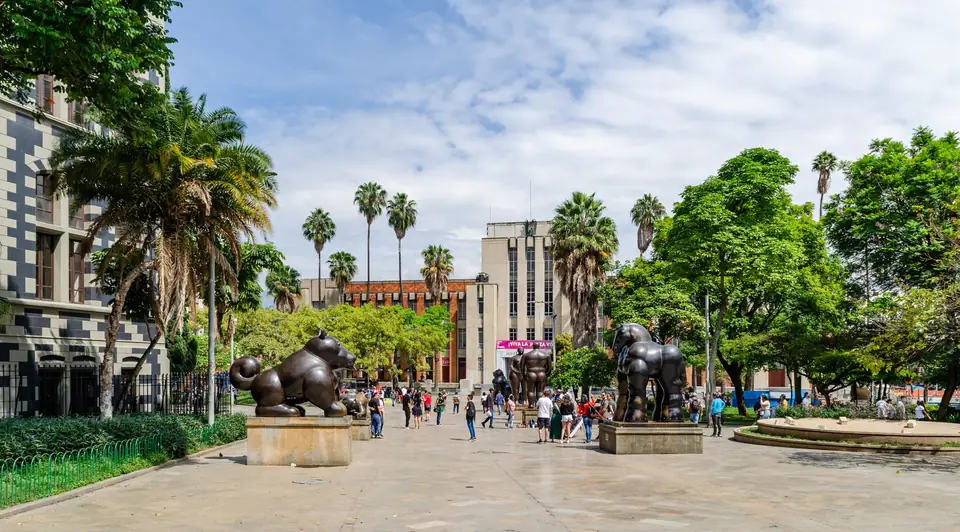
A whole block of downtown Medellín was pulled down to make room for 23 bronzes by Fernando Botero, set by him at hand height: a square born from a fax, 150,000 signatures and a rainy night of chainsaws.
- 30 min of audio
- Botero urban art
Plaza Botero covers about 7,000 m² in front of the old Municipal Palace, opened in 1937 and now home to the Museo de Antioquia. To clear it, the Ciudad Botero project demolished much of the so-called Barrio Viejo between 1999 and 2001, the Luna Park shopping centre included. Botero marked on a plan where each sculpture and each fountain would go, sketched the pedestals and decided which way each figure would face.
The gift grew as the walls came down: it began with 10 sculptures and, seeing how the little square was taking shape, Botero raised it to 14, then 18 and finally 23. And the space he donated so the city could walk through it freely spent 334 days behind police fences, until 1 January 2024.
Highlights
- 23 bronze sculptures — Man on Horseback, Eve, Adam, Maternity, Roman Soldier and The Rape of Europa, among others
- Low pedestals — sketched by Botero himself so that each figure stays within arm's reach
- Gleaming bronzes — the parts polished by thousands of hands that, according to popular belief, seek luck or love
- Museo de Antioquia — the former 1937 Municipal Palace, sold by EPM for one peso
- Palacio de la Cultura Rafael Uribe Uribe — a black and green chequerboard that many took for a church
On 23 May 1997 a handwritten letter from Fernando Botero arrived by fax for Pilar Velilla, director of the then Museo de Zea: it offered a painting room, a sculpture room and a drawing room, and a million dollars for a new building. From that letter, through demolition, Plaza Botero was born, some 7,000 m² opened in the most battered heart of Medellín. According to El Colombiano, the first stage was inaugurated on 14 October 2000, next to the new home of the Museo de Antioquia, and the square was completed with its 23 sculptures in 2001, although other sources give different dates for the donation and the opening.
The story of Plaza Botero does not fit in a photo with the «fat ladies». Beneath the bronzes lies a block that once held pool halls, tailors and hairdressers; on top of them have fallen pigments, hacksaws and fences. In December 2020 someone sprayed nine of the sculptures with an industrial powder that turned purple with water, and they could not be cleaned without an urgent permit from the Ministry of Culture, because although they stand in Medellín they belong to all Colombians. In 2021 a man cut off the Roman Soldier’s spear to sell it at a scrapyard, and the cameras made it possible to recover it.
Between the two palaces that frame it, more than 70 people work every day as vendors, photographers and living statues; some photographers, such as Ramón and Saúl, have been there since 2001 and hand over a printed portrait in ten minutes with the 23 sculptures along its edge. The audio guide, documented and checked against historical sources, covers in four stops what to see at Plaza Botero, the architecture of its palaces and the dispute still being fought over this public space.
About 250 metres away, Parque Berrío holds another of the painter’s sculptures, La Gorda, in the square where the town was born; to the south, Plaza Cisneros is another downtown square raised on what was knocked down, and some 2 km to the north the Medellín Botanical Garden is the city’s great green public space.
A fax, 150,000 signatures and a palace for one peso
Museo de Antioquia facade
Summary of this stop
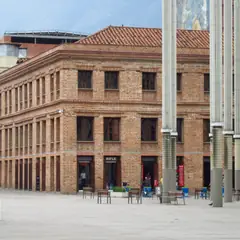
From the eastern edge, under the Metro viaduct and a few steps from Parque Berrío station, the square opens towards the brick facade of the Museo de Antioquia, the former Municipal Palace of 1937, which came into view when the block hiding it was demolished. The building reached the museum for a symbolic sum: Empresas Públicas de Medellín, its owner, sold it to the municipal administration for one peso.
First the painter had to be persuaded. With no answer from Medellín to his first offer, Botero even offered his collection to the Banco de la República in Bogotá, and from August 1998 the architect Ana María Villa gathered 150,000 signatures by hand to ask him for his work for the city, under the slogan «if Botero doesn’t give away his works, the fat is in the fire» (a pun on gorda, fat).
On the eve of the inauguration, according to those who were there, Botero rose from a dinner at La Aguacatala determined to place the sculptures that same night. What happened next, with a downpour, umbrellas, chainsaws and some lamps swapped before dawn, is told at this point of the narration.
Bronzes over the Luna Park pool halls
Botero bronze sculptures
Summary of this stop
In the middle of the square, among Eve, Adam, the Dog, the Maternity, the Man on Horseback and the Reclining Woman, the ground keeps the memory of a neighbourhood. To open the space, the Centro Comercial Luna Park was demolished along with other buildings of the Barrio Viejo, with its pool halls, its café, its tailors and its hairdressers, and also a Metro de Medellín building barely three months old that had not yet been used. Mayor Juan Gómez Martínez took the risk with a phrase that sums up the operation: «It is better to ask forgiveness than permission».
As the walls fell, the donation grew: from 10 pieces to 14, to 18 and at last to 23. In 1999 Botero drew on a plan the place of each sculpture and of the three fountains, sketched the pedestals and set their height so that the public could touch them. That is why the figures rest on low bases, even though they are often described as sculptures at ground level.
That closeness feeds a living ritual. Popular belief, the so-called «Botero legend», holds that rubbing the bronzes brings love, money or good fortune, and that each figure serves a different purpose; a photographer in the square even claims that Adam grants fertility. The most touched parts look worn and shiny, as if polished. What people ask of each sculpture is revealed by walking among them.
The unfinished palace that looked like a church
Palacio de la Cultura Rafael Uribe Uribe
Summary of this stop
To the south, at the corner of Bolívar and Calibío, rises the Palacio de la Cultura Rafael Uribe Uribe, the former Governor’s Office, with its neo-Gothic air, its dome and a facade checkered in black and greyish green. The Belgian Agustín Goovaerts wanted it in exposed brick; when required to cover it, he chose that chequerboard, which led many people in Medellín to take the Governor’s seat for a church.
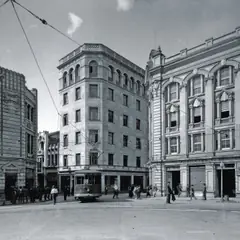
What can be seen is only part of the dream. Goovaerts designed it around 1920, but after the 1929 crisis only a little over a quarter of the project was built, which, had it been finished, would have occupied the site where the square stands today. Opposite, the Municipal Palace, or Carabobo Palace, whose competition was won in 1927 by the brothers Horacio and Martín Rodríguez, was the seat of the Mayor’s Office until its move to La Alpujarra in 1987.
Two palaces, two ways of understanding the city, one on each side of the void. The comparison between them, and what this place would have become with Goovaerts’s full project, occupies this stop.
Evictions, fences and the last farewell
Museo de Antioquia steps
Summary of this stop
From the steps of the Museo de Antioquia, the whole square can be seen. Its opening was not peaceful: the demolitions of the first stage of the Ciudad Botero project were carried out with a security force escort, anticipating possible clashes with those being evicted from shops, street corners and homes. What is officially presented as the recovery of the centre through art, others describe as a renewal that displaced its users.
At the end of January 2023, Daniel Quintero’s administration fenced off the square with police barriers and access controls. Botero wrote from Monaco that he had donated his 23 sculptures so that the city could move freely among them. The enclosure lasted 334 days and its balance is still disputed: the Mayor’s Office reported a 97 % drop in thefts from people inside the perimeter, while critics and the press pointed to the exclusion of vendors and homeless people and the shift of crime to Parque Berrío and neighbouring districts. It ended on 1 January 2024, when Federico Gutiérrez took office from the square itself and ordered the fences removed.
Between one date and the other, on 26 September 2023, Botero’s coffin returned to his square and was placed at the top of these same steps, before hundreds of admirers and with the fences still standing. How that farewell went, and who was there, closes the route.