Sixteenth-century mansion
Casa de Montejo Audio Guide
The house of the conquistadors of Yucatán was raised with stones from the Maya city of T'Hó. Its doorway, with two giant halberdiers trampling the heads of the defeated, is the conquest carved in limestone facing the Plaza Grande.
- 40 min of audio
- Plateresque façade
When Mérida was founded in 1542, Francisco de Montejo reserved the south plot of the Plaza Mayor for his family's house. The work, built between 1542 and 1549 for the Adelantado, his son the Younger and his nephew, made use of the cut stone of the temples and palaces of T'Hó, the Maya city over which the new capital was born. Of that sixteenth-century construction only the façade still stands: a Plateresque doorway that is at once the most beautiful piece on the square and a manifesto of domination.
The plot came to occupy the whole block, more than 13,000 m², and was sold off in parts. What remains has passed from hand to hand without ever leaving the circle of power: entailed estate of the Montejos, French-style residence of the Peóns, Banamex headquarters since 1981 and, since 2010, the Museo Casa Montejo, with free admission and the bank branch still open at the back of the courtyard.
Highlights
- Plateresque doorway of 1549 — giant halberdiers trampling the heads of the defeated
- Wild men with clubs — a medieval figure repeated in Ávila and San Gregorio in Valladolid
- Montejo coat of arms — granted by Charles V and quartered with the Herrera arms
- T'Hó stone — ashlars taken from the temples of the Maya city
- Museo Casa Montejo — late nineteenth-century rooms and a bank at the back of the courtyard
On the south side of Mérida’s Plaza Grande there is a façade that reads from afar as a piece apart. It is all that remains of the house that the three Francisco de Montejos, the Adelantado, the Younger and the Nephew, began to raise in 1542, the same year they founded the city over the old Maya T’Hó. The stone came from the temples and palaces of that demolished city, and the inscription on the pediment dates the work to 1549. Rarely does the story of a conquest fit whole on a single wall.
The story of the Casa de Montejo does not end at the doorway. Inside, the building tells another four and a half centuries: an entailed estate that forbade its sale, the French-style makeover by the Peóns, a bank that bought it in 1981 and a museum opened in 2010. What to see at the Casa de Montejo, who is carved on its façade and why the city came to fear losing it are better understood in front of the stone, with a documented audio guide that reads it from the bottom up.
The house closes the south side of the Plaza Grande, a few steps from the San Ildefonso Cathedral, also raised with T’Hó stone. More than three centuries later, the Palacio Cantón took the ostentation of the Yucatecan elite to the Paseo de Montejo.
A house made from the defeated city
Casa de Montejo
Summary of this stop
When laying out Mérida in 1542, the founders drew a Plaza Mayor with four plots per side, and Francisco de Montejo took the southern one. The land occupied the entire block, more than 13,000 m², and the house raised on it between 1542 and 1549 was built with cut stone torn from the ruins of T’Hó. Over the centuries the plot was sold off in parts to different buyers: a fraction remains today, and what flanks the doorway is nineteenth-century façade or entirely unrelated.
The façade also has a history of failures. In the early 1840s, according to a documented tradition, the traveller John Lloyd Stephens and the draughtsman Frederick Catherwood stopped before it as soon as they entered the square. Catherwood, the man who would draw the great Maya ruins, came down at dawn to escape the sun, but onlookers crowded around him until he had to give up. What Stephens found when he tried to look for the history of the work in the town council archive is part of what the narration tells in front of the doorway.
Giants with halberds and heads beneath their feet
Halberdiers of the doorway
Summary of this stop
On the upper part of the doorway, around the balcony, two giant Spanish halberdiers, in helmet, armour and sword, rest their feet on the heads of the defeated, who wear a look of pain. Beside them appear smaller figures dressed in rough skins and armed with knotted clubs: the «wild men» of medieval European myth, the same ones that peer out on the doorway of Ávila cathedral and on that of the Colegio de San Gregorio in Valladolid. At the top, between two rampant lions, a worn inscription recalls that «this work was ordered made by the Adelantado Don Francisco de Montejo» in MDXLIX, 1549, although some have read MDLIV.
Who those defeated are remains unclear. The popular reading takes them for Maya; another interpretation links them to the heads of heretics and to the European iconography of military and noble affirmation, and some even see the wild men as Indigenous allies of the conquistadors. Nor is the material authorship of the carving settled: Maya stonecutters are said to have worked on it, the coat of arms is tequitqui in execution, and still no name has been established for the architect or the sculptor. In Mérida there is also a legend that so much arrogance in stone displeased Charles V.
What the façade represents did come to happen on the square. According to the sources, on 14 December 1761 Jacinto Canek, the Maya who had led the Cisteil uprising, was executed here, and tradition adds that the governor watched from the balcony of this house. How that morning went is told in the audio guide, in front of the same halberdiers.
What the written stones say
Plaques beside the door
Summary of this stop
Beside the entrance, on Calle 63, two plaques sum up the official version. The older one was placed by the Liga de Acción Social on 6 January 1942, on Mérida’s fourth centenary, and states that Don Francisco de Montejo lived in this house until his death. The sentence does not fit the documents: in 1550 the Adelantado was accused of abuses against the Maya and removed from the government of Yucatán, and he died in 1553 in his native Salamanca, with the case before the Council of the Indies unresolved. The Younger, for his part, moved to Guatemala. Sources do not even agree on which of the two Montejos lived in it.
The one who truly tied the house to the family was a woman. Doña Andrea del Castillo, widow of the Younger, entailed it as a mayorazgo: it could not be sold, only pass to her descendants. So it stayed in the Montejos’ hands for almost three centuries, until 1832, already in independent Mexico, although one source stretches that ownership much longer. What the coat of arms on the balcony conceals, granted by Charles V and mixed with the arms of the Adelantado’s Sevillian wife, is one of the details the narration reveals here.
Power still sits at the back of the courtyard
Garden courtyard and bank door
Summary of this stop
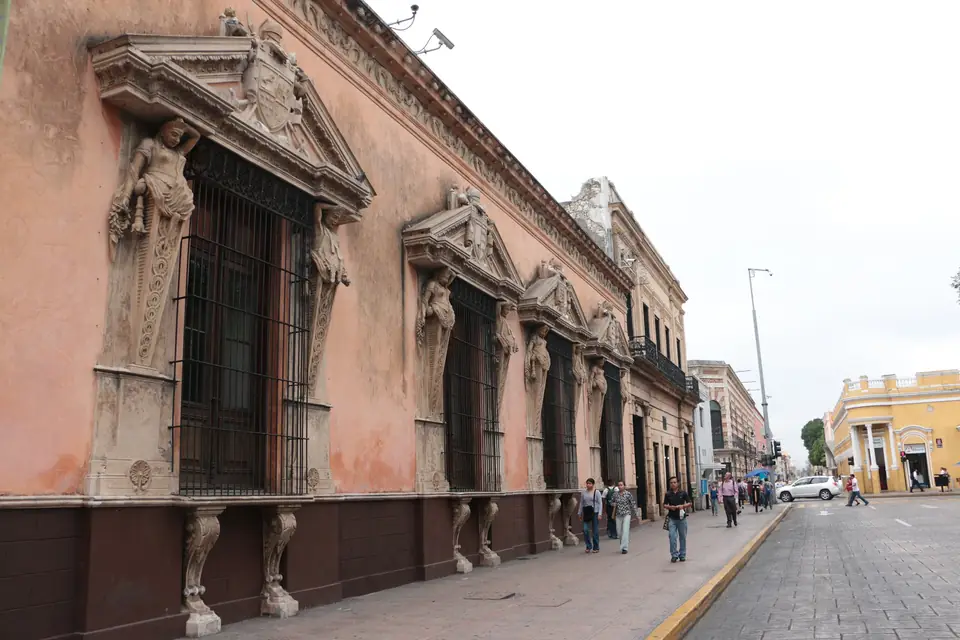
Past the entrance hall another house appears. Simón Peón y Peón bought it in late 1839 and in 1896 came the last great makeover: the interior was adapted to the French-style taste of the time and the caryatids framing the four windows on the right were added, pairs of a man and a woman of Indigenous appearance that, according to a documented tradition, are not carved stone but come from a Mérida factory of artificial stone. The exact dates of the renovations vary by source. Today, around a garden courtyard, the site museum recreates the house towards the end of the nineteenth century: dining room, sitting room, study and bedchamber, with painted ceilings and dark woods.
At the back of the courtyard a bank branch still works. Banamex bought the property in 1981 through its cultural foundation, the oldest in the bank, and after a restoration supervised by the INAH between 2007 and 2010 it opened the Museo Casa Montejo on 2 December 2010, with free admission. In 2016 there was another cleaning of the doorway to remove cables, lamps and fifteen years of dust and bird droppings.
In January 2022, Citigroup’s sale of Banamex put the house of Mérida’s founders into a lot alongside the Palacio de Iturbide in Mexico City. What the city answered then, and why it admitted it could hardly buy it, closes the route in the same courtyard.