Franciscan neighbourhood
La Mejorada Park Audio Guide (Parque de La Mejorada)
A quiet square in eastern Mérida that was a market for the villages, the starting point of Yucatán's first railway and the forecourt of a Franciscan convent turned barracks, hospital, prison and school of architecture.
- 30 min of audio
- Colonial Mérida
La Mejorada Park opens in front of a Franciscan church dedicated in 1640, whose construction was paid for by the encomendero Diego Montalvo de García before he handed it over unfinished to the order. Its dome on a false drum is one of the first on the Yucatán peninsula, and the complex was one of the two great Franciscan complexes of Mérida. Beside the church stands the convent of 1688-1694, designed for friars under rules of maximum severity.
In the shade of the laurels, nothing betrays that in this square Yucatán's first rail was driven, that for centuries vendors from the interior villages came here, and that, next to the church, a former barracks kept beneath its floor three graves with human remains that did not come to light until 1992.
Highlights
- Monument to the Niños Héroes — effigies of the cadets crowned by a great eagle, from 1970
- La Mejorada Church — a temple of 1640 with one of the first domes of the Peninsula
- Former Franciscan convent — cloister of 1688-1694, now UADY's Faculty of Architecture
- Arch of Dragons — a colonial gate the city never closed
- Former Dragoons Barracks — Franciscan hospital, barracks and now a children's cultural centre
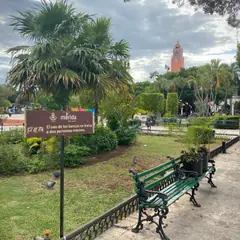
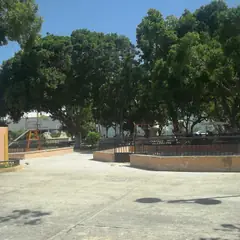
In the east of Mérida’s historic centre, La Mejorada Park has the scale of a neighbourhood: benches, laurels and a sculptural group in the centre. The story of La Mejorada, however, goes far beyond that calm. In 1621 work began here on a church funded by the encomendero Diego Montalvo de García, who had first wanted to build a hermitage on the outskirts and later a convent of cloistered nuns; in the end he handed it over unfinished to the Franciscans, and the temple was dedicated on 22 January 1640 to the Transit of Our Lady.
Since then, the square has been a market for the interior villages, a railway station, a barracks parade ground and a park dedicated to the Niños Héroes. What to see at La Mejorada Park is not limited to a façade: every building around it has changed lives several times, and some of those lives left traces that cannot be seen at a glance. The audio guide, researched and checked against historical sources, walks through those layers in four stops, from the square of the first rail to the Arch of Dragons. One block away, on Calle 57, the Museo de la Canción Yucateca completes the portrait of a neighbourhood that still celebrates itself.
On the other side of the centre, Santiago Park is another neighbourhood with a seventeenth-century church and a life of its own, and a few blocks to the west lies the Plaza Grande, where Mérida was laid out in 1542.
The square where the train began
La Mejorada Park
Summary of this stop
The route starts at the centre of the park, under the eagle that crowns the effigies of the Niños Héroes cadets. The monument dates from 1970, the year the old square, documented in 1875 as Plaza de la Libertad, was remade as a park. But long before the bronzes, this open space was the arrival point for vendors from the interior villages, who came all the way here to trade.
That vocation as a crossroads explains what came next. In this park Yucatán’s first railway rail was driven, that of the Mérida–Progreso line, around 1875, and its first station worked here. The date is not peaceful: some sources place that first rail in 1870, while the history of the line puts it in 1875 and its inauguration in 1881.
For decades each company had its own station, until in 1920 a central station with ten tracks opened two blocks from the former convent. How a neighbourhood square came to be the departure point of the train to Progreso is better understood by listening to it in the same place, with the church in the background.
A convent with five lives
UADY Faculty of Architecture
Summary of this stop
On one side of the temple opens the door of the former convent, built between 1688 and 1694 for Franciscans bound by rules of maximum severity; among its founders was Juan de Acevedo. Its arcaded courtyard is still the heart of the building, although those who walk it today are students of the Faculty of Architecture of the Autonomous University of Yucatán.
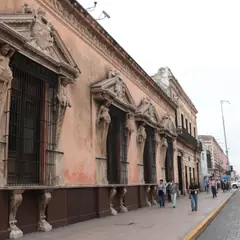
Between the friars and the future architects there is room for uses far removed from monastic life. Once the mendicant orders were suppressed by royal decree, the last colonial governor of Yucatán, Juan María Echeverri, assigned the convent as troop quarters and the friars left it, in 1820 according to some sources or in 1821 according to others. It was later the hospital of San Juan de Dios in the nineteenth century, a women’s prison, a barracks, the seat of the General Police Inspectorate and of the army’s X Battalion.
Beneath that cloister, moreover, Mérida places one of its most repeated legends: popular tradition says that a network of tunnels linked the Cathedral with this convent and other points of the city, as an escape route from pirates or a hiding place for weapons and treasure. Archaeology speaks of isolated underground spaces, not a great network. What is true in the passage, and why nobody stops telling it, is reserved for the narration.
La Mejorada, a name that came from Madrid
La Mejorada Church
Summary of this stop
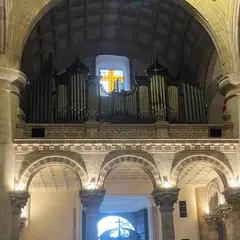
In front of the sober stone façade, almost without ornament, the inevitable question arises: where does the name come from. The temple is known as La Mejorada for its resemblance to the church of La Mejorada in Madrid. Originally dedicated to the Transit of Our Lady, it is now dedicated to the Virgen del Carmen, whose image presides over the back of the temple. Over the nave rises a dome on a false drum, one of the first on the Yucatán peninsula, visible from the park itself.
The architecture of La Mejorada also holds a small puzzle of dates. The most cited chronology has the work begun in 1621 and finished in 1640, but other official records assign it different dates, and even a different name, without the sources managing to agree. What is certain is that this complex was one of the two great Franciscan complexes of Mérida, along with that of La Asunción, now vanished.
The church is not only heritage: it is still the neighbourhood’s home. Every July, the Virgen del Carmen comes down from her niche to the sanctuary and on the 16th, before dawn, the neighbours sing her Las Mañanitas; hours later, the atrium fills with stalls of cochinita, panuchos and salbutes. How that early morning is lived is told in detail when listening to the audio guide in front of the façade.
The Arch of Dragons and the barracks of the graves
Arch of Dragons
Summary of this stop
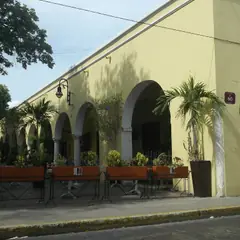
A few steps south of the park, on Calle 50 at 61, stands the Arch of Dragons, with a niche and a small image of a saint at the top. Mérida’s arches were raised, by the most cited date, around 1690 under Governor Juan José de la Bárcena, as gates of a city they never came to close; other sources take them to the early decades of the eighteenth century. This one takes its name from the neighbouring Cuartel de Dragones, the yellow building beside the church that was formerly a Franciscan hospital and is today the Centro Cultural del Niño Yucateco.
That barracks holds the darkest episode of the route. In 1992, during works to turn it into a cultural centre, three graves with human remains turned up by accident. The most plausible hypothesis points to soldiers of the Dragoon Regiment who died in the cholera outbreak of 1853, in the middle of the Caste War, although the identity of the bodies remains unsettled.
At the far end, Calle 50 opens towards the San Cristóbal neighbourhood, only 500 metres away. Until the early twentieth century there was no passage here: it was cut off by the Cerro de San Antón, a pre-Hispanic platform that had to be dismantled to connect the two neighbourhoods. What is known of that pyramid, and of the plaque that still celebrates its disappearance, is the close of the audio guide.