Historic square
Santa Lucía Park Audio Guide (Parque de Santa Lucía)
A tiny square three blocks from the Plaza Grande that was a Maya village, a provisional cemetery and the tomb of an executed colonel. Since 1965, every Thursday night, it has also been the home of Yucatecan trova.
- 25 min of audio
- Yucatecan history and trova
Santa Lucía Park began as an Indigenous village outside the walls, founded around the 1570s north of Mérida's main square. Its small church, raised by the encomendero Pedro García and finished in 1575, reached its present form around 1760. In 1804 a decree turned the space in front into a square, and in 1873 the L-shaped arcades that now frame two of its sides were closed, over a floor of English bricks.
Almost nothing here is what its plaques say. The neighbourhood that tradition paints as destined for Black slaves appears in the Sagrario registers as a Maya village with its own authorities. And the obelisk that claimed to hold the remains of Colonel Sebastián Molas sits beside an awkward fact: his remains were the first to enter the Rotunda of Illustrious Men in the General Cemetery.
Highlights
- Santa Lucía Church — a temple finished in 1575 in a Maya village of around 1570
- L-shaped arcades — some 200 metres of colonnade finished in 1873
- Sebastián Molas obelisk — the colonel executed in 1853 and his possibly empty tomb
- Giant confidant chair — 2.4 metres of fibreglass and a legend of jealousy
- Serenade corner — eleven busts of troubadours and trova on Thursdays since 1965
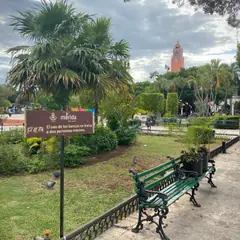
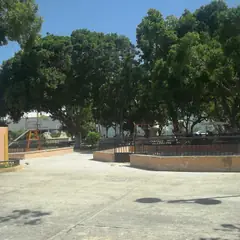
Three blocks north of the Plaza Grande, Santa Lucía Park looks at first like a quiet square of terraces and arches. Its history is far denser than its size suggests. Here stood an Indigenous village founded around the 1570s, outside Mérida’s Spanish core; a church finished in 1575; an atrium that served as the city’s provisional cemetery between 1813 and 1821; a square created by decree in 1804 and arcades closed in 1873. Some popular sources take its origin back to the founding layout of 1542, although archive research points to that decade of the 1570s.
The story of Santa Lucía Park is also that of an executed colonel, of a chair born, so it is told, from a father’s jealousy, and of a trova serenade that has summoned the city every Thursday since 1965. There are five stops in just a few metres, and each one disproves something taken for granted. The audio guide, researched and checked against historical sources, walks them in the order in which the square gained its layers.
Three blocks south lies the Plaza Grande, where confidant chairs also wait; to the west, Santiago Park is another former Indigenous village with its own night of music, and farther north, on the Paseo de Montejo, rises the Palacio Cantón.
A Maya chapel with an Afro-Maya wedding
Santa Lucía Church
Summary of this stop
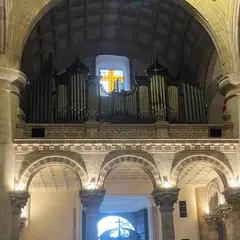
The route starts in front of the Church of Santa Lucía, a small temple with a plain façade: a rectangular doorway framed in stone, a stained-glass window above the entrance and a bell gable. It was raised by the conquistador and encomendero Pedro García for the emerging neighbourhood, finished in 1575 and, after several enlargements, reached its present form around 1760.
For decades it was repeated that Santa Lucía had been built «for Black slaves». The idea comes from the historian Rubio Mañé, in 1943, and still appears on plaques and in guidebooks. More recent research, based on the Sagrario books, describes something else: an Indigenous village with its own authorities, in which Black and Afro-descendant neighbours also lived. The debate remains open among historians, and this stop presents it with its documents.
One of them is a wedding. On 24 July 1589 Hernando Cutz and the widow Catalina Chan, both Maya residents of Santa Lucía, were married here, with witnesses from the same village and two Black godparents, Pedro and Isabel, recorded as «morenos». What that ceremony says about how sixteenth-century Mérida coexisted is unpacked in the narration, at the very same door.
English bricks for a decreed square
Park arcades
Summary of this stop
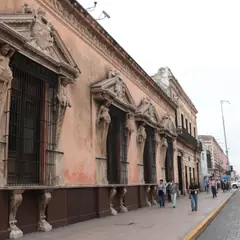
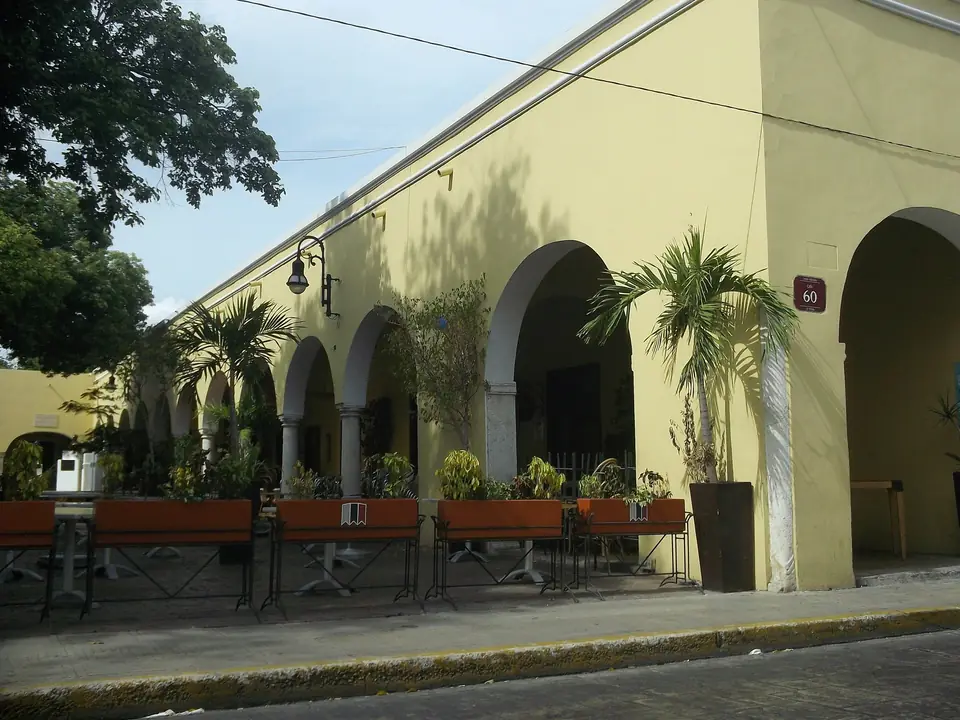
Beneath the L-shaped arcades, the square shows its most everyday face. The arcade frames two sides of the park, from Calle 60 to 55, along some 200 metres, and today it is taken up by restaurant terraces. At night its arches even serve as a screen for video-mapping shows.
It all began with a decree. On 6 November 1804, Governor and Captain General Benito Pérez Valdelomar ordered the space in front of the church turned into a square to beautify the city. In 1871 Governor Manuel Cirerol designated the atrium, park and arcades as public space, and in 1873 the arcades were finished and the floor was paved with English bricks. It is said that, before the restaurants and the trova, stagecoaches linking Yucatán’s towns with the capital boarded and unloaded beneath these same arches.
The park was renovated in 2012 and reopened in 2013 with shops and restaurants, whose tables and chairs have been gaining ground. The local press has for years denounced that occupation of public space, while the official renovation reopened it precisely with that use. To whom this square really belongs is a question with more than two centuries of history, and the audio guide follows it to the present day.
The obelisk that swore to guard Molas
Obelisk of Colonel Sebastián Molas
Summary of this stop
In the middle of the park rises an obelisk dedicated to Colonel Sebastián Molas (1819-1853), the «Lion of the East» of the Caste War. He was executed in Mérida on 14 November 1853 after a summary trial. The monument’s first plaque read «Here lie the remains of Colonel Sebastián Molas, hero of the Caste War»; it was later replaced by another calling him «martyr of federalism in Yucatán». Even the date of the obelisk is unclear: some sources place it in 1887 and others in 1878.
The ground around the monument has its past too. After the Cortes of Cádiz banned burials inside settlements on 1 November 1813, the atrium of Santa Lucía became Mérida’s provisional cemetery. Its southern part functioned as a graveyard until 1821, the year the General Cemetery was inaugurated.
And there the enigma appears. In March 1887, when the Rotunda of Illustrious Men was created in the General Cemetery, the first remains placed in it were precisely those of Molas. There is no independent confirmation that anything of his remains beneath the obelisk. What lies underneath, if anything does, is the story this stop keeps for whoever listens right there.
The giant chair invented as a chaperone
Giant confidant chair
Summary of this stop
In the centre of the park stands a fibreglass confidant chair 2.4 metres high. It was installed by the city’s tourism department in December 2016, at a cost of 78,000 pesos, and it is an enlarged replica of the «you and me» chairs, an everyday piece of furniture in Yucatecan parks. The real-size ones reached Mérida in 1915, in the Plaza Grande.
The most widespread legend in Yucatán says these chairs were born from the jealousy of a father in Bokobá, in the henequen region, although another version places it in Mérida itself. His daughter only wanted to «chat» with a young man, and the father let them meet on a park bench, until he saw that on a bench sweethearts sat too close. So he commissioned a double seat in the shape of an «S»: the two sat almost face to face, could talk up close and look into each other’s eyes, but not touch.
Nobody knows who really designed them: the model comes from the French «tête-à-tête» seats of the nineteenth century, in the Napoleon III style. Why a piece of furniture conceived as a chaperone became the favourite backdrop for couples’ photos is one of the audio guide’s winks.
Eleven busts and a Thursday serenade
Troubadour busts
Summary of this stop
The route ends at the serenade corner, a stage in one corner of the park watched over by the busts of eleven figures of Yucatecan song: Pastor Cervera, Pepe Domínguez, Guty Cárdenas, Ermilo Padrón López «Chispas», José Antonio Zorrilla «Monís», Cirilo Baqueiro, Sergio Esquivel, Luis Rosado Vega, Ricardo Palmerín, Ricardo López Méndez and Armando Manzanero.
The Serenata de Santa Lucía began on 14 January 1965 on the initiative of the poet Luis Pérez Sabido, then head of the City Council’s cultural department, a week after his 25th birthday. On that first night the Orquesta Típica Yukalpetén, the Grupo Folklórico de Bellas Artes and the Rondalla del Mayab played. Since then it has been held every Thursday at 9 p.m. and totals more than 3,000 performances. Sixty years later, in January 2025, Pérez Sabido himself unveiled the anniversary plaque, at an evening that left another unpublished episode in the history of the serenade.
In October 2026, for the first time in more than 60 years, the serenade left the park because of rehabilitation works and moved to the arcades of the Municipal Palace, on Thursdays at the same hour and with no confirmed date of return. What happened on that anniversary night and what this silence means for the square close the audio guide.