Maya neighbourhood of 1542
Santiago Park Audio Guide (Parque de Santiago)
It began as the village of the Maya who built Mérida and still keeps its own pulse: a church dated 1637 that holds a bishop's heart, a market that never switches off at night and a danzón dance every Tuesday.
- 25 min of audio
- Historic neighbourhood
The Santiago neighbourhood was organised with the founding of Mérida in 1542 as a village of Indians on the outskirts of the Spanish city. Here lived the Maya population of T'Hó that supplied the labour to build the capital, alongside Indigenous people from central Mexico who arrived with the conquistadors. Its church of Santiago Apóstol was finished in 1637, rebuilt in 1883 and shows a Baroque façade with a bell gable and two free-standing statues that in Mérida have a match only in the Cathedral.
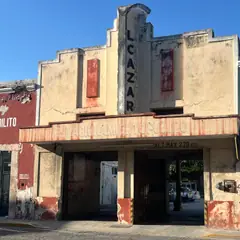
Behind the quiet square lies a neighbourhood reliquary: the heart of fray Luis de Piña y Mazo, who asked to stay here while his body went to the Cathedral, the remains of a cacique executed in the Caste War and the memory of the baker Jacinto Canek, a Santiago resident before leading the 1761 rebellion. Across the way, an Art Deco cinema of 1949 that closed in 2023 has switched its screen back on.
Highlights
- Church of Santiago Apóstol — the date 1637 over the door and two statues unique outside the Cathedral
- Plaque of the bishop's heart — fray Luis de Piña y Mazo, on the north wall of the sanctuary since 1795
- Black Christ of the Transfiguration — one of Mérida's most venerated images, with a feast on 6 August
- Remembranzas Musicales — live danzón, mambo and bolero every Tuesday night
- Cine Rex — Art Deco façade of 1949, closed in 2023 and reopened in 2026 as Cinespot Rex
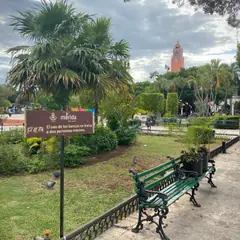
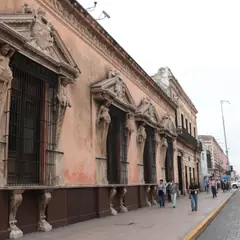
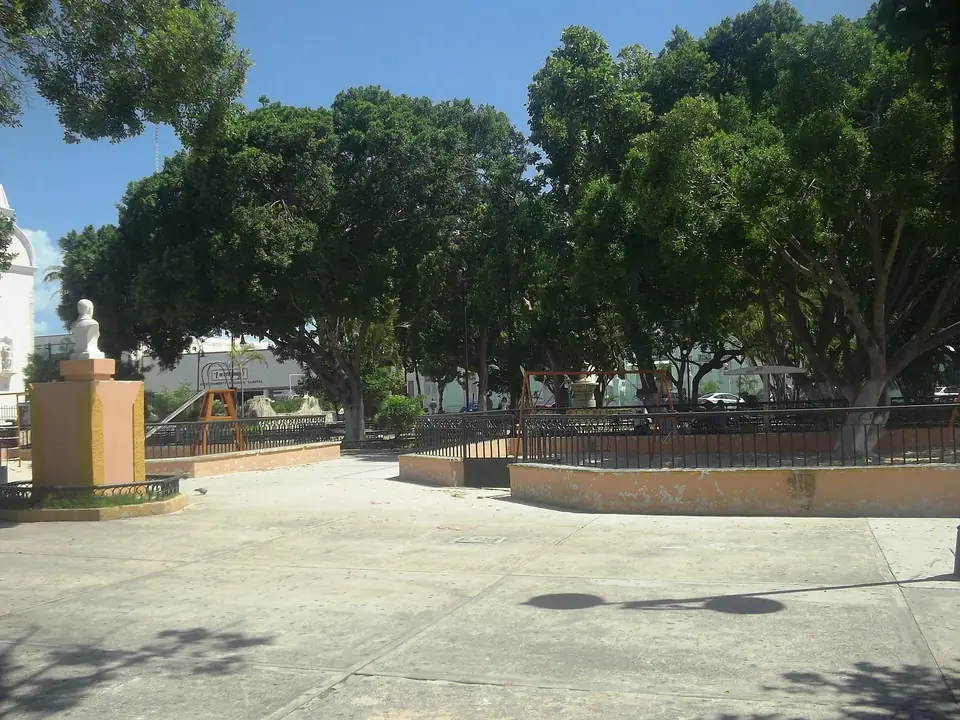
In Mérida, Santiago Park looks at first like just another neighbourhood square: a church, a market, a few benches in the shade. The story of Santiago Park, however, begins in 1542, when the founding of the Spanish city by Francisco de Montejo the Younger brought with it a village of Indians on its outskirts. There the Maya population of T’Hó, which raised the new Mérida with its own hands, was gathered, together with Indigenous people from central Mexico who had arrived with the conquistadors. How far the original layout reached is still debated: some sources place the neighbourhood outside it and others inside, and its exact limits were never fixed.
Almost five centuries later, Santiago keeps a character of its own that shows on every side of the square. The church holds a date of 1637, a bishop’s heart and one of the city’s most venerated images; the market feeds the neighbourhood day and night; on Tuesdays the municipal orchestra fills the square with danzón, and across from the park an Art Deco cinema has come back to life. What to see at Santiago Park, and why every corner tells something different, is better understood by walking it with the audio guide, documented and checked against historical sources.
A few blocks to the east, Santa Lucía Park was also born as a village of Indians and is the cradle of the trova serenade; on the other side of the centre, La Mejorada Park holds another seventeenth-century church.
The village that built Mérida
Santiago Park
Summary of this stop
At the centre of the park the heart of a neighbourhood with its own history is read at a glance. Next to the church there was trade from colonial times, although Santiago’s market was not officially built until 1918. The City Council remodelled it in 2017, after thirty years without major work, and today by day it sells fruit, vegetables, flowers, meat and tortillas; as night falls, the panucho and salbute stalls take over.
Every Tuesday night, the square changes its skin. The City Council holds the Remembranzas Musicales here, a free dance at which the Orquesta del Ayuntamiento, with more than 15 musicians, plays live danzón, mambo, cha-cha-chá, bolero and cumbia around a dance floor ringed by some 200 chairs.
And in this same park, according to the Mena family, the marquesita was born, the crisp rolled wafer filled with queso de bola that is now sold across the peninsula. The story has more than one version: some credit the idea to the ice-cream seller Leopoldo «Polo» Mena Bonilla and others to his son Vicente, «Polito», and there is no agreement either on which marquises gave it its name. Which of the accounts is told in the neighbourhood, and what failed fillings came before the cheese, is left for the narration on the spot.
An old date on a new façade
Church of Santiago Apóstol
Summary of this stop
In front of the main door, which faces west, the church of Santiago Apóstol plays with first impressions. Above the doorway 1637 is still engraved, the year the temple was finished, but almost everything around that inscription is later: the church was rebuilt in 1883 and the Baroque façade, with its bell gable of pinnacles topped by a stone cross, belongs to the nineteenth century. Of the original building there remain mainly the sanctuary and the date.
On either side of the door stand two free-standing statues, a rarity in the city: they are the only ones on a Mérida façade apart from those of the Cathedral. No inscription identifies them, and although they could represent Saint Paul and Saint Sebastian, their identity remains open.
Calle 59, which passes in front of the church, has its own memory. In the second half of the nineteenth century, Santiago was the start of the Camino Real to the port of Sisal, along which henequen fibre left in the years of the first boom, and the stretch between Calles 62 and 70 was called Camino Real de Santiago. The space around the temple was also used for military drills and, from 1892, for baseball games.
The bishop who left his heart here
Plaque of the bishop's heart
Summary of this stop
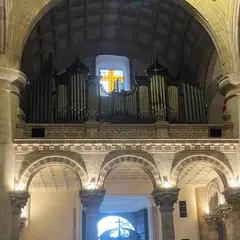
Inside, beneath the roof of round timber beams and between arcades on plain columns, the church reveals itself as a neighbourhood reliquary. Fray Luis de Piña y Mazo, Benedictine bishop of Yucatán, died in Mérida on 22 November 1795 and left a singular arrangement: his body would go to the Cathedral and his heart would stay in Santiago. A stone plaque on the north wall of the sanctuary, beside the high altar, marks where it rests. Hence the saying the neighbourhood still repeats: «santiaguero de corazón», a Santiago man at heart.
The temple also holds the remains of Francisco Uc, the neighbourhood cacique executed during the Caste War, begun in 1847, accused of collaborating with the rebel Maya, when several Santiago residents were arrested on suspicion of supporting the insurrection.
A century earlier, in these same streets lived Jacinto Canek, Jacinto Uc de los Santos, a baker trained by the Franciscans who led the Maya rebellion of Cisteil in November 1761 and was executed by torture in Mérida’s main square on 14 December. His figure still divides the chroniclers, who portray him in almost opposite ways; those two faces of the man are told calmly in the narration, beside the bishop’s wall.
The Black Christ and his centuries-old guilds
Black Christ of the Transfiguration
Summary of this stop
In the chapel south of the sanctuary the Black Christ of the Transfiguration is venerated, a dark crucifix with a serene face, with gilded rays and crown of thorns. His cult already existed in the first half of the eighteenth century, and his feast on 6 August became one of the best-attended in Mérida in the twentieth.
Attached to the south side of the church, the chapel of the Santo Cristo de la Transfiguración bears a plaque proclaiming it the first chapel in Mérida where Mass was said. The claim is more disputed than it seems: the chapel was destroyed in 1916, during political unrest, and almost entirely rebuilt in 1925 with a donation from Juana María Palma de López, in memory of her husband, the Spaniard Emilio Rodrigo; no document proves that primacy over other places of worship of the founding period.
The neighbourhood’s documented tradition is still alive every summer. As the festivities of Santiago Apóstol begin, in July, the Black Christ goes out in procession amid bells, rockets and brass band, and until 7 August the guilds arrive at the atrium with banners, flowers and music. The León XIII guild, founded in 1925, changes the Christ’s shroud that day, and its meeting with the other guilds in the atrium holds a gesture that the audio guide reveals right there.
The cinema that lit up again
Cinespot Rex
Summary of this stop
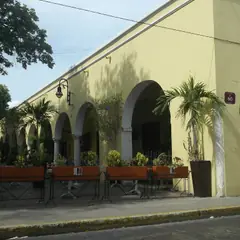
On Calle 57, facing the park, a vertical façade breaks the horizontal line of the colonial houses. It is the Cine Rex, inaugurated on 13 January 1949 with the film «Man-Eater of Kumaon»: an Art Deco building with a single hall of 700 to 800 seats, divided in two in 1998. Some sources link it to the former Apolo cinema-theatre, documented around 1915 on the same plot, without it being clear whether it replaced or transformed it. After 74 years as the last independent cinema in the centre, it closed on 30 March 2023 and reopened on 30 April 2026 as Cinespot Rex.
It was not the neighbourhood’s only spectacle. The Circo Teatro Yucateco occupied an entire block, with room for more than three thousand people, and between 1900 and 1961 hosted bullfights, boxing, theatre and circus; by 1902 it was already screening films with Lumière equipment. It was later demolished, and houses of the sixties and seventies were built on its site.
The neighbourhood’s present has its figures too. A study published in 2020 counted, in the 19 central blocks of Santiago, 67 Airbnb houses, at least 28 owned by foreigners, 44.05% of homes uninhabited and 39.23% of residents over 60; the area, together with part of Santa Ana, was nicknamed «Gringo Gulch». How that change coexists with the neighbourhood that prays, eats and dances every week is the question that closes the route.