Porfirian architecture
Palacio Cantón Audio Guide
The only mansion on the Paseo de Montejo that Mérida calls a «palace»: it was raised, with the money from a railway, by a general who had fought the Maya since he was 16, and it ended up as the place where Yucatán learned to study them.
- 60 min of audio
- Paseo de Montejo
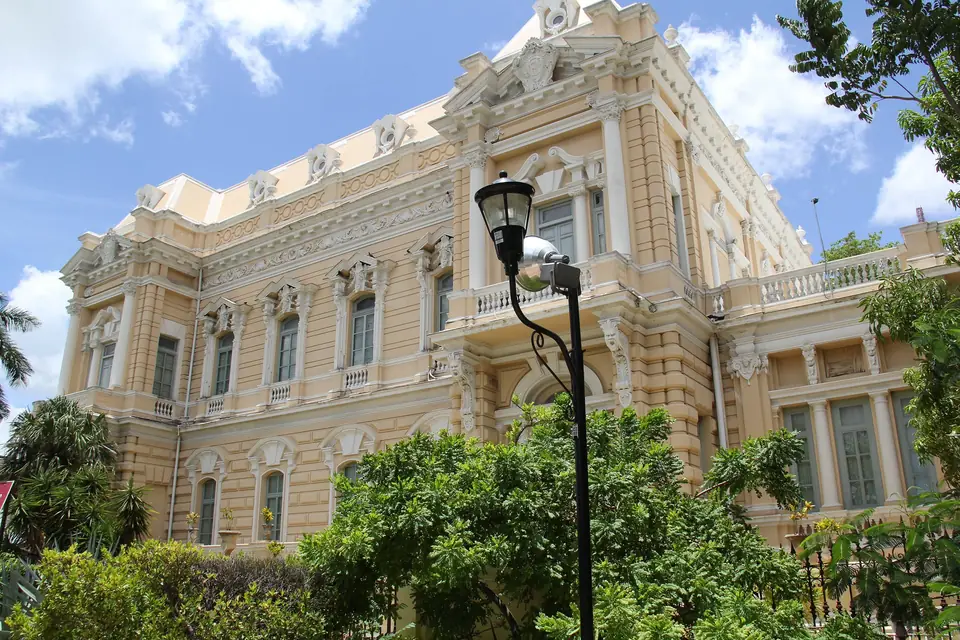
The Palacio Cantón was built in the early twentieth century, in the most cited dates between 1904 and 1911, as the residence of General Francisco Cantón Rosado, governor of Yucatán from 1898 to 1902. The project is by the Italian Enrico Deserti, who in those same years was directing the Peón Contreras theatre, and the ornamentation by the sculptor Michele Giacomino: an eclectic, French-style Beaux-Arts architecture, with mansards, balustrades brought from Europe and materials from France, Italy and Germany.
After the general's death in 1917, the house lived several lives: school of fine arts, boarding primary school, official residence of governors, the state's first archaeological museum in 1959 and Regional Museum of Anthropology from 1980. Two presidents of the Republic inaugurated museums in it, and the staircase on Calle 43, which looks as stately as the rest of the façade, was not built until 1978.
Highlights
- Beaux-Arts façade with mansards, European balustrades and gargoyles that drain the rain
- Vaulted white marble staircase with a mascaron carved in the same stone
- First residential elevator on the Yucatán peninsula, made in Germany
- Witness of History hall: some 300 m² with the general's medals and diplomas
- Original mural paintings and plasterwork restored by the INAH in 2016
At the corner of the Paseo de Montejo and Calle 43 stands a house that sums up half a century of Yucatán’s history. Its owner, General Francisco Cantón Rosado, was born in Valladolid in 1833, fought from a very young age in the Caste War and came to govern the state between 1898 and 1902. With what he obtained from selling the Mérida-Valladolid railway, whose concession he had won in 1880, he commissioned a Porfirian residence worthy of his biography. The dates of the work are not unanimous: most sources speak of 1904-1911, others push the start back to 1909, although a photograph in the Fototeca de Yucatán already shows the building almost finished in 1907.
The story of the Palacio Cantón does not end with the general, who died in the house in 1917. His heirs transferred it to the state government in 1932; exactly how it left the family is still disputed, and the version of a fortune lost at gambling has no source to back it. A family tradition speaks of debts and an exchange for a more modest residence, with the date of the move noted by the general’s daughter-in-law on the back of a thermometer. Since then the building has been a school, a governors’ residence, where President Miguel Alemán stayed in 1950, and a museum, inaugurated first by Adolfo López Mateos in 1959 and then by José López Portillo in 1980.
This 60-minute audio guide, documented and checked against historical sources, walks the palace from the façade to the upper floor, and each floor reveals a different life of the same building.
Towards the south, on the way to the centre, Santa Lucía Park is the antechamber of the historic quarter, and on the Plaza Grande the Casa de Montejo shows Mérida’s other great mansion, that of the sixteenth-century conquistadors.
The only «palace» on the Paseo de Montejo
Palacio Cantón
Summary of this stop
The route begins in front of the main façade, an eclectic, French-style front of projecting balconies, open pediments topped with scrolls, rusticated corners and engaged columns. Above, the French-style mansards crown the whole; below, the balustrades imported from Europe live alongside Yucatecan limestone, lime, sascab and wood. Even the gargoyles have a job: they are part of the rain drainage.
The architecture of the Palacio Cantón is better understood alongside the avenue on which it stands. The Paseo de Montejo was planned in 1888, when its first stone was laid, and only truly advanced during Cantón Rosado’s own government. It was finished in 1904, the same year in which, by the most widespread dating, work on the house began.
Among dozens of mansions of the henequen boom, only this one kept the name «palace». The press of the time gave it that name, and local custom holds a clue about who its owner was and what relation he had with those newspapers; the narration reveals it in front of the façade.
A railway turned into marble
Marble staircase with mascaron
Summary of this stop
At the foot of the white marble staircase appears the luxury the general paid for with the sale of his railway, transferred to form the Ferrocarriles Unidos de Yucatán. The staircase joins the two main floors with a vaulted technique very modern for its time, and a mascaron was carved in the same marble. The ornamentation, inside and out, is the work of the Italian sculptor Michele Giacomino.
Nearby waits an uncommon piece for a house of the period: the first residential elevator installed on the Yucatán peninsula. It was made in Germany, arrived by ship at the port of Progreso and was fitted at the end of the work. Today it is not open to the public and serves only to carry large pieces up.
Behind the project stands the architect Enrico Deserti, although some sources present his authorship of the plans as only probable, and the construction was directed by the engineer Manuel G. Cantón Ramos, the general’s nephew. How the materials of three countries fit into a single house is part of what the audio guide tells at this point.
The general’s medals and his cigar
Witness of History hall
Summary of this stop
On the upper floor, the «Witness of History» hall, of about 300 square metres, gathers a timeline of the building, photographs of the work and of the Paseo de Montejo in the early twentieth century, and the general’s medals and diplomas. They tell the life of a man who fought in the Caste War from the age of 16, who was exiled to Havana in 1867 as an imperialist and who, already governor, in 1901 backed the federal army’s capture of Bacalar and Chan Santa Cruz.
To that biography is added an episode that Valladolid’s tradition still tells in several versions. In March 1869, the then Colonel Cantón was led before a firing squad in Santa Ana park, and it is said that he smoked a cigar with all the calm in the world while he waited. What arrived on horseback in those minutes explains why this house came to be built.
The general lived in the palace until his death, on 30 January 1917, aged 83, and afterwards his son, who bore the same name, inherited it. The phrase with which his descendants sum up that day in Valladolid is heard in this hall.
From the general’s house to the anthropologists’ classroom
Rooms with mural paintings
Summary of this stop
The rooms on the floor preserve original decorative paintings and plasterwork, recovered by the INAH as part of a full restoration that began in late 2014 with the attic, terraces and mansards, continued in 2016 with the painted walls and went on with the vaults of the north wing of the ground floor. In the attic, when layers of paint were removed in 2015, far more than the original light ochre appeared beneath.
After the family stage, the house filled with students. In the 1930s it housed the State School of Fine Arts, with the modelling workshop of the sculptor Alfonso Cardone in the basement, and tradition places here the first painting lessons of a young Fernando Castro Pacheco, the author of the murals of Mérida’s Government Palace. Then came the Escuela Hidalgo primary school, although the order of the school uses varies by source.
In 1959 the basement became the Museo Arqueológico e Histórico de Yucatán, the state’s first, and in the 1960s the upper floor trained Yucatán’s first generation of archaeologists and anthropologists. From 1980 the whole building was the Regional Museum of Anthropology, with a permanent exhibition of Maya archaeology that in 2012 moved to the Gran Museo del Mundo Maya; today the palace presents temporary exhibitions. What some schoolchildren of the 1940s left written in the attic closes the route.