Heart of Mérida
Plaza Grande Audio Guide
Mérida's main square was laid out in 1542 over a levelled Maya hill, whose stones raised the buildings around it. It saw kings sworn in and Jacinto Canek burned, and today it is the open-air drawing room where the city talks and dances.
- 30 min of audio
- Colonial and Maya history
Towards the end of 1542, Francisco de Montejo «the Younger» ordered the Plaza de Armas as a chessboard of power: the Cathedral to the east, the royal houses and civil government to the north, the Montejo residence to the south. Beneath lay the Maya hill of Bakluumchan, where the conquistadors had camped, dismantled to build the new city. Since then the square has changed its name with the tide of history: Plaza de la Constitución Española in 1812, Plaza de la Independencia in 1821.
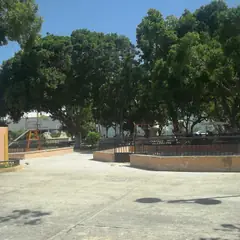
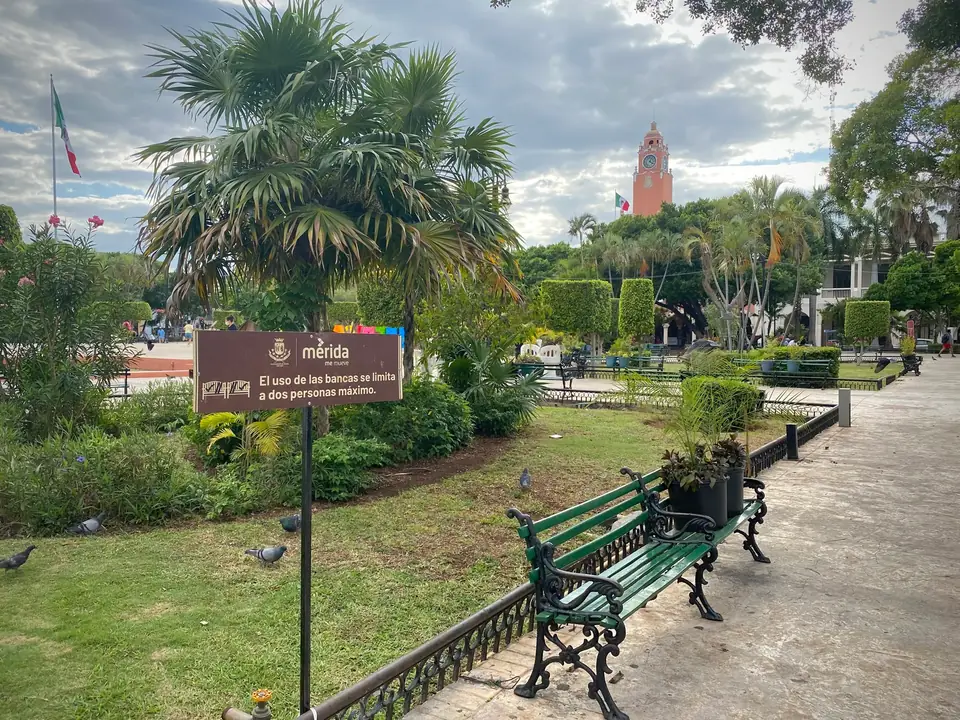
The contrast lies in the ground the visitor treads. The same space that hosted oaths to kings, bullfights and the torture of Jacinto Canek in 1761 is today a garden of laurels and paired chairs facing each other, designed for talking face to face. And Mérida's people defend it as their own: in 2024, when the remodelling took away its green benches, they got them back.
Highlights
- Plaza de los Poetas — the last visible remnant of the Maya hill of Bakluumchan
- Confidant chairs — the «you and me» seats that arrived with the 1915 remodelling
- Fernando Castro Pacheco murals — 27 oil paintings of the «History of Yucatán» in the Government Palace
- Hall of History — «The Torture of Jacinto Canek» and the balcony of the Grito
- Beneath the Municipal Palace arcades — birthplace of «Mérida en Domingo» and of the Monday vaquería
Every city has a square that explains everything, and in Mérida it is this one. The story of the Plaza Grande begins in January 1542, with the founding of the city over the old T’Hó, and follows a five-century script: oaths to kings such as Philip II’s in 1557, processions, bullfights, the execution of Jacinto Canek in 1761, the change of name after the Constitution of Cádiz and the independence proclaimed in 1821 a few steps away, in the Casas Consistoriales. Its official name is Plaza de la Independencia, but in Mérida nobody calls it that.
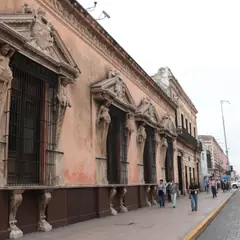
What to see at the Plaza Grande goes far beyond the garden. Around it stand the Cathedral, the Casa de Montejo, the Government Palace with Fernando Castro Pacheco’s murals and the Municipal Palace with its clock tower, and each building holds a chapter. The architecture of the Plaza Grande is better understood as a story than as a catalogue of façades, and the audio guide, documented and checked against historical sources, threads it together stop by stop.
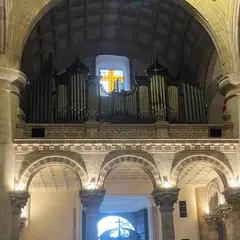
On the east side of the square rises the San Ildefonso Cathedral and, on its south side, the doorway of the Casa de Montejo. Three blocks to the north, Santa Lucía Park keeps the giant version of its confidant chairs.
Four powers over a Maya hill
Plaza Grande
Summary of this stop
The route starts on the circular esplanade at the centre, where the national flag flies. From here one reads the plan drawn by Francisco de Montejo «the Younger» when he shared out plots among his fellow conquistadors: the Cathedral to the east, civil power to the north, the Montejo house to the south. The west side kept something unexpected for centuries, a Maya structure that stood until the eighteenth century.
Beneath the square lay the Maya hill of Bakluumchan, where the Spaniards camped. After the founding it was levelled, and its stones went into the walls of the buildings that surround it today. Only one fragment survived: the Plaza de los Poetas, in the upper part of the Municipal Palace courtyard.
There is also a question almost nobody asks: why a Yucatecan city is named after a city in Extremadura. Tradition says that the first Europeans to reach T’Hó, in 1541, saw hills crowned with ancient Maya sanctuaries that reminded them of the Roman ruins of Spain. What exactly those twenty men saw, and how it became a name, is revealed by listening to the narration in the very centre of the square.
Chairs for talking without touching
Confidant chairs
Summary of this stop
Beneath the laurels stand white S-shaped seats, double and face to face: the confidant chairs, also called «you and me». Popular legend credits them to a jealous father who wanted his daughter and her suitor to converse without brushing against each other. The documented context tells another story: the first ones arrived with the 1915 remodelling driven by Governor Salvador Alvarado, alongside an octagonal platform in the centre, and from here they spread through Mérida’s parks and the Paseo de Montejo.
Those pieces of furniture are also a matter of pride. On 13 August 2024, in the middle of a state remodelling, the green wooden benches were removed to be replaced with concrete ones and dozens of trees were felled. The INAH ordered the new furniture stopped and, at the end of that year, the historic benches came back. The government defended the felling as preventive; neighbours and historians saw it as an unnecessary loss.
It was not the first time the city had stood up for its square. The writer Eugenio Noel, of the Generation of ‘98, is said to have called it «the most beautiful square in America» after visiting in 1920. How that praise was defended decades later, with some pavements in between, is left for the audio guide.
The maize man presides over the staircase
Yucatán Government Palace
Summary of this stop
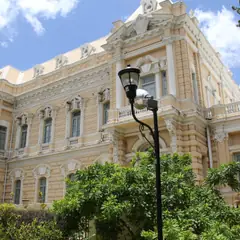
On the north side stands the Government Palace, two storeys high with pistachio-green arcades. It was planned in 1879 to a design by the engineer Olegario G. Cantón, measures 42 metres in both frontage and depth, and was inaugurated by Governor Daniel Traconis on 15 September 1892. Outside it is a palace of its time; inside it holds a surprise.
Between 1971 and 1975, according to the most widespread dating, the Mérida-born Fernando Castro Pacheco painted the series «History of Yucatán» for this building: 27 oil paintings on metal sheets spread across the courtyard, the staircase and the Hall of History. The two longest panels, «Social Evolution of Man in Yucatán», greet the visitor on either side of the main entrance.
At the head of the limestone staircase appears the maize man, in an intense yellow, flanked by the red and black bacabs. A Maya cosmogony in the heart of a Porfirian palace: what each figure means, and why the climb reads as a story, is revealed by listening to it step by step.
Canek on the mural, the square below
Hall of History
Summary of this stop
On the upper floor, the Hall of History gathers 17 of the murals. The first one installed in the palace, in 1971, was «The Torture of Jacinto Canek», and it hangs precisely in the room whose balconies overlook the square, the same ones from which the governor gives the Grito at the Independence celebrations.
The coincidence is not innocent. Canek led the Maya rebellion of Cisteil on 19 November 1761, and less than a month later, on 14 December at eight in the morning, he was executed after torture in front of the Plaza Grande. His body was burned, his ashes scattered and eight of his companions hanged.
From the balcony, the painting and the real place lie a few metres apart. What happens when the gaze crosses from one to the other is the most intense moment of the route, and the audio guide keeps it for that exact spot.
Beneath the arcades where Mérida dances
Mérida Municipal Palace
Summary of this stop
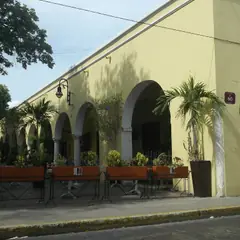
The finale comes on the west side, under the arcade of the Municipal Palace and its clock tower. This is the building of official history: in its Casas Consistoriales the independence of Yucatán from Spain was proclaimed on 15 September 1821, the same year the square received the name Plaza de la Independencia.
It is also the place where the square turned into a party. On 17 March 1985 the first «Mérida en Domingo» was held beneath these arcades, as an experiment with no second edition guaranteed, with calesas, crafts, dances and a military-band concert. Forty years later it is repeated every Sunday.
On Monday nights it is the turn of the Vaquería Yucateca: embroidered ternos, white filipinas and jaranas that chain sones together until «El Torito». It looks like a centuries-old tradition, but this event was born in 1982 in the palace’s back courtyard. And at any moment someone may stop the music with a shout of «¡bomba!»; what follows that shout is discovered at the end of the audio guide.