Viceregal cathedral
San Ildefonso Cathedral Audio Guide (Catedral de San Ildefonso)
Raised with stone from the pyramids of T'Hó, with the look of a fortress and a coat of arms that changed owners with every regime: the oldest cathedral on the American mainland holds four centuries of rewritten history in its walls.
- 30 min of audio
- Colonial Renaissance
For twenty years, on the plot chosen after the founding of Mérida in 1542, there stood only a provisional thatched-roof church. The stone work began in 1562 under Bishop fray Francisco Toral, picked up speed under fray Gregorio de Montalvo and was declared complete on 4 November 1598. It was the only cathedral in the New World finished in the sixteenth century, and only that of Santo Domingo, on a Caribbean island, is older: a Renaissance mass of three naves, a 33.60-metre dome and 43.50-metre towers facing the Plaza Grande.
Its interior carries one night marked in red. On 24 September 1915, with Salvador Alvarado's troops in the city, a mob of «quemasantos» («saint-burners») carried off the Baroque high altarpiece, the cathedral treasury and the German Walcker organ. Afterwards, the church served as a henequen warehouse until 1917. The void left by that looting is now part of what people come to see.
Highlights
- Façade coat of arms: royal arms chiselled off in 1822 and an imperial eagle covered and uncovered with every regime
- Cylindrical stones from the Maya city of T'Hó reused in the north wall
- Christ of Unity, a 7.65-metre birch carving that fills the sanctuary emptied in 1915
- Chapel of the Christ of the Blisters, the black Christ to whom Mérida's guilds come every autumn
- Twin towers: ten bells to the north, the oldest from 1618, and a London clock of 1731 to the south
From the Plaza Grande, the San Ildefonso Cathedral seems the most motionless thing in Mérida: grey stone, walls with loopholes, two 43.50-metre towers and almost no ornament. And yet it is a building rewritten again and again. It was fed by the five great pyramids of T’Hó, the Maya city of the «five hills» that the Spaniards dismantled to raise Mérida; every regime retouched its coat of arms; and a single night in 1915 left it bare inside. Its story begins in 1562 and its construction was declared complete in 1598, although some sources push the closing to 1599, the year that appears on the façade. By its architecture, a plan of 66.75 by 31.30 metres with three naves, 12 columns and 20 vaults, it is the oldest cathedral on the American mainland. The audio guide walks it in four stops, from the square to the black Christ, with narration that is documented, researched and checked against historical sources.
Opposite it opens the Plaza Grande, on whose south side the Casa de Montejo shows another sixteenth-century work raised with T’Hó stone. A few blocks to the east, La Mejorada Park preserves the neighbourhood’s Franciscan convent.
A coat of arms that changed owners
Plaza Grande
Summary of this stop
The façade stands before the Plaza Grande with the air of a fortress: rows of defensive slits in the walls and, across its entire surface, not a single cross. The only religious figures carved on the building are Saint Peter, with his keys, and Saint Paul, with sword and book, on either side of the Door of Forgiveness, which opens only on special occasions. The towers share the work: the north one holds ten bells still in use, the oldest cast in 1618; the south one has none and keeps the dial of a public clock made in London in 1731, stopped since 1871, with a little balcony for the clockmaker.
Above the choir window is the great stone coat of arms, with the inscription to Philip III and the year 1599 (one source reads it as dedicated to Philip II). After independence the royal arms were chiselled off and in their place was set Agustín de Iturbide’s imperial eagle on a nopal cactus, crowned and still without a serpent, in 1822 according to most sources. Then came a succession of coverings and uncoverings: mortar over the crown when the republic returned, the whole shield hidden from 1826 to 1865, in view for Empress Carlota, covered again in 1867. Which visit in 1906 finally left it uncovered, and which details still betray each change, is told in front of the façade.
Maya drums and a hidden cenote
Maya stones of the north wall
Summary of this stop
The cathedral was a long time coming. After the founding of Mérida over T’Hó, on 6 January 1542, Francisco de Montejo the Younger ordered a site chosen for the church, but for twenty years there was only a thatched temple there. The stone work began in 1562 with fray Francisco Toral, advanced slowly and sped up under fray Gregorio de Montalvo, with the project in the hands of Pedro de Aulestia, Juan Miguel de Agüero and Gregorio de la Torre.
On the north wall, along Calle 61, the origin of that stone is in plain view: cylindrically carved stones, the column drums of the Maya buildings of T’Hó, fitted among reused ashlars. Beside them appears an embedded arch that looks like a bricked-up entrance, and there begins a disputed story. The anthropologist Alfredo Barrera Vázquez maintained that a cenote had been there, covered over to build that stretch of wall above it, and he relied on a rough inscription, probably scratched by a mason, that began with the word «cenote» and bore the date 1713. There is no archaeological confirmation, and what Barrera managed to read on that wall is saved for the audio guide, at the foot of the arch.
The sanctuary emptied in 1915
Christ of Unity
Summary of this stop
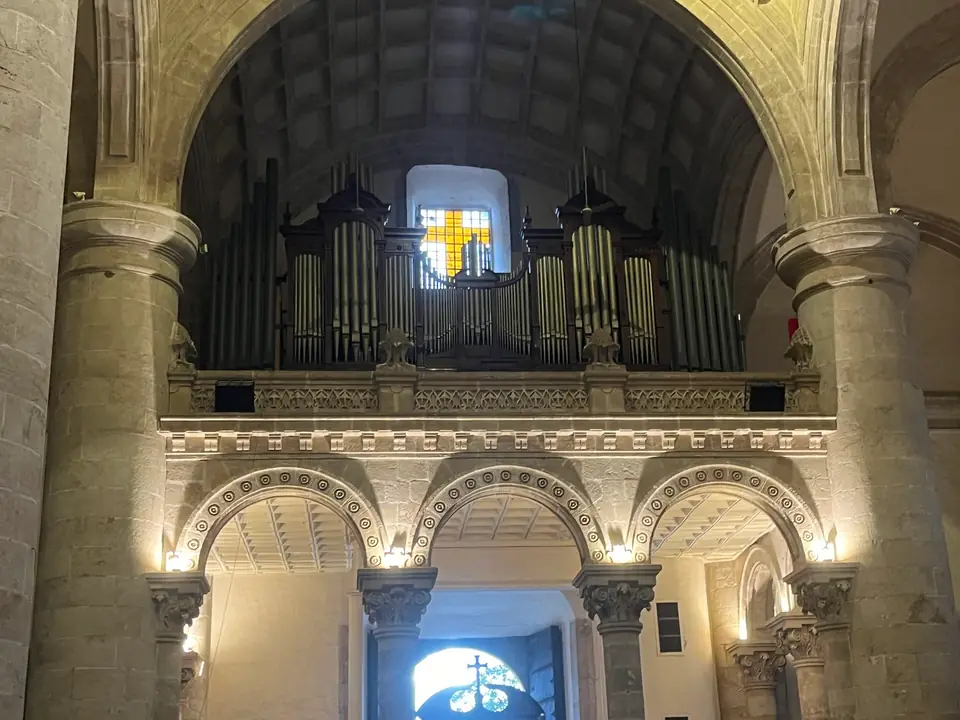
Inside, the scale takes over: three naves separated by thick columns, vaults of 22.27 metres and a half-orange dome of 33.60, with a lantern inspired by the Pantheon in Rome. But what draws the most attention is what is missing. On the night of 24 September 1915, with Salvador Alvarado’s troops in the city, a mob of «quemasantos» looted the church: lost were the Baroque high altarpiece inaugurated in 1762, altarpieces of the seventeenth and eighteenth centuries, the cathedral treasury and the German Walcker organ of 1902. The government afterwards confiscated the cathedral, which was a henequen warehouse until 1917, and in 1916 two chapels on the south flank were demolished to open the walkway now called Pasaje de la Revolución.
The sanctuary stood bare for half a century. On 10 October 1967 Archbishop Fernando Ruiz Solórzano blessed the answer to that void: the Christ of Unity, a birch carving by Ramón Lapayese del Río that most sources measure at 7.65 metres, on a mahogany cross of about 12. The same sculptor signed the Way of the Cross in relief that runs along the walls, and his signature is engraved in an unexpected spot on the carving itself, one of the details discovered by listening to the narration in the nave.
The black Christ who came back
Chapel of the Christ of the Blisters
Summary of this stop
In a chapel on the north side, beside the sanctuary, stands the Christ of the Blisters, a blackened carving with open eyes that look downward. It came from Ichmul by way of Hocabá, brought by the parish priest Juan de la Huerta, and entered the cathedral in solemn procession on 16 May 1645. Tradition ascribes to it an origin of fire: a tree that burned without being consumed and an outsider sculptor who finished the work in a single day and vanished. The original was lost in the looting of 1915, although sources disagree on whether it was destroyed that night or carried off and never heard of again.
The present image is a replica carved in Querétaro on the initiative of Archbishop Martín Tritschler y Córdova, placed in its chapel on 24 September 1919, exactly four years after the assault. And the city has never stopped visiting it. Every 14 September the Christ leaves its chapel, and until 17 October Mérida’s trades each have their day reserved to enter in procession: the alarifes, the building guild, with flowers and banners; the bakers, with children dressed as bakers and baskets of bread on their heads. What is handed out at the end of that mass closes the audio guide.