Marian shrine
Basilica of Guadalupe Audio Guide (Basílica de Guadalupe)
At the foot of Tepeyac hill, a piece of sixteenth-century cloth draws millions of pilgrims and forces two basilicas to share the ground: a Baroque one leaning over the mud of the old lake and a round one held up on piles so it will not sink.
- 75 min of audio
- Shrine and colonial Baroque
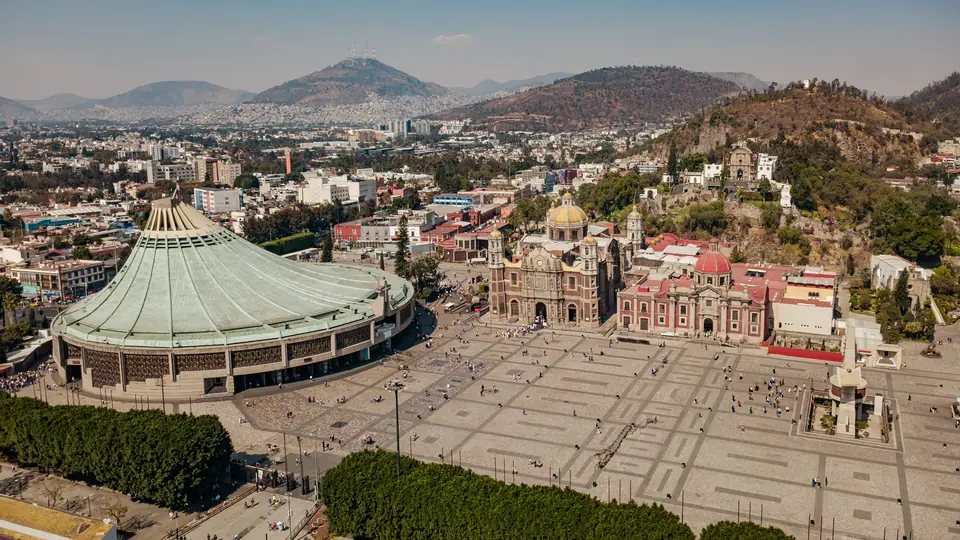
The Basilica of Guadalupe is the most visited Marian shrine in the world: about 20 million pilgrims a year, nearly 9 million of them around 12 December. Gathered around the Atrio de las Américas are Pedro de Arrieta's Old Basilica, opened in 1709; the circular basilica of 1976, with a nave about 100 metres wide and no columns; the Pocito Chapel; and the Cerrito Chapel at the top of the hill. Three centuries of history, architecture and faith in a single complex.
Everything revolves around an ayate, a cloak of rough cloth. According to Catholic tradition, the image of the Virgin was imprinted on it in 1531; as early as 1556 a Franciscan claimed from the pulpit that an Indian named Marcos had painted it. It survived a bomb in 1921, spent a year hidden in the false bottom of a wardrobe during the religious persecution, and is now viewed from a moving walkway that lets nobody stop.
Highlights
- The tilma behind the main altar — seen from a walkway with moving belts
- Santo Cristo del Atentado — the 34-kilo crucifix twisted by the 1921 bomb
- Old Basilica (1695-1709) — the Baroque church tilted by the lake-bed subsoil
- The 1976 basilica — a circular nave without columns on 344 control piles
- Pocito Chapel — the only circular eighteenth-century church still standing in Mexico
The story of the Basilica of Guadalupe is that of a difficult pact between faith, mud and Mexican history. On Tepeyac hill, where according to Fray Bernardino de Sahagún there stood a temple to Tonantzin before the conquest, Catholic tradition places the apparitions of the Virgin to the Indigenous man Juan Diego in December 1531. The shrine has kept growing ever since: Pedro de Arrieta’s Old Basilica opened its doors on 1 May 1709, in 1754 Pope Benedict XIV declared the Virgin of Guadalupe patroness of New Spain, and in 1976 the image moved to a new circular church, founded to withstand a subsoil that tilts everything placed on top of it.
Today the complex brings together buildings from four centuries around a great esplanade: the modern basilica with its green copper roof, the leaning Baroque church, the Indians’ Chapel of 1649, the Pocito Chapel and, at the top of the hill, the Cerrito Chapel with the city at its feet. The architecture of the Basilica of Guadalupe is best understood piece by piece, and the audio guide, documented and checked against historical sources, links each building with the scene that explains it.
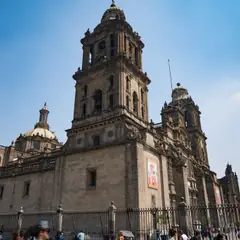
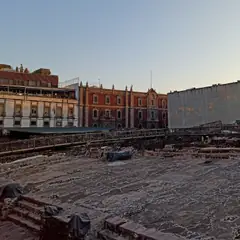
The city’s great cathedral, the Metropolitan Cathedral, presides over the Zócalo, and beside it the ruins of the Templo Mayor show the sacred heart of the Mexica before the conquest.
A courtyard between two churches and a sinking lake
Atrio de las Américas
Summary of this stop
The route starts at the centre of the Atrio de las Américas, the esplanade opened in the 1950s that joins the churches and fills every 12 December with the tide of pilgrims that makes this the most visited Marian shrine in the world. From here the two answers given to the same problem can be read at a glance: on one side, the Old Basilica that Pedro de Arrieta raised between 1695 and 1709; on the other, the basilica of 1976, resting on 344 control piles devised by engineer Manuel González Flores to avoid the settling that tilted its neighbours.
The green of its huge roof is not paint either: it is the copper cladding the reinforced concrete, oxidised over the years. And this same courtyard keeps one of Mexico’s best-loved traditions, Las Mañanitas, sung to the Virgin on the night of 11 to 12 December. What looks like a centuries-old rite was born, the story goes, almost by accident in 1955, from a phrase improvised live and a man perched on the roof of a television truck; how a whole crowd ended up singing is one of the stories kept for listening on the spot.
The tilma, in view from anywhere
Basilica of Santa María de Guadalupe
Summary of this stop
Inside the circular basilica, the nave of about 100 metres has no interior columns: it is designed so that the ayate bearing the image of the Virgin can be seen from any point. Beneath the altar, a walkway with moving belts carries the faithful past the image without letting them stop, a solution as practical as it is surprising for a place that receives millions of visits.
The cloth presiding over the sanctuary carries a controversy almost as old as itself. In 1556 Archbishop Alonso de Montúfar praised in a sermon the devotion to the painting in the Tepeyac hermitage; days later the Franciscan Francisco de Bustamante replied from the pulpit that an Indian named Marcos had painted it «yesterday», and the archbishop opened an inquiry. For Catholic tradition the image was imprinted miraculously; the identity of that possible painter remains disputed.
To that dispute is added a modern and much-debated legend: that of the tiny figures some claim to see in the Virgin’s eyes. The story begins, so it is told, with a photographer in 1929 who was asked to keep quiet, and goes on through magnifying glasses, reports and digitised photographs. Who thought they saw what, and why the reading of those shapes does not convince everyone, changes the way the cloth looks from the nave.
The Baroque church that leans
Old Basilica of Guadalupe
Summary of this stop
The Old Basilica, with its screen-like portal and four octagonal towers topped with Talavera tile, gives away the slope of its base at a glance. The differential sinking of the lake-bed subsoil, together with a lack of space for pilgrimages, forced its closure: on 12 October 1976 the tilma left in procession for the new church, after 267 years in the Baroque building. In 1979 the INAH began its rescue, lifting it with hydraulic jacks and control piles, and after 24 years closed it reopened in 2000 as the Expiatory Temple of Christ the King.
Its walls also keep the wounds of the twentieth century. On 14 November 1921 a charge of dynamite hidden in a flower arrangement at the foot of the altar went off: it shattered the marble altar and twisted a 34-kilo iron and bronze crucifix, while the tilma and its glass stayed intact. That Santo Cristo del Atentado is now displayed in a case in the new basilica.
A few years later, facing the religious persecution that led to the Cristero War, Abbot Feliciano Cortés removed the image from the altar, replaced it with a copy and, in the most widespread version, hid it wrapped in silk in the false bottom of a small Chinese wardrobe. The dates and the keepers of that hiding place vary by source, and the audio route pauses on that enigma inside the church itself.
The miraculous well that had to be covered
Pocito Chapel
Summary of this stop
East of the courtyard, the Pocito Chapel stands out for its zigzag tiled dome. Francisco Guerrero y Torres raised it between 1777 and 1791 over a well of waters held to be miraculous, and it is the only circular-plan church of the eighteenth century still standing in Mexico. Inside, angels with symbols of the Litany of Loreto decorate the dome and a carved Juan Diego holds up the pulpit.
The well, however, is no longer in view: it had to be covered because the sick who came to drink and wash in it had turned it into a source of infection. The chapel also keeps a scene from the War of Independence, that of José María Morelos, who in 1815, before being shot, was granted as a last wish to pray here to the Virgin of Guadalupe. What is known of that visit is told in the audio guide, under the same dome.
December roses at the top of Tepeyac
Cerrito Chapel
Summary of this stop
The climb ends at the Cerrito Chapel, begun around 1740 on the summit, with murals by Fernando Leal on the apparitions, a small plaza with Ernesto Tamariz’s archangels and a wide view over the complex and the city. It is the place where tradition sets the decisive moment of the story: Juan Diego, sent to the barren summit in the middle of December, would have found fresh roses to carry to Bishop Zumárraga wrapped in his ayate.
From this height one also hears the debate that has never closed. In the late 1570s Sahagún complained that the Indigenous people still called the Virgin of Tepeyac Tonantzin, «our mother», although some researchers doubt that such a goddess or a shrine on the hill ever existed. And in 1996 Abbot Guillermo Schulenburg resigned after an interview attributed to him the claim that Juan Diego was a symbol and not a real person; with him the abbacy of Guadalupe came to an end. How legend and doubt fit together in the place where it all supposedly began is the closing note kept for the end of the route.