National theatre and museum
Palace of Fine Arts Audio Guide (Palacio de Bellas Artes)
A marble theatre promised for the 1910 centenary that took thirty years to open, sinks into the mud of the old lake and keeps the volcanoes of the Valley of Mexico behind its glass curtain.
- 60 min of audio
- Art Nouveau and Art Deco
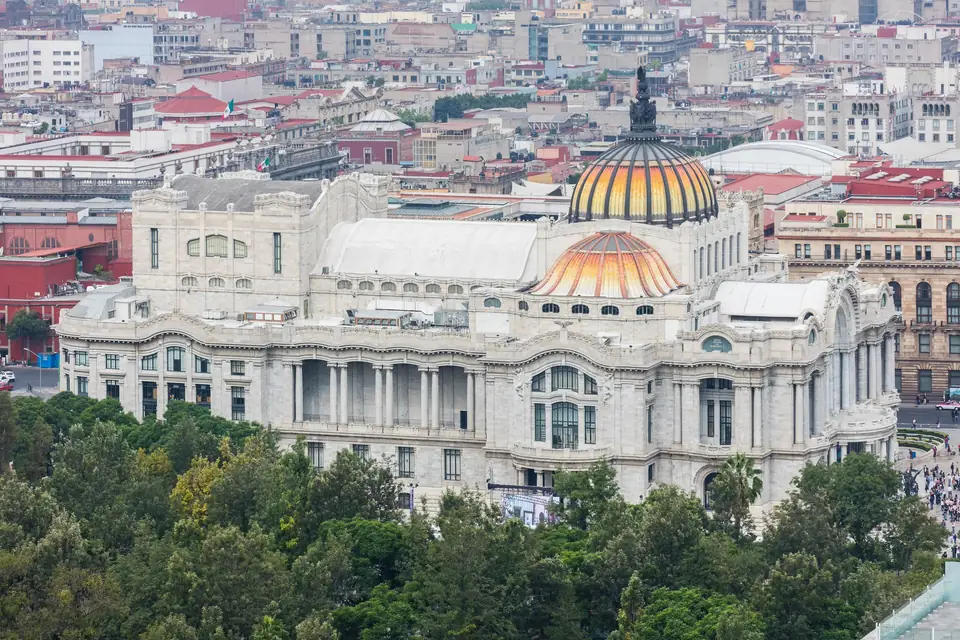
Porfirio Díaz commissioned it from the architect Adamo Boari to celebrate the centenary of Independence: it was to be ready in four years. The Revolution, the lake mud and its author's departure left it stranded until Federico Mariscal finished it and it was inaugurated in 1934 as the Palacio de Bellas Artes. The result is a building with two souls: an Art Nouveau façade of Carrara marble outside and an Art Deco interior of serpents and rain gods within.
Beneath the gala there are cracks of history. The palace began to sink in 1907, during construction itself, and on the Eje Central side its base now sits 1.4 metres below the pavement. Inside, Diego Rivera repainted the mural the Rockefellers destroyed in New York, and in its lobby Mexico has bid farewell to 65 public figures lying in state, from José Clemente Orozco to Juan Gabriel.
Highlights
- Tiffany glass curtain — nearly a million pieces with Popocatépetl and Iztaccíhuatl
- Man, Controller of the Universe — Rivera's mural censored at Rockefeller Center
- A sinking palace — its base sits 1.4 metres below the Eje Central pavement
- Agustí Querol's Pegasi — taken down from the roof in 1921 because of the sinking
- Art Deco lobby — serpent heads and masks of Chaac and Tlaloc
The story of the Palace of Fine Arts begins with a broken promise. Work on the new National Theatre started in 1904 and Porfirio Díaz laid the first stone in 1905: Adamo Boari’s building was to be finished in four years, in time for the centenary of Independence. It took thirty. In between came the Revolution, a lake-clay soil that began to swallow the works and an architect who left Mexico without seeing it complete. When Federico Mariscal finished it and it was inaugurated in 1934, that Porfirian whim of white marble beside the Alameda already had another name and another purpose.
Today it is at once a theatre, a museum and a stage for the country’s public life. The architecture of the Palace of Fine Arts tells two eras in a single building: the Art Nouveau façade of Carrara marble, with Leonardo Bistolfi’s sculptural group at the portal and the dome crowned by Géza Maróti’s eagle, and an Art Deco interior peopled with pre-Hispanic motifs. On its upper floors seventeen murals by seven artists come together, from Rivera, Orozco and Siqueiros to Tamayo and González Camarena, and in the Main Hall a glass curtain with the volcanoes of the Valley of Mexico awaits. Going through it with the audio guide, from the esplanade to the hall, is a matter of joining those pieces until one understands why this palace ended up as the place where Mexico argues, celebrates and mourns its own.
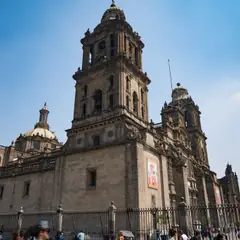
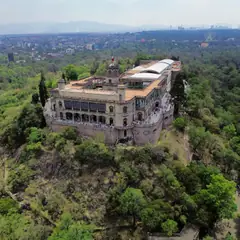
A short walk through the Historic Centre brings you to the Metropolitan Cathedral, on the Zócalo. Diego Rivera’s trail continues in Coyoacán, at the Casa Azul he shared with Frida Kahlo, and Porfirio Díaz’s Parisian taste reappears in the stained glass of Chapultepec Castle.
Winged horses over a demolished convent
Palace of Fine Arts
Summary of this stop
The esplanade in front of the main façade is guarded by four Pegasi by Agustí Querol on marble pedestals. They arrived from Spain in 1911 and were not meant for the ground: they crowned the four corners of the roof until 1921, when they had to be taken down because the building was sinking. They spent a decade in the Zócalo before settling here in 1933, which makes these sculptures the first witnesses of the palace’s great problem.
The site was not empty either. In the sixteenth century it was the tianguis, or market, of Juan Velázquez and from 1601 the convent of Santa Isabel, which after the Reform ended up split between a silk factory, housing and offices. All of it was expropriated and demolished to raise the theatre with which Díaz’s regime wanted to dazzle in 1910. What that ambition miscalculated is best understood before the façade itself, where the narration reveals what came of that four-year promise.
The mark of the lake on Eje Central
Slope of the Eje Central façade
Summary of this stop
On the rear façade, the one facing Eje Central, the palace shows its best-kept secret: the base of the building sits 1.4 metres below the pavement. The building rests on lake clay, the montmorillonite of the old lake, and began to sink in 1907, in the middle of construction; by 1921 it had already dropped more than 1.80 metres. Figures for the total descent vary by source, but what is beyond dispute is that it keeps going down at the pace of the Historic Centre.
While the ground gave way, the Revolution slowed the works until their suspension in 1916. Adamo Boari left Mexico leaving more than four thousand documents for others to carry on and died in 1928 without seeing his theatre finished. From his time on the site an intimate memory remains in the stone: among masks and garlands, Gianetti Fiorenzo carved a dog’s head in memory of Aida, the setter that accompanied the architect on his rounds. Finding it among so much ornament is part of the game of this stop.
Rain gods in the lobby
Art Deco lobby
Summary of this stop
In 1927, with the theatre half built, Boari himself proposed turning it into the «Cinema México», a modern movie house. It did not happen. In the early 1930s Federico Mariscal took over the work and finished it by dressing the inside in pre-Hispanic Mexico: under the glass-and-iron roof, the lobby of Mexican marbles shows serpent heads on the window arches and masks of Chaac on the light panels, and at the entrance to the hall wait the bronze masks of Tlaloc and Chaac. President Abelardo L. Rodríguez inaugurated it as the Palacio de Bellas Artes in 1934.
This space also has a solemn function: it is the lying-in-state chapel of Mexican culture. Sixty-five public figures have been paid homage here with their bodies present, from José Clemente Orozco in 1949 to Juan Gabriel in 2016 or Silvia Pinal in 2024. Juan Gabriel had already starred in 1990 in one of the house’s most controversial episodes, with four sold-out nights in the Main Hall that part of the critics considered a profanation of the temple of high culture. What was said that week, inside and outside the hall, is told in full in the audio guide.
The mural New York ordered erased
Mural Man, Controller of the Universe
Summary of this stop
On the third floor awaits «Man, Controller of the Universe», the mural Diego Rivera repainted in 1934. It was the second version of a work commissioned in 1933 for Rockefeller Center in New York and destroyed for including Lenin. According to the documented story, Rivera had asked his assistant Lucienne Bloch to photograph the original just in case, and with those black-and-white images he redid it here.
But he did not simply copy it: the Mexican version includes changes with the air of a settling of scores, and one of them points straight at the family that had the wall torn down. Finding them completely changes the way one looks at the painting. The same political passion reappeared in 1954, at Frida Kahlo’s wake held in this palace, when a hammer-and-sickle flag covered her coffin and ended up costing the director of Bellas Artes his post. The exact detail of that painted revenge is revealed in front of the mural.
Glass volcanoes and a legendary high note
Tiffany glass curtain
Summary of this stop
The Main Hall holds a unique piece: a glass curtain commissioned in 1909-1910 from the Tiffany firm of New York and designed by the set designer Harry Stoner. Its 206 panels bring together nearly a million pieces of opalescent glass that draw the Valley of Mexico with Popocatépetl and Iztaccíhuatl; it measures about 12.5 by 14.5 metres and its weight is put at around 22 tonnes, although some sources raise the figure. It was born as a fire curtain: a single rigid metal structure that neither rolls nor folds, rising in 90 seconds into a vault above the stage and slowing its fall with two air pistons. Some attribute its inspiration to a work by Dr. Atl, against the official version that places it in the real view of the volcanoes.
On this stage four presidents took office, from Miguel Alemán in 1946 to Gustavo Díaz Ordaz in 1964. And here, according to a famous episode, Maria Callas, still far from being a legend, went in 1950 from being hissed at her debut to bringing the house down with a note Verdi never wrote, borrowed from a nineteenth-century Mexican singer. Who that singer was and how her secret reached the Greek soprano is left for the narration, with the curtain in view.