House museum
Frida Kahlo Museum Audio Guide (Casa Azul)
A middle-class house of 1904 that Frida Kahlo and Diego Rivera painted cobalt blue, that was Trotsky's bunker and where the painter was born, painted and died. Her ashes are still inside.
- 75 min of audio
- An artist's home
On the corner of Londres and Allende, in Coyoacán, the photographer Guillermo Kahlo built in 1904 a one-storey, C-shaped house around a courtyard. Over the years, his daughter and Diego Rivera remade it in their own image: they tore off the Porfirian façade, painted it blue, filled it with pre-Columbian pieces and, in 1946, added a volcanic-stone wing with Juan O'Gorman. Since July 1958, four years after Frida's death, it has been a house museum.
Between 1937 and 1939 the Casa Azul stopped being a home and became a fortress: windows bricked up with adobe, a watchtower and a Russian exile whom Stalin wanted dead. In its largest room the counter-trial to the Moscow trials was held, behind a barricade of sandbags.
Highlights
- Cobalt-blue façade — a deliberate repainting over a Porfirian house of 1904
- Leon Trotsky's refuge — bricked-up windows, a watchtower and the Dewey Commission in 1937
- Basalt studio of 1946 — easel, wheelchair and the bed with a mirror in the canopy
- Toad-shaped urn — Frida's ashes on the dressing table of her bedroom
- Bathrooms sealed for half a century — corsets, crutches and Tehuana dresses
The Casa Azul seems a house stopped in time, but it is the opposite: a building that changed skin with every turn in the lives of those who lived in it. Guillermo Kahlo built it in 1904 on an 800 m² plot that had belonged to the Carmelites; his daughter Frida turned it, with Diego Rivera, into a manifesto of Mexican identity; Leon Trotsky occupied it as an armoured refuge between 1937 and 1939; Juan O’Gorman added a volcanic-stone wing in 1946, and in 1953 ramps were opened for a painter who could no longer walk. Frida died in one of its bedrooms on 13 July 1954, aged 47, and her ashes never left.
Rivera put the house and its collection into a trust at the Bank of Mexico, the poet Carlos Pellicer designed the museum display and the museum opened in July 1958. The history of the Frida Kahlo Museum, its architecture and what each room holds are best understood by going through it from the inside, from the façade to the garden, with a documented audio guide that reveals, room by room, why this house is also the biography of the woman who painted it.
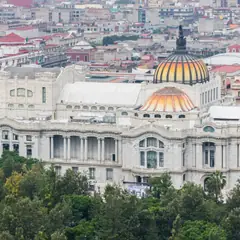
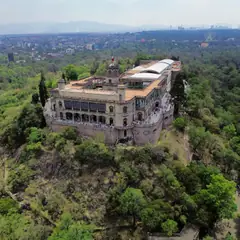
The mural Diego Rivera remade after the Rockefeller Center censorship hangs in the Palace of Fine Arts. And at Chapultepec Castle each tenant, from viceroys to emperors, also remade the house to his own measure.
A blue that was not in the plans
Frida Kahlo Museum
Summary of this stop
The corner of Londres and Allende greets the visitor with the most photographed blue in Mexico: smooth walls of intense cobalt and windows with round bars painted green. But that blue is not the original. The house Guillermo Kahlo built was Neoclassical, of Porfirian taste, with a brick frieze, a Greek-key border and wrought-iron grilles. A photograph from 1938 already shows it flattened, without frieze or border, and with agaves and pre-Columbian pieces where there used to be flowerpots.
The change came earlier than is usually thought. In October 1932, the American muralist Lucienne Bloch, who was accompanying Frida after her mother’s death, noted in her diary a house «all shining blue», with pink corners, green windows and a courtyard of cacti, orange trees and Aztec idols. What on the façade looks like pure tradition was, in fact, a deliberate gesture: wiping out the bourgeois house to paint another idea of Mexico over it. Why the couple chose that colour, and what the gesture said in its day, is what the narration reveals in front of the wall itself.
A painted date and a bunker for Trotsky
Sign «Frida and Diego lived in this house»
Summary of this stop
On one of the courtyard walls, a sign sums up the life of the house: «Frida and Diego lived in this house 1929–1954». The phrase is as emphatic as it is debatable. According to several sources, residence was intermittent: the couple lived at other addresses and in the United States, from 1933 in San Ángel, and Frida did not settle here permanently until 1939-1941. Nor is the plaque on the façade free of puzzles: it repeats that Frida was born on 7 July 1910, the year of the Mexican Revolution, when the civil registry gives her birth as 6 July 1907. It was she who chose that date.
Between January 1937 and 1939, the house sheltered Leon Trotsky and Natalia Sedova. The street windows were bricked up with adobe, a watchtower was built, the wall was raised and the neighbouring plot, of some 1,040 m², was bought. From 10 to 17 April 1937, the largest room hosted the thirteen hearings of the commission chaired by the philosopher John Dewey, the counter-trial to the Moscow trials, protected by a barricade of sandbags and bricks that Rivera had put up.
And between those walls, a well-documented tradition says, there was a brief affair between Frida and the exile that ended around July that year. Months later, she gave him a self-portrait dressed as a Tehuana, which Trotsky hung in front of his desk. The fate of that painting, and of the relationship between the painter and her guest, takes an unexpected turn that is told in the courtyard.
Painting seated among volcanic stone
Volcanic-stone studio
Summary of this stop
It all began with a mirror. After the 1925 accident that left her immobilised, her mother, Matilde Calderón, adapted her bed and had a mirror installed in the canopy. In front of that reflection, Frida began to portray herself. The bed is preserved in the daytime bedroom, with her death mask on the cover: the piece of furniture where her self-portraits began.
Two decades later, the house grew upward for her. Around 1946, Juan O’Gorman raised over the old service courtyard a new studio and two bedrooms faced with blocks of local volcanic basalt, with shells, jugs and mirrors set into the walls. In the roofed courtyards, the couple left their signature in mosaic: Frida’s ceiling panel, with the eye, the clock, the moon and the sun; Diego’s, with the hammer and sickle. In the studio wait the easel, the wheelchair before an unfinished portrait of Stalin, the brushes and the library of both.
In 1953, after the amputation of part of her right leg, Frida had ramps added from the garden atrium to the old part and moved into the smallest of the new rooms, beside the studio, so she could get around by herself. The architecture of this wing is, deep down, the story of how a house was remade so that its owner could keep painting; the details of that last stage are discovered in the narration, beside the easel.
A clay pot shaped like a toad
Urn with Frida's ashes
Summary of this stop
In the upstairs bedroom, on the dressing table, a pre-Hispanic vessel shaped like a toad holds Frida Kahlo’s ashes. She died in this room on 13 July 1954; she lay in state at the Palace of Fine Arts, was cremated at the Panteón Civil de Dolores and her remains came back home. Around the urn her personal belongings remain, as if the room had not finished saying goodbye.
In the house there also hangs «Viva la vida», the still life of watermelons with the inscription «Coyoacán 1954» written on the red flesh of a slice. The popular version says she painted it days before dying; the museum’s current record dates the watermelons to around 1950 and places only the phrase in her last days. A farewell written, in any case, on a piece of fruit.
The cremation was anything but solemn. According to the journalist Adelina Zendejas, there were songs, The Internationale and people clinging to her hands, and David Alfaro Siqueiros claimed to have seen something in her face when the flames were lit. What happened that afternoon, and how the ashes ended up in a clay pot, is one of the most intense moments of the route.
Diego’s garden and the sealed doors
Stepped pyramid in the garden
Summary of this stop
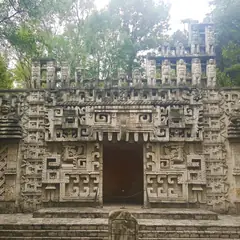
The garden is Rivera’s territory. In 1941, after remarrying Frida, he had a stepped pyramid built to display part of his pre-Columbian sculptures permanently, alongside a fountain, a reflecting pool and a room for archaeological pieces. Among orange trees and cacti, the pyramid works as an open-air display case of the pre-Hispanic, the passion the couple shared.
The house also hid a secret for decades. Rivera had two bathrooms sealed with Frida’s belongings until at least fifteen years after his own death, and Dolores Olmedo kept them closed as long as she lived. When they were finally opened, under the direction of Hilda Trujillo and on dates that vary by source, some 300 objects turned up: corsets, crutches, bottles of Demerol, dresses, more than 400 photographs and letters. There were so many that the neighbouring building had to be annexed, where «Appearances Can Be Deceiving: The Dresses of Frida Kahlo» is now on show, with her Tehuana wardrobe.
Each autumn, for Day of the Dead, the garden also receives the traditional offering dedicated to Frida, with a different theme every year: in 2024, seventy years after her death, a spiral of papel picado with watermelons at its foot; in 2025, an altar of stone, cacti and marigolds in homage to Juan O’Gorman. What exactly appeared behind those doors, and why they were closed, is the closing note the narration keeps for the end.