Viceregal cathedral
Metropolitan Cathedral Audio Guide (Catedral Metropolitana)
More than two centuries of building on the mud of the old lake, a pendulum watching it sink and a black Christ who, tradition says, swallowed poison: the cathedral of the Zócalo is a building that has never stopped moving.
- 45 min of audio
- Baroque and Neoclassical
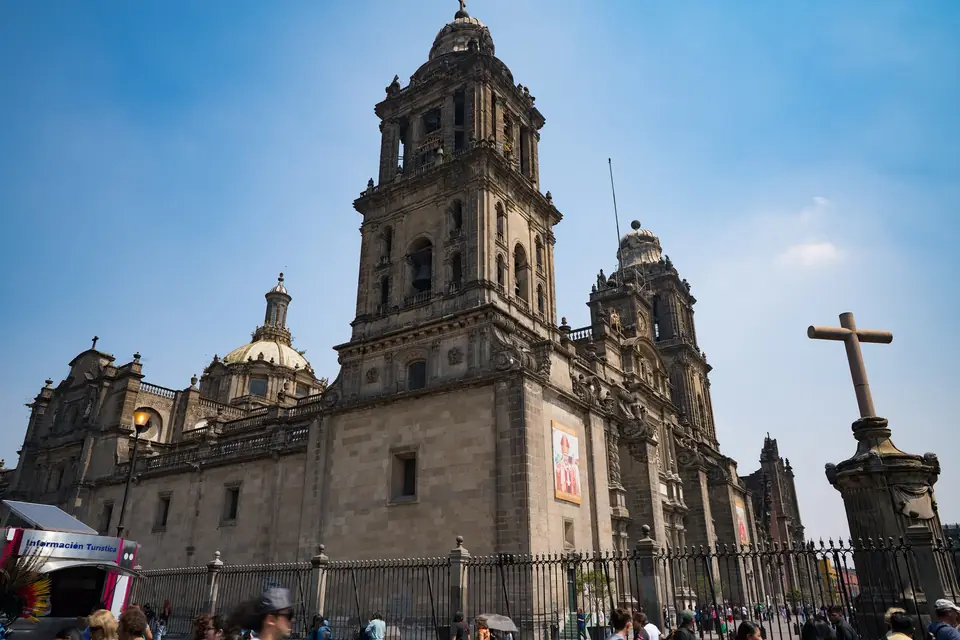
The first stone was laid in 1571 and the cathedral was not declared finished until 15 August 1813. In between came the plans of Claudio de Arciniega, the Baroque of Jerónimo de Balbás and the Neoclassicism of Manuel Tolsá, so its history and architecture read like a catalogue of viceregal styles: Gothic, Baroque, Churrigueresque and Neoclassical in a single church, built facing the Mexica Templo Mayor.
Beneath the ground there are about 20,000 wooden stakes driven into the lake clay, and still the building, weighing 127,000 tonnes, sinks. Between 1993 and 1998, 32 shafts 20 metres deep were dug to correct the tilt; the rescue did not stop the sinking, it made it uniform, and from the dome a great pendulum goes on recording every movement.
Highlights
- Altar of the Kings: Balbás's «golden cave», 25 metres of Churrigueresque altarpiece
- The dome pendulum, witness to the sinking of a 127,000-tonne building
- 35 bells with names of their own, among them «la Castigada», silent for 57 years
- Altar of Forgiveness and the Lord of Poison, the most venerated black Christ in the church
- Tolsá's façade and the three virtues returned to their place after the 2017 earthquake
The Metropolitan Cathedral of the Assumption of the Most Blessed Virgin Mary into Heaven, to give its full name, looks like the most motionless monument on the Zócalo, and it is exactly the opposite. It was begun in 1571, work formally got under way in 1573 with plans by Claudio de Arciniega, the interior was finished in 1667 and the exterior in 1813: just under 250 years of construction on the clay of the old Lake Tenochtitlan. In that time it was flooded by water, burned by fire, shaken by earthquakes and rescued with tunnels dug beneath its floor. The story of the Metropolitan Cathedral is that of a building that has spent four centuries negotiating with the ground that holds it up. The audio-guide route goes from the street to the gold of the apse in six stops, with narration that is documented, researched and checked against historical sources.
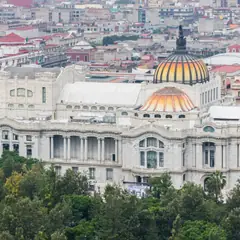
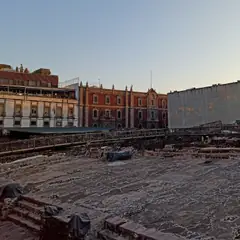
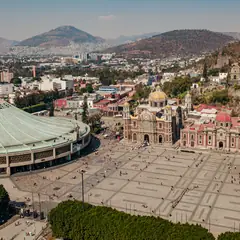
Opposite it appear the ruins of the Templo Mayor, and a walk through the Historic Centre leads to the Palace of Fine Arts. The other great goal of the capital’s faith lies to the north, at Tepeyac: the Basilica of Guadalupe.
The Mexica neighbour that is not underneath
View of the Templo Mayor
Summary of this stop
From the corner of Guatemala and Seminario, the ruins of the Templo Mayor appear beside the cathedral, not under it. For centuries popular memory placed the great Mexica temple beneath its foundations, until Manuel Gamio’s finds in 1913 and the Coyolxauhqui monolith in 1978 put it across the way. The Mexica foundations that did turn up under the building are attributed to secondary temples, and the sources have never quite agreed on which gods they were dedicated to.
What really lies below is the lake mud. To settle the temple, a grid of wooden stakes 3 metres long was driven every 50 centimetres, some 20,000 in all, topped by a 1.60-metre stone fill and masonry counter-beams 3.50 metres high. And that waterlogged subsoil even decided its orientation: the cathedral faces north to south, with the façade toward the Plaza Mayor, instead of the usual east-west orientation of churches. How a water problem ended up drawing the Zócalo as it is known today is left for the narration, right there.
Thirteen tonnes by hand and a secret from 1791
East tower of the cathedral
Summary of this stop
The towers, 64 to 67 metres high, hold 35 bells, each with a name of its own. The largest, Santa María de Guadalupe, was cast in 1791 in Lomas de Tacubaya from some 13 tonnes of bronze and hoisted up the tower in 1792 with 24 pulleys and two cranes driven by men walking inside them, under the direction of José Damián Ortiz de Castro. Some sources push that placement back to 1793.
In October 2007, while restoring the sphere crowning the east tower, a lead box from 1791 turned up with medals, coins, palm crosses and an engraving of Saint Barbara against lightning, and beneath the sphere, carved, a signature: «14 May 1791. Tibursio Cano». Higher still hangs the strangest bell of all, «la Castigada». According to tradition, in the 1940s it killed a very young bell-ringer with one blow, and the canons judged it almost as they would a person. What punishment it received and how it ended up forgiven is one of the stories the audio guide tells at the foot of the tower.
A façade that took two and a half centuries
Metropolitan Cathedral of Mexico City
Summary of this stop
In front of the main façade, the building reads like a calendar in stone: each section belongs to a different era of a work that mixes Gothic, Baroque, Churrigueresque and Neoclassical. The last chapter was written by Manuel Tolsá, in charge of the works from 1793, who added the clock block with the statues of Faith, Hope and Charity and rebuilt the dome.
The cathedral was declared complete on 15 August 1813, with pealing bells, under Viceroy Félix Calleja and in the middle of the War of Independence, while Morelos commanded the insurgent army. Two centuries later, the earthquake of 19 September 2017 brought down Hope from the top of the façade and the cross of the east tower, which pierced a vault of the Sagrario. The three virtues returned to their place on 27 February 2024, and the detail of how they are now fastened is heard while looking up at them from below.
The 1967 fire and the Christ of the poison
Altar of Forgiveness
Summary of this stop
On the night of 17 to 18 January 1967, a short circuit in the sacristy of the Altar of Forgiveness set off a fire that marked the church for ever. It destroyed most of that altar, 75 of the 99 choir seats and Ximeno y Planes’s painting in the dome, partly melted the pipes of the two organs and blackened for ever the canvases of the Altar of the Kings. The altarpiece seen today facing the Door of Forgiveness is a reconstruction.
The fire also uncovered secrets. The restoration, directed by Miguel Ángel Soto Rodríguez, brought to light 51 paintings hidden behind the altar, the tomb of President Miguel Barragán inside a wall and, within one of José Nassarre’s organs, a 1529 copy of Hernán Cortés’s appointment as governor. Today the altar is presided over by the Lord of Poison, an almost black Christ of cane paste: according to tradition, it was light-coloured until someone smeared poison on its feet to kill a devotee who used to kiss them. What happened in front of everyone, and where the little votive offerings left for him end up, is reserved for the audio guide.
The pendulum that measures the fall
Pendulum in the central nave
Summary of this stop
At the crossing, under the dome, hangs a great pendulum that is not decorative: it records the movement of the whole building. The lake had already given warning on 21 September 1629, when a flood left the water two metres high, halted the works and led to plans for a new cathedral on the hills of Tacubaya. The idea was dropped and Juan Gómez de Trasmonte carried on at the same site, swapping the cut stone of the vaults for tezontle, a lighter stone.
Centuries later, the problem was still there. Between August 1993 and May 1998 underexcavation was applied: 32 shafts 20 metres deep beneath the cathedral and the Sagrario removed soil under the higher parts of a 127,000-tonne building, and the floor’s maximum tilt of 240 centimetres was reduced by 83. The exact dates of the programme vary by source, but the result is clear: the sinking did not stop, it became uniform. What the pendulum tells today of that tussle with the lake is explained standing beneath the dome.
Gold, an emperor and the heroes who left
Altar of the Kings
Summary of this stop
The route ends in front of the Altar of the Kings, by Jerónimo de Balbás: 25 metres high, 13.75 wide and 7.5 deep, raised between 1718 and 1725 and gilded until its dedication in 1737. It is called «the golden cave» and was the altarpiece that introduced the estipite column to New Spain. Its canvases by Juan Rodríguez Juárez still keep the darkness of the smoke of 1967.
The cathedral has also been a pantheon. In 1825 the heads of Hidalgo, Allende, Aldama and Jiménez, which had hung in the Alhóndiga de Granaditas, entered in procession through the Jubilee Door; in 1925, by order of Plutarco Elías Calles, the remains of the heroes left for the Angel of Independence. Only one stayed: Agustín de Iturbide, crowned emperor here in 1822, who remains in the Chapel of San Felipe de Jesús. And to this altar returns, when the city falls ill, the Lord of Health, an old crucifix invoked in epidemics, whose story of departures and returns closes the audio guide.