National Museum of History
Chapultepec Castle Audio Guide (Castillo de Chapultepec)
A pleasure palace the Crown mistook for a rebel fortress, which withstood the assault of 1847 and housed emperors and presidents: each owner remade it to his own measure on top of Grasshopper Hill.
- 90 min of audio
- Viceregal and imperial palace
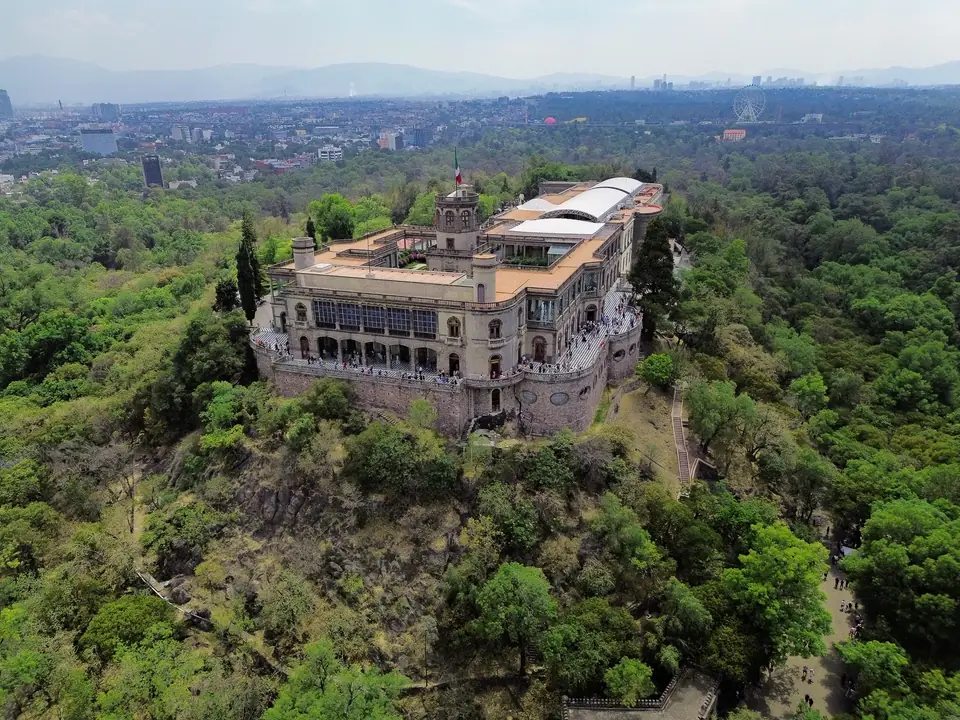
Chapultepec Castle crowns the hill where there once stood a temple to Ehécatl and the springs that supplied water to México-Tenochtitlan. Work began in 1785 on the order of Viceroy Bernardo de Gálvez as a pleasure house, was abandoned after his death, and in the nineteenth century the building became a Military College, the court of Maximilian and Carlota, a presidential residence and an astronomical observatory. Since 1944 it has been the National Museum of History, and the traces of all those tenants remain visible on its terraces, in its halls and in its towers.
The building now called a castle was never born for war: it was christened so by a cadets' tower raised around 1842. Even so, war reached it. On 13 September 1847 it fell to the American army, six cadets died in the assault, and the US Marines have sung of it ever since in their hymn as the halls of Montezuma, though it was built by viceroys centuries after the fall of Tenochtitlan.
Highlights
- Mural of the Niños Héroes — Gabriel Flores painted Juan Escutia falling with the flag in 1967
- Alcázar terrace — Maximilian and Carlota's lookout over the start of Paseo de la Reforma
- Stained-glass gallery — windows with five classical goddesses ordered in Paris in 1900
- Caballero Alto — the 1842 tower that gave the castle its name and housed a telescope
- Siqueiros Hall — the mural «From the Porfiriato to the Revolution», almost nine years of work
The story of Chapultepec Castle begins long before the castle. On the summit there was a pre-Hispanic temple dedicated to Ehécatl, replaced in the sixteenth century by a hermitage of Saint Michael the Archangel, and at the foot of the hill Moctezuma I ordered the aqueduct built that carried water from the springs to México-Tenochtitlan, a work carried out by Nezahualcóyotl, lord of Texcoco. On that memory-laden ground, Viceroy Bernardo de Gálvez ordered a pleasure house in 1785 that he never got to enjoy. What followed reads like the script of several lives: abandonment and looting, the Military College in 1833, the American assault of 1847, the court of Maximilian and Carlota between 1864 and 1867, the first National Astronomical Observatory, Porfirio Díaz’s showcase and, from 27 September 1944, the National Museum of History. Knowing what to see at Chapultepec Castle means reading those layers one on top of another, and the audio guide arranges them on site, stop by stop, with narration that is documented and checked against historical sources.
At the foot of the hill, in the same park, the National Museum of Anthropology holds the Sun Stone. The Porfirio Díaz who ordered his stained glass here also commissioned the Palace of Fine Arts, and another house reinvented by its owners waits to the south, in Coyoacán: Frida Kahlo’s Casa Azul.
A temple, a powder magazine and a fortress that worried the Crown
Grasshopper Fountain
Summary of this stop
On the south terrace, beside Luis Albarrán’s Grasshopper Fountain, the bronze of the insect that gives the hill its name recalls that this place was sacred long before it was a palace. Around it stretch the pergolas and the reflecting pool, which occupy a gap with a history of its own: there stood most of the Military College building, which Carranza had demolished in 1916 so that the Alcázar would show better.
The architecture of Chapultepec Castle starts with a security problem. A disputed story says that there was earlier another viceregal mansion lower down the slope, where viceroys newly arrived from Spain were lodged, and that a neighbouring powder store exploded and left it badly damaged; the date is unclear, somewhere between the mid-eighteenth century and 1784. The work on the summit began on 16 August 1785, according to the most-cited version, under the engineers Francisco Bambitelli and Manuel Agustín Mascaró.
And here suspicion enters: the projecting walls and the parapets facing the city led to Mascaró being accused of building a fortress in order to rebel against the Crown. After Gálvez’s death in 1786, the king suspended the work and ordered it auctioned, without a buyer appearing. What was whispered about that sudden death is kept for the narration at this very spot.
The Niños Héroes and the flag that falls from the sky
Niños Héroes mural by Gabriel Flores
Summary of this stop
Under a ceiling of the building, the mural Gabriel Flores painted in 1967 shows Juan Escutia falling from on high with the Mexican flag, an eagle in the background and, around them, the castle, the former Churubusco convent and the Cathedral. It is the image that fixed in the country’s memory 13 September 1847, when after the American bombardment the castle fell, defended by 832 soldiers and cadets under General Nicolás Bravo. Six pupils of the Military College died in the assault and went down in history as the Niños Héroes.
The scene has its nuances. Some historians hold that Escutia was shot down while fleeing and that the flag was captured, and they remind us that not all the cadets were boys; the debate remains open and the visit presents it without settling it. On the other side, the United States Marine Corps commemorates the assault in the first line of its hymn, «From the Halls of Montezuma», although the building was raised by viceroys more than two and a half centuries after the fall of Tenochtitlan.
There is also a grim episode that happened far from here, but looking toward this hill: according to a documented tradition, thirty men of the San Patricio Battalion waited that morning with ropes around their necks for the stars and stripes to fly over the castle. What that flagpole marked is told at the foot of the mural.
Miravalle, Maximilian and Carlota’s terrace
Alcázar terrace
Summary of this stop
The Alcázar terrace faces east, toward the city, and from it the start of Paseo de la Reforma can be made out. Maximilian of Habsburg and Carlota lived in the castle between 1864 and 1867, renamed it «Miravalle» and chose the ground-floor rooms that looked out over the city, Lake Texcoco and the volcanoes; in front of them they had this panoramic terrace built.
The palace they received was in ruins. Years earlier, the Royal Treasury had sold its doors, windows and glass; Alexander von Humboldt visited it in 1803 and condemned that sale, and in 1806 the Mexico City Council bought it. Even so, the imperial gardener Wilhelm Knechtel found it without a single complete window. To link it with the centre, Maximilian laid out a straight causeway in the manner of European boulevards, the Paseo de la Emperatriz, dedicated to Carlota, which after Juárez’s restoration of the republic in 1867 was renamed Paseo de la Reforma.
The end of the empire left a brief and eloquent scene here, starring the president who defeated it, a single night and a horse-drawn carriage that is still in the castle. That story is kept for the terrace.
Stained glass from Paris and Madero’s morning
Stained-glass gallery
Summary of this stop
On the upper floor, the Stained-Glass Gallery filters the light through windows with five classical goddesses that Porfirio Díaz ordered in Paris in 1900. Díaz wanted the castle as a showcase of progress: he installed lifts, one of them from the base of the hill, and the 1900 elevator linking the dining room with the basement, the upper floor and the roof is still in the building. There was also a bowling alley, and in it Mexico’s first film screening was held in 1896.
All that glitter coexists with a turning-point date. On the morning of 9 February 1913, when the Decena Trágica broke out, Francisco I. Madero rode out of the castle escorted by the cadets of the Military College toward the National Palace: the Marcha de la Lealtad, commemorated every year outside the grounds. How one passes from Díaz’s salons to that gallop is what the narration unpicks in this gallery.
The Caballero Alto, the tower that named the castle
Caballero Alto
Summary of this stop
In the Alcázar garden, bordered by corridors with light roofs on slender iron columns, the Caballero Alto rises at the highest point of the hill. In 1833 it was decided to turn the palace into the seat of the Military College and in 1841 its reconstruction began; this tower, raised around 1842 some 45 metres above the level of the city, gave it the look of a fortress, and from then on it was called a castle.
The tower had another life under the stars. From 1878 to 1883 the castle housed the first National Astronomical Observatory, with the main telescope in the Caballero Alto under a metal-and-glass dome that stayed there until the early twentieth century, although the observatory moved to Tacubaya in 1883 so that the Military College could return.
The route closes with the turn that gave the castle its present role: a president who refused to live in it, the residence moved to Los Pinos in 1934 and the 1939 decree that made it a museum. Why that decision explains everything seen so far is heard in front of the tower.